May 18–24: “Be Strong and of a Good Courage” (Joshua 1–8; 23–24)
Israel is finally at the edge of the promised land — and God's strategy involves wet feet, silent marching, and a very loud shout. This week's songs and scripture ask every family the same question Joshua asked: when it's time to move, will you move?
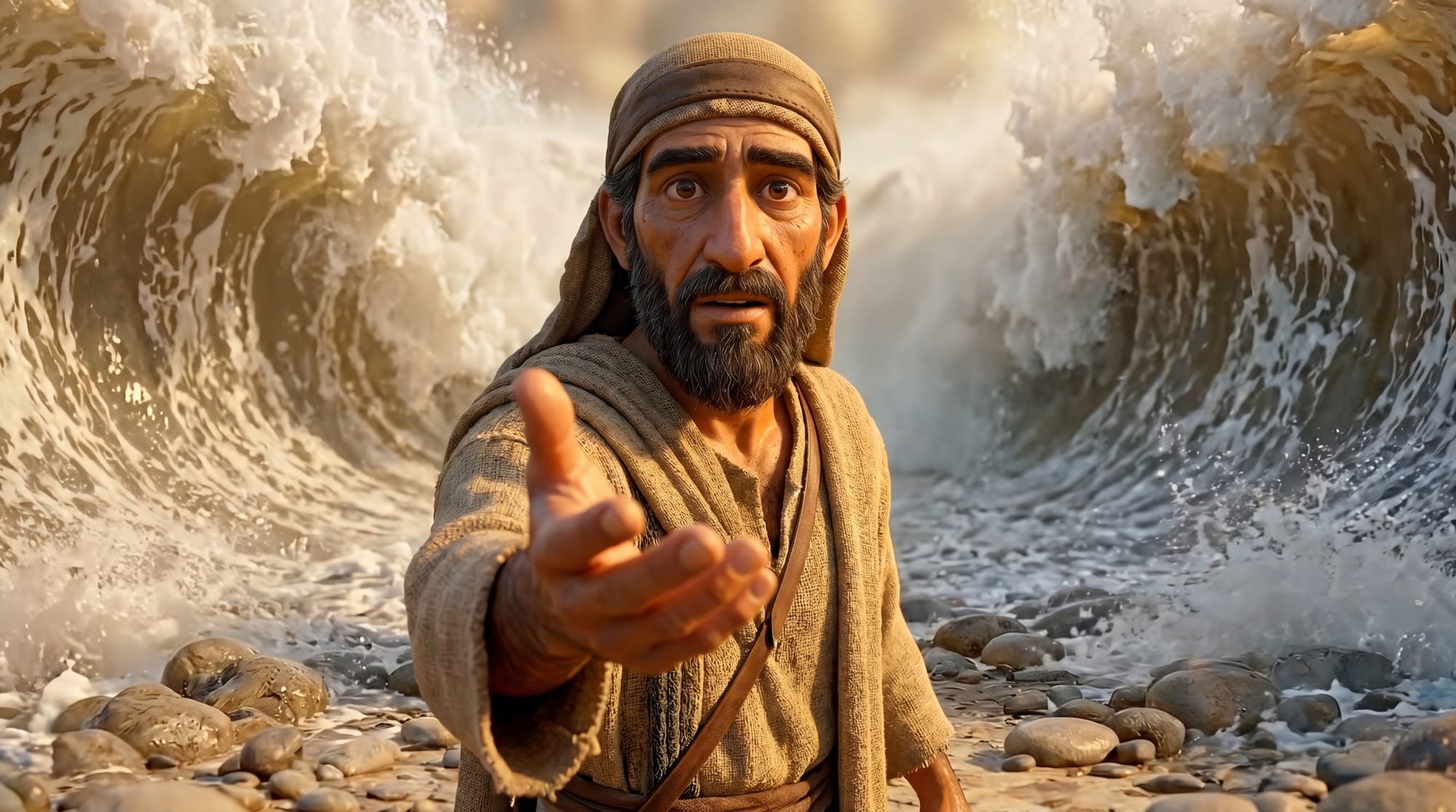
Courage and Trust
"You gotta get your feet wet!
Take a step! Have good courage!"
It had taken several generations, but the Lord's promise was about to be fulfilled: the children of Israel were finally going to inherit the promised land. But in their way stood the Jordan River.
Set the Stage: The Promised Land
Forty years of wandering. An entire generation born, raised, and buried in the desert. And now — finally — the promised land is right there. You can see it. But between Israel and everything God promised stands a flooded river, a city with walls so thick you could park a chariot on top, and a people who have no intention of moving. Joshua is the new guy in charge, Moses is gone, and the Lord's opening pep talk is basically: 'Be strong. Be courageous. I'm with you.' No battle plan. No engineering report on the Jordan River. Just — go. What follows is one of the wildest sequences in all of scripture: priests walking into a raging river until the water stops, soldiers marching silently around a city for six days straight, and walls that fall not from battering rams but from a shout. And then, at the end of it all, Joshua gathers everyone together and asks the question that still echoes in every family's living room: 'Choose you this day whom ye will serve.'
The Big Idea: Faith Moves First
Here's the thing about the Jordan River crossing that should give us pause: God didn't part the water and then ask the priests to walk through. He asked the priests to walk in first — feet in the current, water rising — and then the miracle happened. That's the whole week in one image. Courage isn't the absence of fear; it's taking the step anyway because you trust who's standing on the other side of it. 'Get Your Feet Wet' captures this perfectly — faith isn't a feeling you wait for, it's a move you make.
The battle of Jericho doubles down on the same idea. March in silence for six days. Look completely ridiculous. Trust a strategy that makes zero military sense. 'Bring Down the Wall' leans into the beautiful absurdity of it — because obedience to God has never been about what looks smart to the people watching. It's about who you believe is actually running the operation.
And then Joshua closes his life with a challenge that lands just as hard in your kitchen as it did on the plains of Shechem. 'Choose You This Day' isn't a guilt trip — it's an invitation to clarity. In a world full of noise and competing loyalties, there is something deeply freeing about planting your flag and saying out loud: as for me and my house, we're going with the Lord.

Scripture Bridge
Lyric Highlight
"You can't wait for the dry land to appear
You gotta take a step into the middle of your fear!
Yeah, faith is a step that you haven't taken yet...
You gotta get your feet wet!"
Reflect: Is there something you've been waiting for God to clear the path on before you take a step — and what would it look like to get your feet wet this week?
Family Activity
Try This: Pick one person to be 'the river' — they stand in the middle of the room with arms stretched wide, blocking the path. Everyone else lines up on one side (the wilderness). The goal is to get to the other side (the promised land) without getting tagged. BUT here's the twist: you can only move when someone shouts 'FAITH STEP!' If you freeze before you take a step, you're out. If you take a step and get tagged, you're out. The only way to make it across is to keep moving in faith — no hesitating on the shore! Rotate who plays the river each round.
Reflect: Was it scary to take a step when you didn't know if you'd make it? That's exactly how the priests felt walking into the Jordan. What made you decide to go anyway?
Watch & Listen
Get Your Feet Wet
That's exactly where Joshua 3 puts us. After Moses died, Joshua led the children of Israel to the banks of the Jordan River — at flood stage, of all times — and God told the priests carrying the Ark of the Covenant to step into the current. Not to wait for the water to recede. Not to find a ford. Into the rushing river. And here's the detail that changes everything: the water didn't stop until 'the feet of the priests that bare the ark were dipped in the brim of the water' (Joshua 3:15–16). The miracle was contingent on the movement. Obedience first. Parting the water second.
"Get Your Feet Wet" grabs that sequence and turns it into an anthem. The song opens on the riverbank — nervous, a little overwhelmed, very aware that Moses's shoes are too big to fill — and walks us all the way through to the moment the river stops and a nation walks into its inheritance on dry ground. The chorus doesn't let you off the hook: you can't wait for the dry land to appear. Faith is a step you haven't taken yet.
For your family this week, that's the conversation worth having: where is your Jordan River right now? Because the God who stopped the water for Israel is the same God who promises to be with us 'whithersoever thou goest' — and He's still in the business of meeting us in motion.
Want the full story? Read the complete Fireside Moment or explore the Lyric-Scripture Blueprint in our Joy Tier Deep Dive.
Lyric–Scripture Blueprint (Preview)
Did you know these lyrics come straight from the scriptures?
Explore the full Lyric–Scripture Blueprints and deeper activities in the Joy Tier.
| Lyric Highlight | Scripture Bridge | Why It Matters |
|---|---|---|
| "Forty years of walking and we're finally at the brink / But the river's overflowing and my heart's about to sink!" |
Joshua 3:15 "...and the feet of the priests that bare the ark were dipped in the brim of the water, (for Jordan overfloweth all his banks all the time of harvest.)" 1 Nephi 17:13 "And I will also be your light in the wilderness; and I will prepare the way before you..." Ether 2:25 "What will ye that I should do that ye may have light in your vessels?" |
The Hardest Obstacle Comes Last: God didn't remove the Jordan before Israel arrived — He let it flood at harvest time, the worst possible moment. Nephi's family faced the same pattern: the ocean came after the desert. Ether's brother faced darkness before the light. Families can teach kids that the final obstacle before a blessing is often the biggest one — and that's by design. |
| "You gotta get your feet wet! / If you wanna see the water part! / You can't wait for the dry land to appear / You gotta take a step into the middle of your fear!" |
Joshua 3:13 "...as soon as the soles of the feet of the priests that bear the ark of the Lord... shall rest in the waters of Jordan, that the waters... shall be cut off..." James 2:17–18 "Even so faith, if it hath not works, is dead, being alone." 1 Nephi 3:7 "...I will go and do the things which the Lord hath commanded, for I know that the Lord giveth no commandments... save he shall prepare a way..." |
The Three-Testament Chorus: This single lyric idea is confirmed across all three standard works. Joshua 3 gives the historical event. James 2 gives the doctrinal principle. And Nephi — who literally crossed his own impossible water — gives the personal testimony. When kids sing this chorus, they're singing a truth that God has repeated to His people in every dispensation. |
| "Yeah, faith is a step that you haven't taken yet..." |
Hebrews 11:1 "Now faith is the substance of things hoped for, the evidence of things not seen." Alma 32:21 "...faith is not to have a perfect knowledge of things; therefore if ye have faith ye hope for things which are not seen, which are true." D&C 58:27 "Verily I say, men should be anxiously engaged in a good cause, and do many things of their own free will..." |
Alma Completes What Hebrews Started: Paul's definition of faith in Hebrews 11 is famous, but Alma 32 is its full-color expansion. Both agree: faith operates in the space between what you know and what you do. The song captures this perfectly — faith isn't a feeling you wait for, it's the next step you haven't taken yet. D&C 58 adds the Restoration capstone: God expects us to move without being commanded in every little thing. |
 Shout for Joy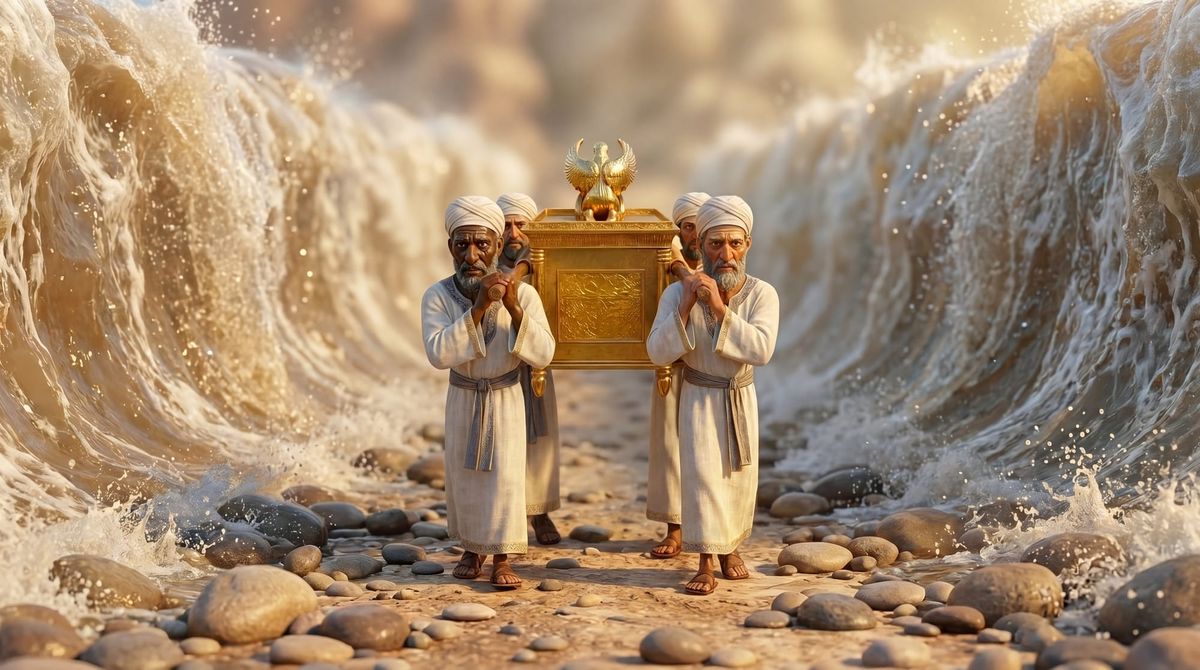
Bring Down the Wall
Here's what actually went down. After Moses died, Joshua took command of Israel and received one of the most repeated commands in all of scripture: 'Be strong and of a good courage' (Joshua 1:6–9). Then the Lord gave him the battle plan for Jericho — a heavily fortified city standing between Israel and the promised land. The plan involved no weapons, no siege equipment, and no shouting. Just the Ark of the Covenant carried by priests, seven priests blowing rams' horns, and the entire army marching once around the city each day for six days in total silence. On the seventh day, they marched seven times — and then Joshua gave the signal. The horns blew. The people shouted. And the walls of Jericho collapsed (Joshua 6:20).
"Bring Down the Wall" captures exactly what made that moment so extraordinary — not the miracle itself, but the six days before it. The song leans into the strangeness of the command ('It might look strange, it might not look pretty') and then lands the real point: when God gives an unconventional instruction, the right move is trust, not negotiation.
For your family this week, that's the conversation worth having. Obedience isn't always dramatic. Sometimes it's just putting on your marching shoes and walking the circle one more time.
Want the full story? Read the complete Fireside Moment or explore the Lyric-Scripture Blueprint in our Joy Tier Deep Dive.
 Shout for Joy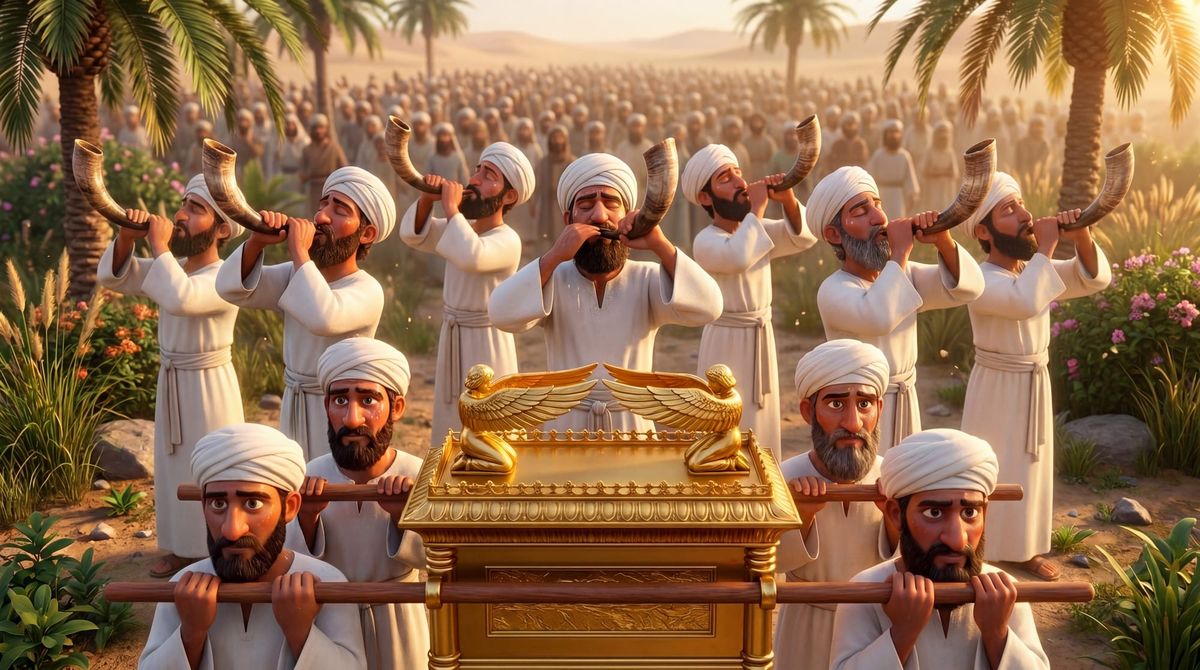
Choose You This Day
Joshua 24 is the farewell address of a man who has earned the right to speak plainly. He has led Israel through the conquest of Canaan — not by military genius alone, but by following a God who knocked down walls with trumpet blasts and stopped the sun in the sky. Now he's old, and he can see what's happening: the people are drifting. The gods of the surrounding nations are attractive, culturally normal, low-commitment. And Israel is hedging. So Joshua does what great covenant leaders do — he forces the question. 'Choose you this day whom ye will serve.' And then, without waiting for the crowd, he answers for himself: 'As for me and my house, we will serve the Lord.'
This song captures that moment with energy that matches the urgency of the original question. It doesn't soften the challenge or make it comfortable — it puts the choice in your face, in the present tense, with a beat underneath it. Verse 1 runs through the whole conquest story in eight lines. The chorus lands the ultimatum. And the bridge makes it personal: not just what Israel chose, but what you choose, today, in your house.
The choice to "Choose You This Day" is the one your kids will face every week — and this song gives them a declaration to stand on.
Want the full story? Read the complete Fireside Moment or explore the Lyric-Scripture Blueprint in our Joy Tier Deep Dive.
 Shout for Joy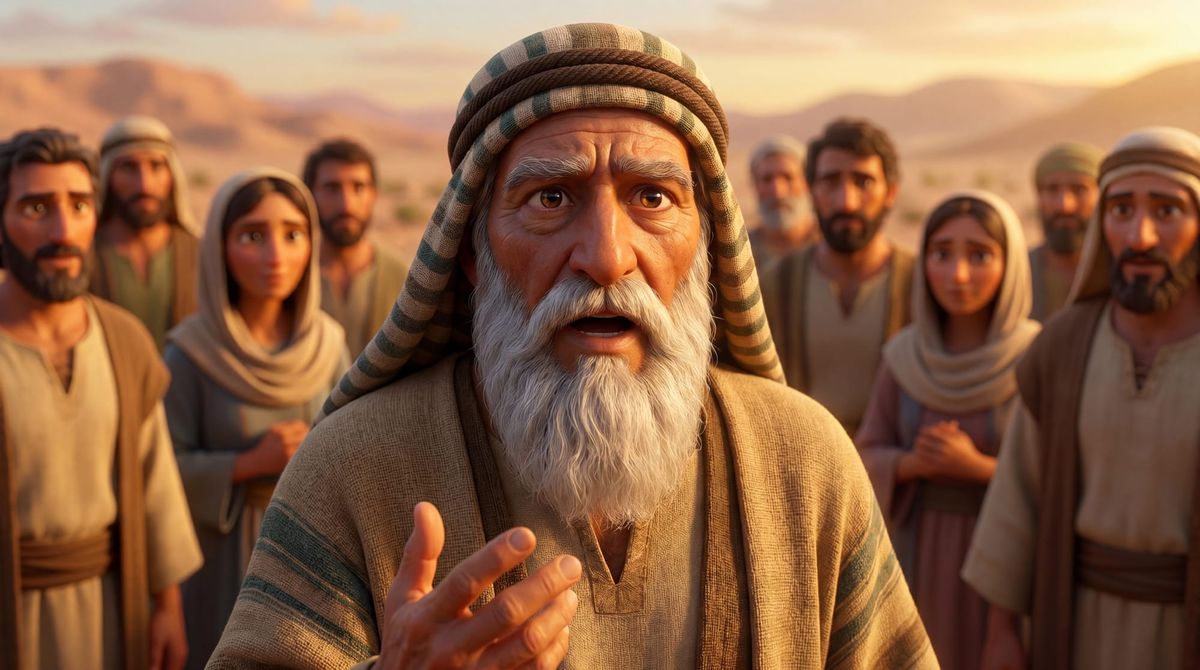
Continue the journey
 Shout for Joy
Miss last week?
Every lesson stands on its own — but together, they tell a bigger story.
 Shout for Joy
Don’t Stop the Music
The Joy Tier starts right here. Go deeper into this week’s scripture story and explore the meaning behind the songs.
Inside Joy you’ll find:
- A weekly Fireside Moment overview of the Come, Follow Me lesson
- Expanded Set the Stage teaching guides for every song
- Choose Your Adventure family activities and simple weekly habits
- Lyric–Scripture Blueprints, printable coloring pages, and lyric sheets
- Cinematic reflection videos designed for quiet viewing and discussion
Access Joy below to turn this week’s song into a weeklong experience of scripture, music, and family conversation.