May 25–31: “The Lord Raised Up a Deliverer” (Judges 2–4; 6–8; 13–16)
From Deborah's palm tree to Gideon's clay pots to Samson's prison, the book of Judges tells one story on repeat: no matter how far we drift, the Lord is always ready to deliver us when we turn back to Him.

He Clears the Way
"He clears the way.
He turns the darkest night into the day
So when He calls you to the front of the line...
Just step right up and let your faith shine.
Is not the Lord gone out before thee?"
Deborah was an instrument in God's hands to inspire faith, hope, and courage to deliver Israel.
Set the Stage: The Pride Cycle
Picture this: a nation that keeps forgetting. The Israelites move into the promised land, things are good — and then they drift. They pick up the habits of the people around them, walk away from their covenants, and suddenly find themselves in captivity again. It's a cycle that plays out over and over in the book of Judges. But here's the thing — every single time they cry out, the Lord sends a deliverer. A judge. Someone to lead them back. This week we meet three of them: Deborah, the prophetess sitting under her palm tree who tells a nervous general that heaven is already on his side. Gideon, the least likely warrior in the least likely family, who defeats a massive army with three hundred men, some clay pots, and a whole lot of trust. And Samson, the covenant-bound strongman who learns the hard way that real strength isn't in your muscles — it's in your faithfulness. Three stories. One message. The Lord is always ready to deliver us when we turn back to Him.
The Big Idea: He Always Sends a Deliverer
The book of Judges isn't exactly a highlight reel of human consistency. The Israelites mess up, get humbled, cry out, get rescued — and then do it all over again. Sound familiar? Because honestly, that cycle isn't ancient history. It's Tuesday. The beautiful thing the Come Follow Me lesson wants us to sit with this week is that the Lord's willingness to deliver never ran out. Not once. Every time His people turned back, He was already moving toward them.
That's the heartbeat running through all three songs this week. 'Gone Out Before Thee' captures Deborah's unshakeable confidence — the Lord has already gone ahead of you, so why are you still standing there shaking? 'Pitchers and Lamps' takes Gideon's wild, counterintuitive battle plan and turns it into a declaration: when God is the strategy, you don't need the numbers. And 'Where the Strength Lies' gives Samson's story the honest treatment it deserves — covenant-breaking has real consequences, but even in the prison, even in the dark, restoration is still possible.
For your family this week, the question isn't whether you've ever been in the cycle. You have. We all have. The question is: do your kids know that the Lord goes out before them too? That He's not waiting at the finish line — He's already on the path ahead, clearing the way? That's the conversation worth having around the dinner table this week.

Scripture Bridge
Lyric Highlight
Is not the Lord gone out before thee?
Why are you stressing over iron and steel?
Step up, breathe out, let the fear just fade
We're walking right into the promise He made!
Reflect: Is there something your family is facing right now that feels like 'iron and steel' — something intimidating or overwhelming? How does it change things to remember that the Lord has already gone out before you?
Family Activity
Try This: Clear a path through your living room with a few pillows or couch cushions as 'obstacles.' One person plays Deborah and stands at the end of the path. Everyone else lines up as Barak's army. Deborah calls out 'Is not the Lord gone out before thee?' and the army has to march forward confidently — no hesitating, no tiptoeing — straight through the obstacle course. Anyone who freezes or backtracks has to go to the back of the line. Switch who plays Deborah each round. Crank the song while you march.
Reflect: Barak was scared even when God had already promised the victory. When is it hardest for you to move forward even when you know Heavenly Father is on your side?
Watch & Listen
Gone Out Before Thee
Here's what actually happened. Israel had been under the thumb of Canaanite king Jabin for twenty years — long enough that an entire generation had grown up knowing nothing but oppression. His general, Sisera, had a chariot army that was essentially unstoppable by conventional means. Into this situation steps Deborah, a prophetess and judge, who summons the military leader Barak and delivers a direct word from the Lord: take ten thousand men to Mount Tabor, and I will deliver Sisera into your hand. Barak's response? 'I'll go — but only if you come with me.' He needed the prophet present. Deborah agrees, but tells him plainly that the glory of the victory will go to a woman because of his hesitation. Then she says the line that became this song: 'Is not the Lord gone out before thee?' And they march. And heaven shows up — a flash flood, a routed army, chariots swallowed by the river Kishon, and Sisera fleeing on foot to meet his end in a tent.
Gone Out Before Thee captures Deborah's voice — warm, a little impatient, completely unafraid — and turns her ancient battle cry into a family anthem for every moment we're standing at the edge of something hard, counting the chariots instead of counting on the Lord.
The Lord still goes out before His covenant people. He still sends the rain. He still moves the stars.
Want the full story? Read the complete Fireside Moment or explore the Lyric-Scripture Blueprint in our Joy Tier Deep Dive.
Lyric–Scripture Blueprint (Preview)
Did you know these lyrics come straight from the scriptures?
Explore the full Lyric–Scripture Blueprints and deeper activities in the Joy Tier.
 Shout for Joy
Pitchers and Lamps
Then Gideon gives the signal.
They smash the pitchers. The torches blaze. Three hundred trumpets scream into the night. And every man shouts: 'The sword of the Lord and of Gideon!' The Midianite camp erupts into chaos — soldiers turning on each other in the confusion, fleeing in every direction. Israel wins without swinging a single blade. The battle belongs entirely to the Lord.
This is the story at the heart of 'Pitchers and Lamps,' and it's one of the most strategically bizarre, spiritually precise moments in all of the Old Testament. God had deliberately whittled Gideon's army from 32,000 down to 300 — not because He needed fewer soldiers, but because He needed Israel to know, without any doubt, who actually won. The clay pitchers had to break before the light could get out. That detail is not accidental. It's the whole sermon.
The song captures Gideon's journey from hiding in a winepress to leading a midnight charge, and it does it with the kind of energy that makes kids want to grab a trumpet and run. But underneath the horns and the brass hits is a question every family can sit with: Are we willing to follow a strategy that looks foolish to the world because we trust the One who designed it? The God who won with 300 pitchers and some fire is the same God walking with your family this week.
Want the full story? Read the complete Fireside Moment or explore the Lyric-Scripture Blueprint in our Joy Tier Deep Dive.
Shout for Joy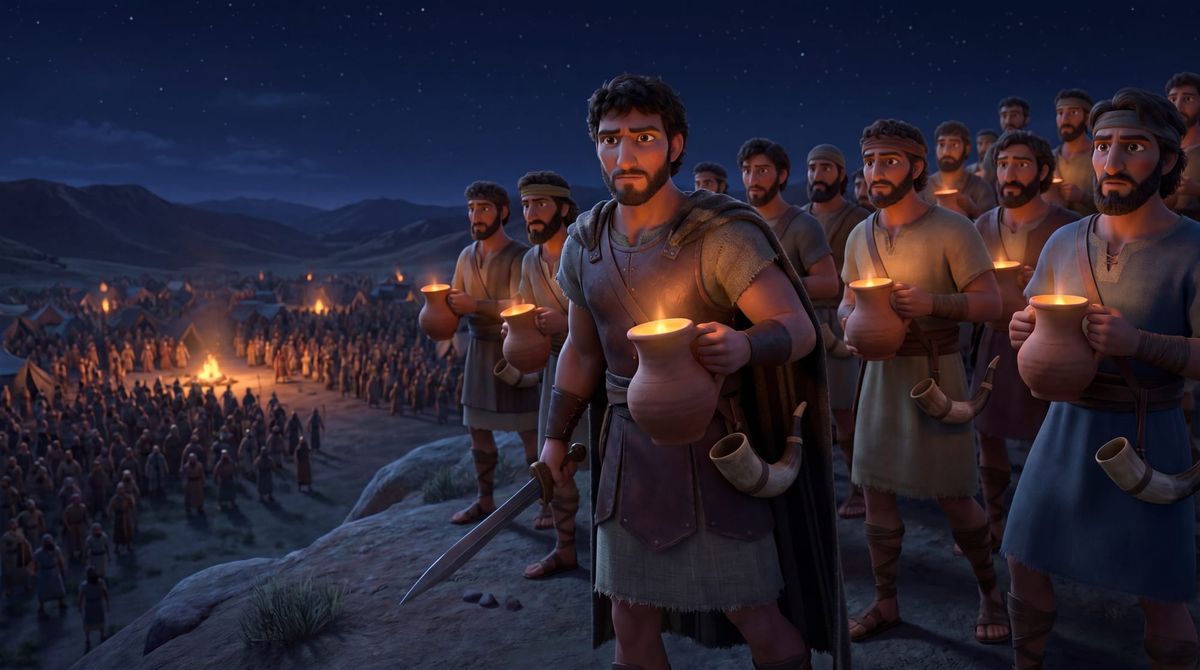
Where the Strength Lies
Samson's story in Judges 13–16 is one of the most dramatic in all of scripture, and it's not really about hair. It's about a man who was set apart from birth — a Nazirite, consecrated by covenant — who spent his life wandering toward the edges of that covenant until there was nothing left to wander away from. The angel who announced his birth told his mother he would 'begin to deliver Israel.' Begin. Not finish. Because Samson never fully surrendered to the calling. He was too busy being impressive on his own terms.
'Where the Strength Lies' captures the whole arc — the promise, the wandering, the betrayal, the chains, and finally, in the bridge, the theology that makes sense of all of it: covenant-keeping is the actual source of divine power. Not talent. Not muscle. Not charisma. The promise. The song doesn't let Samson off the hook, but it also doesn't leave him in the prison. It ends with the chorus ringing out like a question every listener has to answer for themselves.
Every kid who has ever felt strong enough to handle something they shouldn't be handling needs to hear this song. So does every parent who has watched them think it.
Want the full story? Read the complete Fireside Moment or explore the Lyric-Scripture Blueprint in our Joy Tier Deep Dive.
Shout for Joy
Continue the journey
 Shout for Joy
Miss last week?
Every lesson stands on its own — but together, they tell a bigger story.
Shout for Joy
Don’t Stop the Music
The Joy Tier starts right here. Go deeper into this week’s scripture story and explore the meaning behind the songs.
Inside Joy you’ll find:
- A weekly Fireside Moment overview of the Come, Follow Me lesson
- Expanded Set the Stage teaching guides for every song
- Choose Your Adventure family activities and simple weekly habits
- Lyric–Scripture Blueprints, printable coloring pages, and lyric sheets
- Cinematic reflection videos designed for quiet viewing and discussion
Access Joy below to turn this week’s song into a weeklong experience of scripture, music, and family conversation.