| "(Ooh, yeah!) / (Bring what you got!)" |
2 Kings 4:2
"And Elisha said unto her, What shall I do for thee? tell me, what hast thou in the house? And she said, Thine handmaid hath not any thing in the house, save a pot of oil."
Alma 34:17
"Therefore may God grant unto you, my brethren, that ye may begin to exercise your faith unto repentance, that ye begin to call upon his holy name, that he would have mercy upon you."
D&C 4:2
"Therefore, O ye that embark in the service of God, see that ye serve him with all your heart, might, mind and strength, that ye may stand blameless before God at the last day." |
Bring What You Have: The intro is a call to action before the story even begins. The phrase 'Bring what you got' is the theological heartbeat of the entire Elisha oil miracle — the Lord never asks for what you don't have, only for what you do. Alma 34 and D&C 4 confirm that the Lord's economy runs on consecrated effort, not abundance. For families: before the first verse plays, ask your kids — what do you have right now that you could offer the Lord this week? |
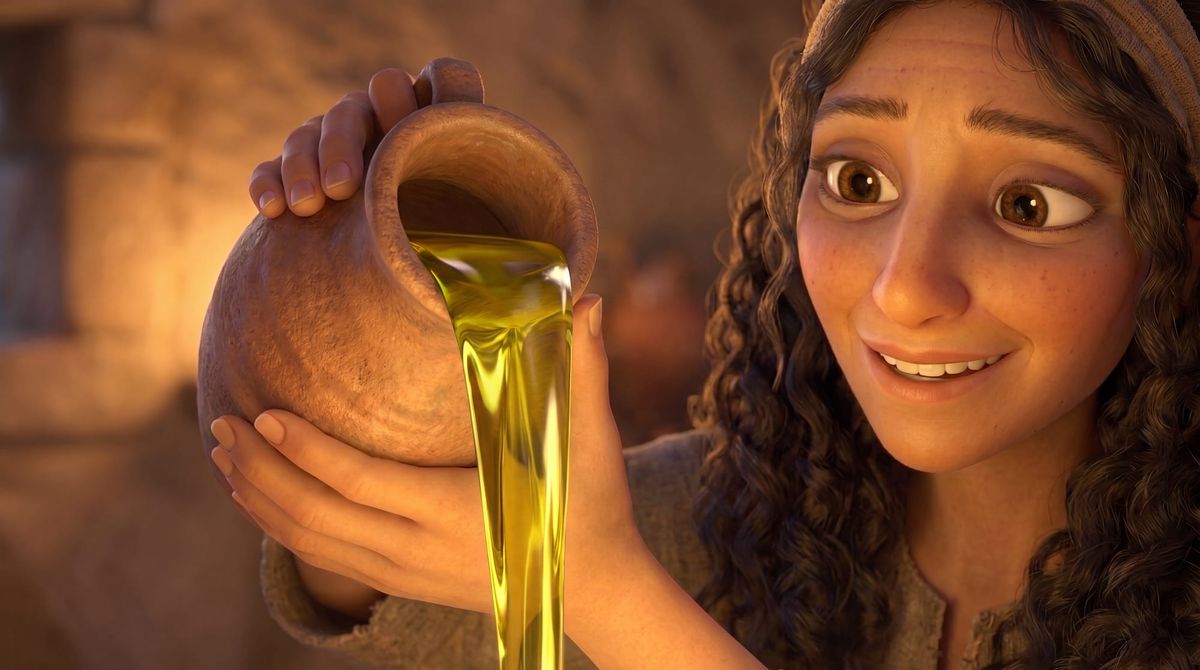
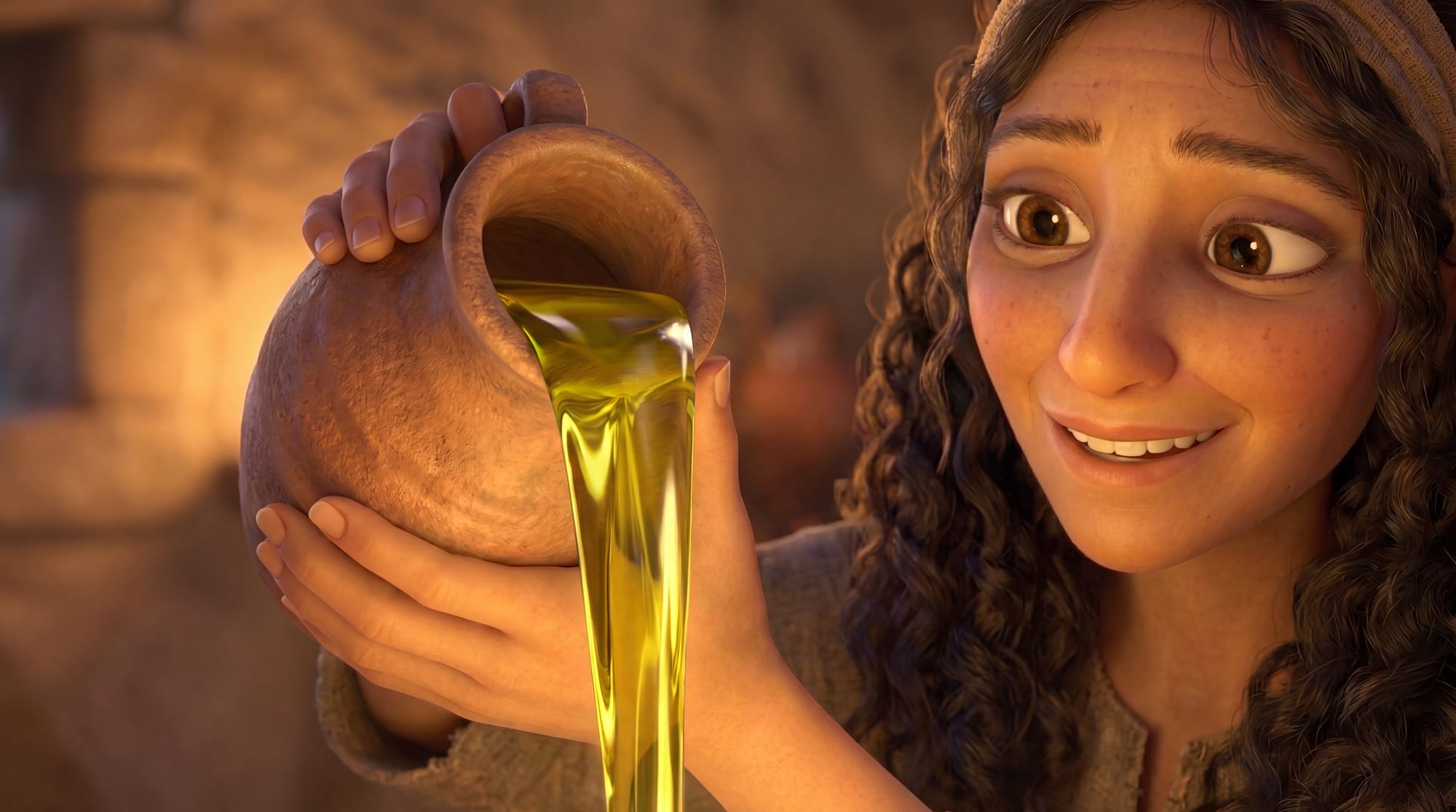
| "The widow was crying, the money was gone / She didn't know how she could carry on. / Elisha came over and said, 'What do you got?' / She said, 'Just a little oil in a tiny pot.'" |
2 Kings 4:1–2
"Now there cried a certain woman of the wives of the sons of the prophets unto Elisha, saying, Thy servant my husband is dead; and thou knowest that thy servant did fear the Lord: and the creditor is come to take unto him my two sons to be bondmen. And Elisha said unto her, What shall I do for thee? tell me, what hast thou in the house? And she said, Thine handmaid hath not any thing in the house, save a pot of oil."
2 Nephi 26:25
"Behold, doth he cry unto any, saying: Depart from me? Behold, I say unto you, Nay; but he saith: Come unto me all ye ends of the earth, buy milk and honey, without money and without price."
D&C 84:88
"And whoso receiveth you, there I will be also, for I will go before your face. I will be on your right hand and on your left, and my Spirit shall be in your hearts, and mine angels round about you, to bear you up." |
Seen in the Crisis: The widow's situation is desperate by ancient standards — debt slavery for her sons was a real and imminent threat. Elisha's first move is not to lecture or prescribe; he asks what she has. This is the Lord's pattern: He meets people in their actual circumstances. 2 Nephi 26:25 confirms that the Lord never turns away those who come with nothing. D&C 84:88 reminds families that prophets and the Spirit are sent precisely into the moments when we feel most alone. For families: talk about a time when someone showed up for your family in a hard moment — that is the Lord working through people. |
| "He said, 'Go to your neighbors and borrow some bowls. / Gather 'em up for the hungry souls. / Shut the door and start to pour... / The Lord's gonna give you a whole lot more!'" |
2 Kings 4:3–4
"Then he said, Go, borrow thee vessels abroad of all thy neighbours, even empty vessels; borrow not a few. And when thou art come in, thou shalt shut the door upon thee and upon thy sons, and shalt pour out into all those vessels, and thou shalt set aside that which is full."
Moroni 7:37
"Behold I say unto you, Nay; for it is by faith that miracles are wrought; and it is by faith that angels appear and minister unto men; wherefore, if these things have ceased wo be unto the children of men, for it is because of unbelief, and all is vain."
Luke 6:38
"Give, and it shall be given unto you; good measure, pressed down, and shaken together, and running over, shall men give into your bosom."
D&C 104:17
"For the earth is full, and there is enough and to spare; yea, I prepared all things, and have given unto the children of men to be agents unto themselves." |
Obedient Preparation Precedes the Miracle: Elisha's instructions are specific and require action before anything supernatural happens — go, borrow, gather, shut the door, then pour. The miracle does not precede the obedience; it follows it. Moroni 7:37 makes clear that miracles are the fruit of faith expressed through action. D&C 104:17 grounds this in Restoration theology: the earth has enough, but the Lord works through human agency and covenant obedience to distribute it. For families: the 'shut the door' detail is worth discussing — some miracles happen in private, in the quiet of a home, away from an audience. |
| "The oil keeps pouring! The jar won't stop! / Blessing after blessing all the way to the top! / When you bring the Lord the little you hold / He turns it into a miracle of gold!" |
2 Kings 4:5–6
"So she went from him, and shut the door upon her and upon her sons, who brought the vessels to her; and she poured out. And it came to pass, when the vessels were full, that she said unto her son, Bring me yet a vessel. And he said unto her, There is not a vessel more. And the oil stayed."
John 6:11–13
"And Jesus took the loaves; and when he had given thanks, he distributed to the disciples, and the disciples to them that were set down; and likewise of the fishes as much as they would. When they were filled, he said unto his disciples, Gather up the fragments that remain, that nothing be lost. Therefore they gathered them together, and filled twelve baskets with the fragments."
3 Nephi 20:8
"And he said unto them: He that eateth this bread eateth of my body to his soul; and he that drinketh of this wine drinketh of my blood to his soul; and his soul shall never hunger nor thirst, but shall be filled."
Malachi 3:10
"Bring ye all the tithes into the storehouse, that there may be meat in mine house, and prove me now herewith, saith the Lord of hosts, if I will not open you the windows of heaven, and pour you out a blessing, that there shall not be room enough to receive it." |
The Abundance Principle: The oil stopped only when there were no more vessels — the miracle was limited not by God's supply but by the widow's preparation. This is one of the most theologically loaded details in the entire Elisha narrative. John 6 and 3 Nephi 20 show that Christ performs the same pattern of miraculous abundance, pointing directly back to Elisha as a type of the Savior. Malachi 3:10, quoted by the resurrected Christ to the Nephites in 3 Nephi 24:10, frames this as a covenant promise still active today. For families: ask how many 'vessels' your family is bringing to the Lord — are you limiting the miracle by not preparing enough room to receive it? |
| "Expect a miracle every single day! / The Lord is gonna make a beautiful way! / So gather the vessels and banish the doubt... / Take a little faith and pour it out!" |
Russell M. Nelson, "The Power of Spiritual Momentum," Liahona, May 2022
"Seek and expect miracles. I promise you that if you will do your part, miracles will follow."
Moroni 7:33
"And Christ hath said: If ye will have faith in me ye shall have power to do whatsoever thing is expedient in me."
Ether 12:6
"And now, I, Moroni, would speak somewhat concerning these things; I would show unto the world that faith is things which are hoped for and not seen; wherefore, dispute not because ye see not, for ye receive no witness until after the trial of your faith."
D&C 58:27–28
"Verily I say, men should be anxiously engaged in a good cause, and do many things of their own free will, and bring to pass much righteousness; For the power is in them, wherein they are agents unto themselves." |
Active Faith Expects Results: President Nelson's direct counsel to 'seek and expect miracles' is the modern prophetic echo of this ancient story. Ether 12:6 is the doctrinal spine here — the witness comes after the trial of faith, not before. The chorus is not wishful thinking; it is a covenant posture. D&C 58 adds that the Lord expects His people to be agents, not passive recipients. For families: 'banish the doubt' is not a command to suppress honest questions — it is an invitation to act before certainty arrives, which is the very definition of faith in Ether 12. |
| "It might not be oil and it might not be bread / It might be a peaceful thought in your head. / It might be a friend when you're feeling down / Turning your heavy heart right around!" |
D&C 6:23
"Did I not speak peace to your mind concerning the matter? What greater witness can you have than from God?"
John 14:27
"Peace I leave with you, my peace I give unto you: not as the world giveth, give I unto you. Let not your heart be troubled, neither let it be afraid."
Alma 34:26
"But this is not all; ye must pour out your souls in your closets, and your secret places, and in your wilderness."
D&C 84:88
"And whoso receiveth you, there I will be also, for I will go before your face. I will be on your right hand and on your left, and my Spirit shall be in your hearts, and mine angels round about you, to bear you up." |
Miracles Wear Ordinary Clothes: This verse is a pastoral pivot — it takes the dramatic oil miracle and translates it into the texture of everyday life. A peaceful thought, a timely friend, a lifted heart — these are miracles too. D&C 6:23 is one of the most intimate miracle-verses in all of scripture, where the Lord points to a quiet moment of peace as evidence of His voice. John 14:27 confirms that Christ's peace is categorically different from what the world offers. For families: invite each family member to name one 'small miracle' from the past week — a moment of peace, a friend who showed up, a worry that lifted — and watch the list grow longer than expected. |
| "The Lord is a provider, He knows what you need / You just gotta plant a little mustard seed!" |
Matthew 17:20
"And Jesus said unto them, Because of your unbelief: for verily I say unto you, If ye have faith as a grain of mustard seed, ye shall say unto this mountain, Remove hence to yonder place; and it shall remove; and nothing shall be impossible unto you."
Alma 32:28
"Now, we will compare the word unto a seed. Now, if ye give place, that a seed may be planted in your heart, behold, if it be a true seed, or a good seed, if ye do not cast it out by your unbelief, that ye will resist the Spirit of the Lord, behold, it will begin to swell within your breasts."
Philippians 4:19
"But my God shall supply all your need according to his riches in glory by Christ Jesus." |
Small Beginnings, Covenant Growth: The mustard seed image is one of Christ's most beloved teaching tools, and Alma 32 gives it its fullest doctrinal development in all of scripture. Alma's seed metaphor is not just about faith in the abstract — it is about planting the word, nurturing it, and watching it grow into something that provides shade and fruit. Philippians 4:19 grounds the 'provider' language in covenant promise. For families: Alma 32 is a perfect companion chapter to this week's study — read verses 28–30 together and ask what 'seed' your family is currently planting and tending. |
| "Bring what you have. (Bring it all!) / Answer the knock. (Answer the call!) / Even when your faith is feeling incredibly small." |
Revelation 3:20
"Behold, I stand at the door, and knock: if any man hear my voice, and open the door, I will come in to him, and will sup with him, and he with me."
2 Kings 4:3
"Then he said, Go, borrow thee vessels abroad of all thy neighbours, even empty vessels; borrow not a few."
Ether 12:27
"And if men come unto me I will show unto them their weakness. I give unto men weakness that they may be humble; and my grace is sufficient for all men that humble themselves before me; for if they humble themselves before me, and have faith in me, then will I make weak things become strong unto them."
D&C 123:17
"Therefore, dearly beloved brethren, let us cheerfully do all things that lie in our power; and then may we stand still, with the utmost assurance, to see the salvation of God, and for his arm to be revealed." |
The Open Door Theology: The bridge compresses the entire week's lesson into three commands — bring, answer, come. Revelation 3:20 is the classic 'knock' verse, but in Restoration context it is not merely an evangelism text; it is a covenant invitation to ongoing communion. Ether 12:27 is the doctrinal anchor for 'incredibly small' faith — the Lord explicitly works through weakness, not despite it. D&C 123:17 adds the Restoration's characteristic blend of action and trust: do what you can, then watch the Lord act. For families: the call-and-response format of this bridge — 'Bring what you have / Bring it all!' — is designed for participation; sing it together and let the kids shout the responses. |
| "He can take a little drop and fill up a sea / Just watch what He does for you and me! / (Hit the horns!)" |
2 Kings 4:6
"And it came to pass, when the vessels were full, that she said unto her son, Bring me yet a vessel. And he said unto her, There is not a vessel more. And the oil stayed."
1 Nephi 17:8
"And it came to pass that the Lord spake unto me, saying: Thou shalt construct a ship, after the manner which I shall show thee, that I may carry thy people across these waters."
John 2:7–9
"Jesus saith unto them, Fill the waterpots with water. And they filled them up to the brim. And he saith unto them, Draw out now, and bear unto the governor of the feast. And when the ruler of the feast had tasted the water that was made wine, and knew not whence it was... the governor of the feast called the bridegroom."
2 Nephi 27:23
"For behold, I am God; and I am a God of miracles; and I will show unto the world that I am the same yesterday, today, and forever." |
God of Miracles, Unchanged: The image of a drop filling a sea is hyperbole that points to a literal theological truth — the Lord's capacity to multiply is not constrained by the size of the offering. John 2 shows Christ doing exactly this at Cana: water into wine, ordinary into extraordinary, small into abundant. 2 Nephi 27:23 is the Restoration's definitive statement that this God has not retired from miracle-working. The 'Hit the horns!' moment in the song is a musical exclamation point — the doctrine earns the celebration. For families: 2 Nephi 27:23 is worth memorizing together this week as a family declaration of faith. |
| "(Pour it out!) / Expect a miracle. / (Ooh, yeah.)" |
2 Kings 4:5–6
"So she went from him, and shut the door upon her and upon her sons, who brought the vessels to her; and she poured out. And it came to pass, when the vessels were full, that she said unto her son, Bring me yet a vessel. And he said unto her, There is not a vessel more. And the oil stayed."
Moroni 7:35–37
"And now, my beloved brethren, if this be the case that these things are true which I have spoken unto you, and God is the same yesterday, today, and forever, it is expedient that all things should be done in the name of Christ... And who shall say that Jesus Christ did not do many mighty miracles? And there were many mighty miracles wrought by the hands of the apostles. And if there were miracles wrought then, why has God ceased to be a God of miracles and yet be an unchangeable Being?"
D&C 1:37–38
"Search these commandments, for they are true and faithful, and the prophecies and promises which are in them shall all be fulfilled. What I the Lord have spoken, I have spoken, and I excuse not myself; and though the heavens and the earth pass away, my word shall not pass away, but shall all be fulfilled." |
The Miracle Is Still Pouring: The outro is not a fade — it is a declaration. 'Expect a miracle' is the song's final theological statement, and Moroni 7:35–37 is its doctrinal foundation: a God who worked miracles then is the same God working miracles now. D&C 1:37–38 grounds this in the certainty of prophetic promises — what the Lord has spoken will be fulfilled. The widow's oil stopped only when the vessels ran out; the outro invites families to keep bringing vessels. For families: end the week by asking each person to name one miracle they are expecting — and write them down to revisit later. |
 Bob LeBaron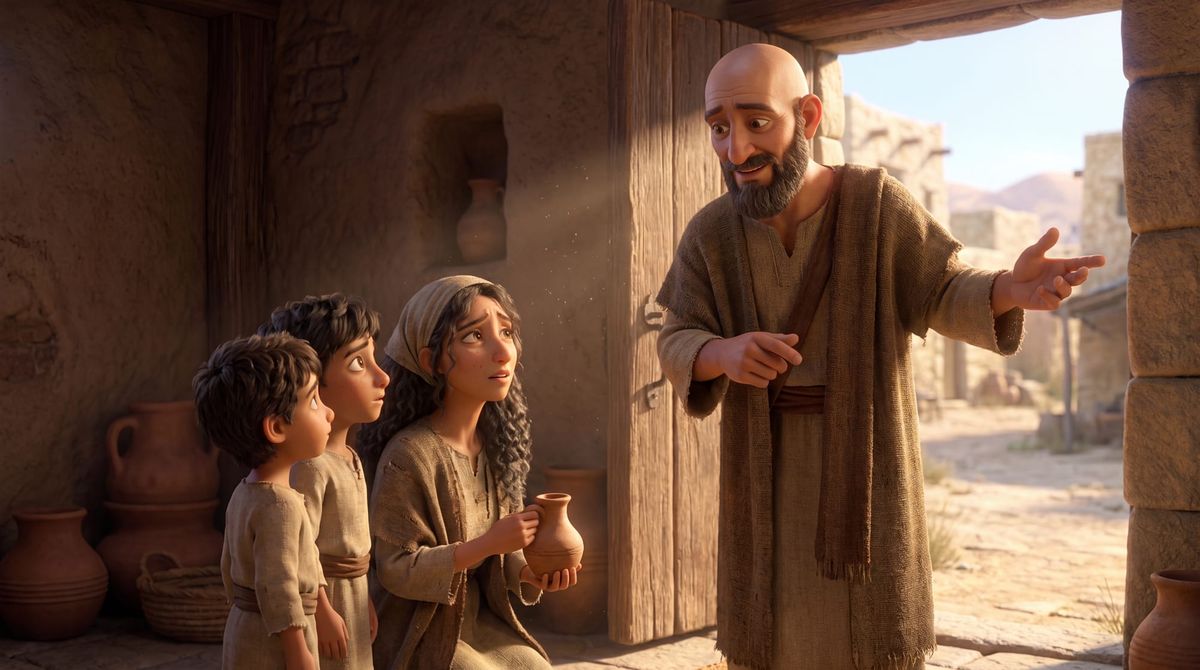
 Bob LeBaron
 Bob LeBaron