July 6–12: "There Is a Prophet in Israel" (2 Kings 2–7)
A widow with one jar of oil, a general too proud to wash in a river, and a servant who couldn't see the army standing right behind him — this week in 2 Kings 2–7, Elisha's miracles reveal a God who specializes in doing the impossible with whatever small, scared, faithful thing you bring Him.
Bring What You Have and Pour
Bring what you have. (Bring it all!)
Answer the knock. (Answer the call!)
Even when your faith is feeling incredibly small.
The oil keeps pouring! The jar won't stop!
Blessing after blessing all the way to the top!
A widow with almost nothing. A prophet with a simple instruction. And a God who specializes in turning 'just a little' into more than enough.
Set the Stage: One Jar. Every Bowl.
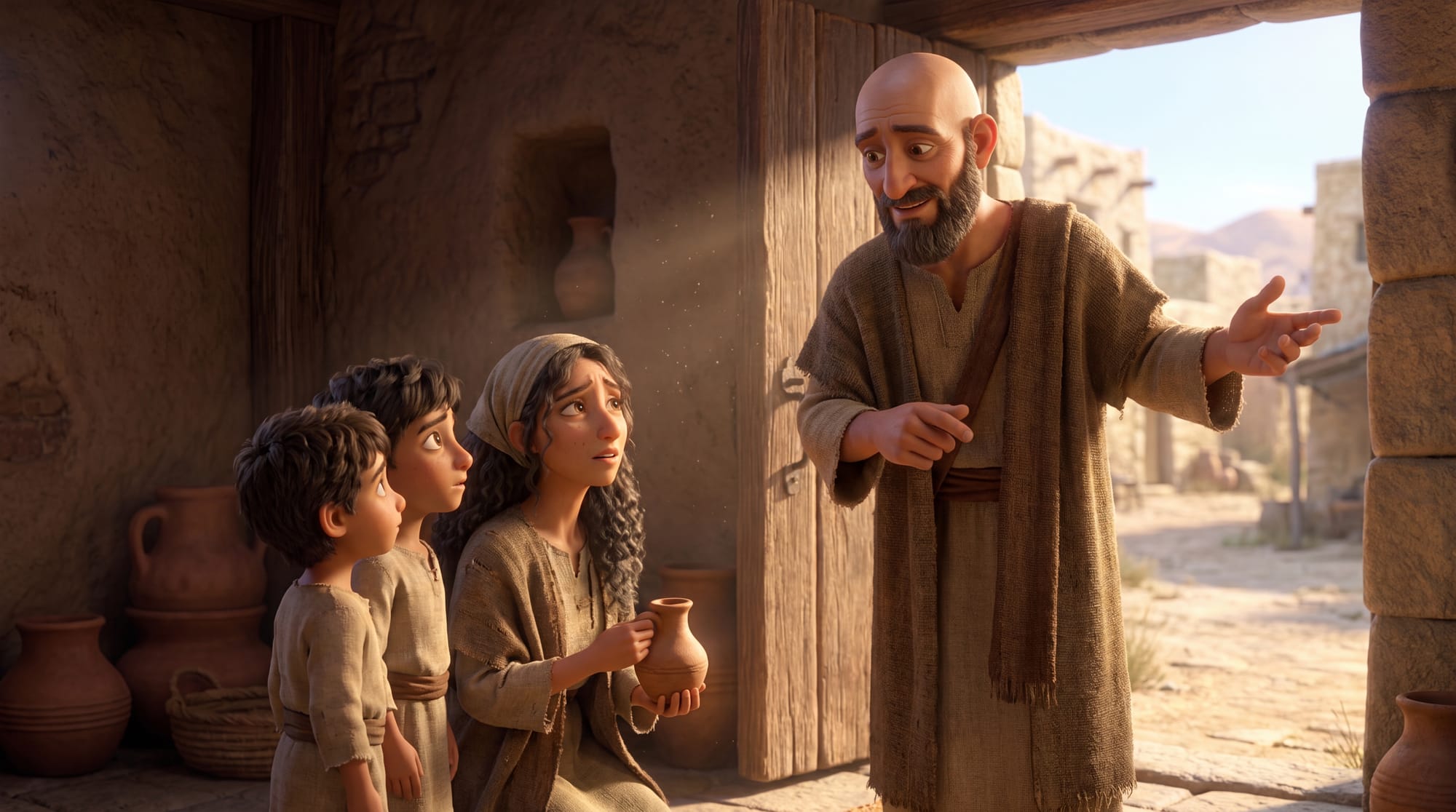
She had nothing left. The creditors were coming. Her husband was gone, her sons were about to be taken as payment, and all she had in the house was one small jar of oil. Not exactly the raw material of a miracle. But Elisha didn't ask her what she lacked — he asked what she had. Then he told her to do something that probably sounded ridiculous: go borrow every empty bowl she could find from her neighbors, shut the door, and start pouring. So she did. And the oil didn't stop until the last vessel was full. That's the week we're stepping into — a week of miracles that look nothing like what we expected. A general healed by a muddy river. A terrified servant who couldn't see the army standing right behind him. A widow who poured out everything she had and ended up with more than she needed. Elisha's ministry is a masterclass in what happens when ordinary people bring their small, scared, insufficient selves to a God who is anything but small.
The Big Idea: Small Offerings, Unstoppable God
The thread running through every story in 2 Kings 2–7 is almost embarrassingly simple: God doesn't need much from us to do something extraordinary. He just needs what we actually have. The widow didn't have a warehouse of oil — she had a jar. Naaman didn't need a dramatic ceremony — he needed a river and a little humility. The servant didn't need a bigger army — he needed open eyes. In each case, the miracle was already in motion. The only question was whether the person in the story would trust enough to participate. 'Pour It Out' captures this beautifully — 'bring what you have, bring it all, even when your faith is feeling incredibly small.' That's not a motivational poster. That's the actual pattern of how the Lord works with His people, from ancient Israel to your living room this week.
For families, this is one of the most practical spiritual lessons in the entire Old Testament. We spend a lot of energy wishing we had more — more time, more patience, more faith, more resources — before we feel ready to act. But Elisha's question to the widow reframes everything: 'What do you have?' Not what do you wish you had. Not what you used to have. What's in your hand right now? The Lord's track record, from the widow's oil to the feeding of the five thousand (a miracle Elisha's own story foreshadows), is consistent: He multiplies what is offered in faith.
This week, 'The Simple Things' and 'Chariots of Fire' round out the picture. Obedience doesn't have to be complicated — sometimes it's just washing in a river. And when the odds feel impossible, the unseen support surrounding your family is more real than the fear. Let these songs open your family's eyes to the miracles already in motion around you.

Scripture Bridge
Lyric Highlight
When you bring the Lord the little you hold
He turns it into a miracle of gold!
So gather the vessels and banish the doubt...
Take a little faith and pour it out!
Reflect: What is the 'little oil' your family is holding right now — and what would it look like to pour it out in faith this week?
Family Activity
Try This: Clear a little space in your living room. One person is 'Elisha' and stands at one end of the room. Everyone else grabs a random container from around the house — a cup, a bowl, a water bottle, a pot, whatever they can find — and lines up at the other end. Elisha calls out a movement (hop on one foot, crab walk, spin three times, etc.) and everyone has to cross the room that way while holding their vessel steady. When they reach Elisha, they shout 'Pour it out!' and Elisha tags them back. First one to make it across without dropping their vessel wins the round and becomes the next Elisha. Play until everyone has had a turn calling the shots.
Reflect: The widow didn't have much — just one little pot of oil. But she gathered every vessel she could find and trusted the Lord to fill them. What's one 'vessel' in your life right now — a talent, a friendship, a little bit of courage — that you could offer to the Lord and watch Him multiply?
2 Kings 4:3–6
Watch & Listen
Pour It Out
She did. And the oil didn't stop. It filled bowl after bowl after bowl — every vessel she had gathered — until the moment she ran out of containers. Then it stopped. Elisha's instruction: sell the oil, pay the debt, live on the rest. The miracle was real, practical, and perfectly sized to her need. Not a drop wasted. Not a vessel left unfilled.
What Pour It Out does with this story is something special — it takes the widow's miracle and turns it into a theology of small beginnings. The chorus isn't just catchy; it's a direct musical retelling of what happened in that house. And the second verse makes the move that great scripture songs always make: it brings the miracle home. It might not be oil. It might be a thought that calms you down, or a friend who shows up when you're falling apart. The Lord is a provider, and He works with what you bring.
For your family this week, the question the song keeps asking is the same one Elisha asked: what do you have? Because that's always where the miracle starts.
Want the full story? Read the complete Fireside Moment or explore the Lyric-Scripture Blueprint in our Joy Tier Deep Dive.
Lyric–Scripture Blueprint (Preview)
Did you know these lyrics come straight from the scriptures?
Explore the full Lyric–Scripture Blueprints and deeper activities in the Joy Tier.
 Bob LeBaron
The Simple Things
Naaman was the commander of the Syrian army, powerful and decorated, but he had leprosy. A young Israelite servant girl in his household told him about the prophet Elisha in Samaria. So Naaman made the trip — with serious resources and serious expectations. Elisha didn't even come outside. He sent a messenger: go wash in the Jordan River seven times. Naaman was furious. The Jordan was a muddy, unremarkable river. He had better rivers at home. This felt like an insult. He turned around to leave — still sick, still proud. It was his servants who stopped him. 'If the prophet had asked you to do something hard, you would have done it. Why not something easy?' Naaman went. He dipped seven times. On the seventh, his skin was restored like a child's. He returned to Elisha and declared, 'Now I know that there is no God in all the earth, but in Israel' (2 Kings 5:15).
The Simple Things captures every beat of that story with energy and just enough humor to make Naaman's pride feel familiar rather than foreign — because it is. The song then makes the turn that matters most: our Jordan Rivers are scripture study, prayer, and showing up for the people around us. Not flashy. Not complicated. Just faithful.
The next time your kid rolls their eyes at family prayer or scripture time, this song gives you a shorthand: 'Remember Naaman?' Sometimes the simplest things are exactly the point.
Want the full story? Read the complete Fireside Moment or explore the Lyric-Scripture Blueprint in our Joy Tier Deep Dive.
 Bob LeBaron
Chariots of Fire
Elisha's servant walked outside one morning in Dothan and saw the Syrian army — horses, chariots, soldiers — surrounding the entire city. It was a legitimate military encirclement, not an exaggeration. He ran back to Elisha in full panic: 'Alas, my master! How shall we do?' Elisha's answer was surprising: 'Fear not: for they that be with us are more than they that be with them.' Then Elisha prayed one of the most specific prayers in all of scripture — not for deliverance, not for the enemy to flee, but simply that his servant's eyes would be opened. And they were. The mountain was full of horses and chariots of fire. Heaven's army had been there the whole time, surrounding Elisha, surrounding the servant, outnumbering the Syrians completely. The servant's fear wasn't irrational — he just couldn't see the full picture yet.
Chariots of Fire takes that moment and turns it into an anthem for every kid who has ever felt surrounded. The song walks through the servant's panic in Verse 1, then the chorus erupts into the prayer Elisha prayed — except now your child is singing it for themselves. 'Open my eyes! Let me see the fire!' isn't just a fun lyric. It's a real ask, set to music kids will actually remember when they need it.
The truth this song is handing your family is one of the most stabilizing in all of scripture: the armies of heaven are not on their way — they are already there. We just need eyes to see them. That's as true on a hard day in your kid's life as it was on that mountain in Dothan.
Want the full story? Read the complete Fireside Moment or explore the Lyric-Scripture Blueprint in our Joy Tier Deep Dive.
 Bob LeBaron
Miss last week?
Every lesson stands on its own — but together, they tell one continuous story.
 Bob LeBaron
Don’t Stop the Music
The Joy Tier starts right here. Go deeper into this week’s scripture story and explore the meaning behind the songs.
Inside Joy you’ll find:
- A weekly Fireside Moment overview of the Come, Follow Me lesson
- Expanded Set the Stage teaching guides for every song
- Choose Your Adventure family activities and simple weekly habits
- Lyric–Scripture Blueprints, printable coloring pages, and lyric sheets
- Cinematic reflection videos designed for quiet viewing and discussion
Access Joy below to turn this week’s song into a weeklong experience of scripture, music, and family conversation.