Chariots of Fire
When the mountain looks full of enemies, this song prays your eyes open to see what's already there.
Chariots of Fire
Open my eyes! Let me see the fire!
Let me see the chariots lifting me higher!
They that be with us are more than them!
We got the angels defending the hem!
When the mountain looks full of enemies, this song prays your eyes open to see what's already there.
Set the Stage: The Morning the Servant Couldn't See
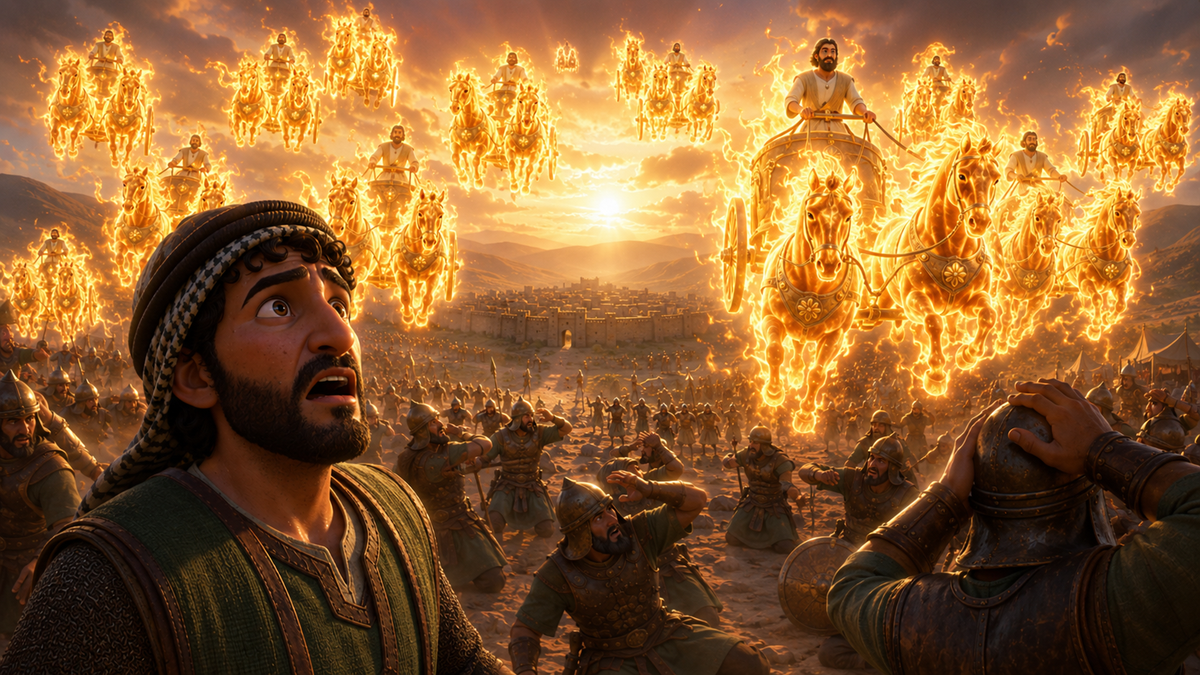
The city of Dothan sat quiet in the early morning hours — until it didn't. Elisha's servant stepped outside, probably still half-asleep, and froze. Surrounding the city on every side was the Syrian army: horses, chariots, soldiers. A full military encirclement. The kind of sight that drains the blood from your face and makes your legs stop working. He ran back to Elisha in a panic. 'Alas, my master! How shall we do?' It's one of the most human moments in all of scripture — a man staring at an impossible situation and seeing only the threat.
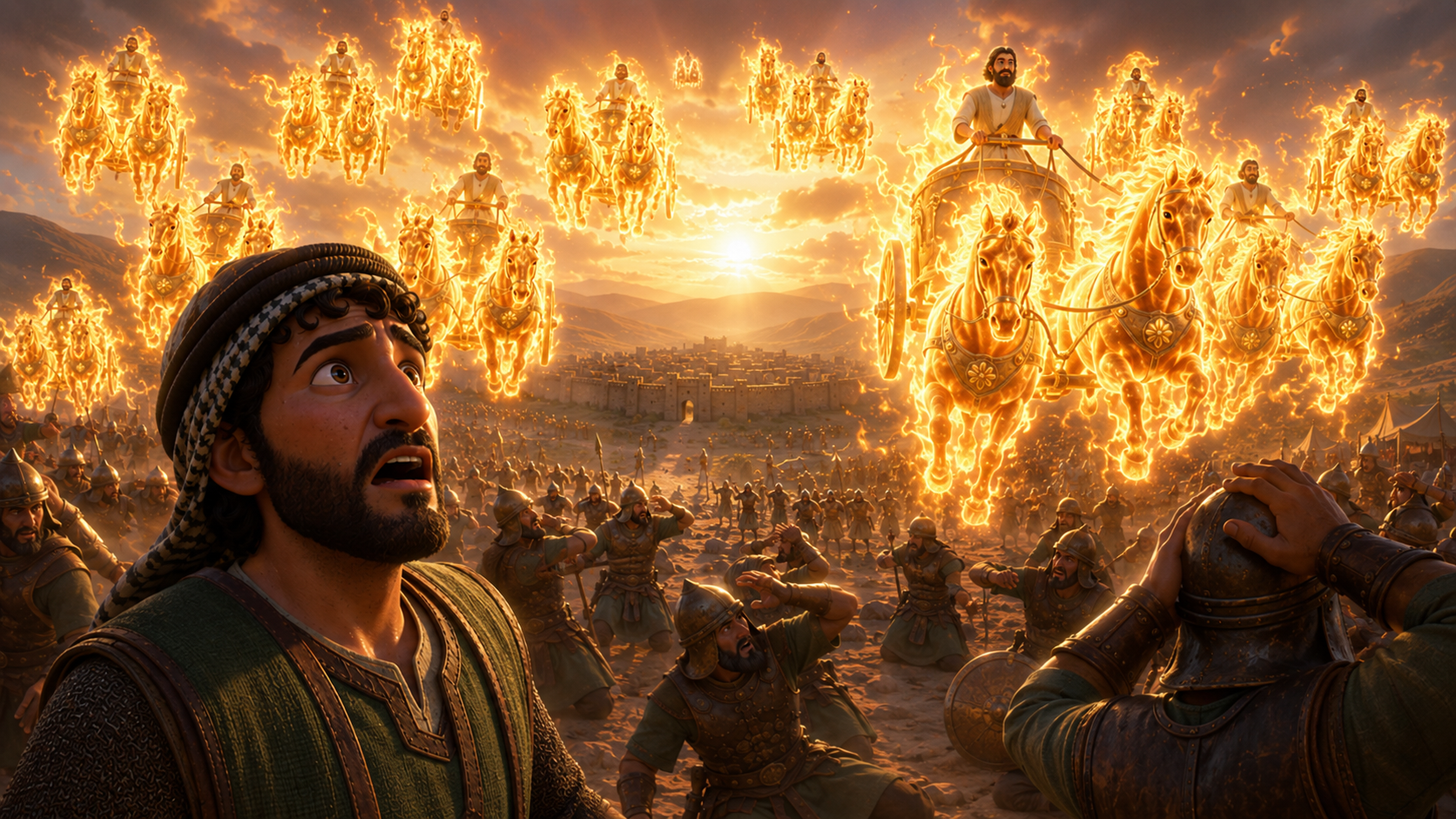
Elisha's response is one of the most quietly powerful lines in the Old Testament: 'Fear not: for they that be with us are more than they that be with them.' Then he prayed — not for rescue, not for fire from heaven, not for the army to scatter. He prayed for his servant's eyes to be opened. And when they were, the servant saw what had been there all along: the mountain full of horses and chariots of fire, the armies of heaven surrounding Elisha, surrounding them both, outnumbering the Syrians by a margin that made the whole threat look almost small.
The miracle wasn't that God sent reinforcements. The miracle was that the servant finally saw what was already true. Heaven's armies were already there. They had been there the whole time. The servant's fear wasn't wrong — it was just incomplete. He was seeing real danger with incomplete vision. Elisha's prayer didn't change the battlefield. It changed the servant's eyes. That distinction matters enormously for how we face our own impossible mornings.
The Big Idea: The Army You Can't See Is Still Winning
There's a reason Elisha didn't say 'Don't worry, help is on the way.' He said help is already here — you just can't see it yet. That's the theological gut-punch at the center of 2 Kings 6, and it's the same truth 'Chariots of Fire' is built around. The song doesn't promise that hard things will disappear. It promises that the hard things are never the whole picture. The Father is on the throne. The heavenly army has already stepped into the fight. The chariots are already on the hill. Our job — the servant's job, our kids' job, our job — is to ask for eyes that can see it.
From a Restoration perspective, this isn't just poetic comfort. Doctrine and Covenants 84:88 promises that the Lord will go before our face, be on our right hand and on our left, and His angels will be round about us to bear us up. That's not metaphor — that's covenant language. President Nelson has taught repeatedly that the Lord's power is real and available to those who seek it with faith. The servant in Dothan didn't manufacture courage by thinking positive thoughts. He received a gift — opened spiritual eyes — through a prophet's prayer. That same gift is available to us through the Holy Ghost, through priesthood blessings, through sincere prayer, and through the ordinances of the Restoration.
'Chariots of Fire' gives kids a song to sing when the Syrian army shows up in their life — when they feel outnumbered at school, when anxiety surrounds them, when the problem looks bigger than any solution they can see. The chorus is practically a prayer set to music: 'Open my eyes and let me see the light.' Teach your kids to mean it when they sing it. That's not a lyric. That's a petition.
Thoughtful Question
When was the last time you were the servant — seeing only the threat — and what helped you finally see what God had already placed around you?
Lyric Scripture Blueprint
Family Activity: Choose Your Adventure
Try This: Set up two zones in your yard or living room — a 'valley' (start line) and 'the hill' (far wall or tree). Split into two teams. One team is the Syrian Army, one team is the Heavenly Host. On 'GO,' the Heavenly Host team has to run relays carrying a baton (a rolled-up paper labeled 'Chariot of Fire') from the valley to the hill and back without being tagged. Every time a runner makes it back safely, shout the chorus line together: 'They that be with us are more than them!' Switch roles each round. Keep score, but here's the catch — the Heavenly Host team gets one extra runner added each round, because heaven's army only grows.
Reflect: How did it feel when your team kept getting bigger? Doctrine and Covenants 84:88 promises the Lord will be on our right hand and on our left, and His angels round about us. When has your family felt that kind of backup in a hard moment? Share one story each.
Doctrine and Covenants 84:88; 2 Kings 6:17
Try This: Give everyone a blank piece of paper and some colored pencils or markers. Draw a simple hill in the middle of the page. On one side of the hill, write or draw something that feels scary, overwhelming, or 'too big' in your life right now — it could be a friendship problem, a fear, a hard goal, anything real. On the other side of the hill, draw what you imagine heaven's help might look like for that situation — angels, the Savior, family members, the Holy Ghost, a priesthood blessing, a prophet's words. It doesn't have to be fancy. When everyone's done, share your drawings. Parents go first to model vulnerability.
Reflect: Elisha prayed, 'Lord, open his eyes that he may see' — and the servant saw chariots of fire on the hills. President Nelson has taught us to 'seek and expect miracles.' Looking at your drawing, what's one small act of faith you could take this week to invite heaven into your hard thing? Write it at the bottom of your page and put it somewhere you'll see it.
2 Kings 6:17; Russell M. Nelson, 'The Power of Spiritual Momentum,' Liahona, May 2022; Moroni 7:37
Walk With Me: Reinforce the Week with a Daily Habit
Try This: Each morning this week, before anyone looks at a screen or starts the day's noise, pause for sixty seconds and say out loud — or have a child say — 'Lord, open my eyes so I can see what You've already placed around me today.' Keep it that simple. One sentence. Every morning.
Why: Elisha's prayer for his servant wasn't a long theological argument — it was a short, specific ask for spiritual sight. The pattern matters: we ask, God opens. Starting the day with that posture trains the heart to look for heaven's hand in ordinary moments rather than only noticing it in crisis. Over time, that daily ask reshapes what your family notices and what it fears.
Behind the Music
The Cadence: The verse melody is deliberately conversational and almost storytelling-flat, which lets the chorus explode with contrast. When 'Open my eyes!' hits, it lands harder because the verses didn't oversell it. That dynamic arc — quiet story, then erupting declaration — mirrors the emotional journey from fear to sight that the servant himself experienced.
The Bridge Architecture: The bridge drops the energy intentionally before the final chorus. 'You are not alone' delivered softly, with the call-and-response echo, creates an intimate moment inside an otherwise high-energy track. That's where the song stops being about Elisha's servant and becomes about the listener. The '1-2-3-GO!' is a deliberate reset — almost playful — that launches the final chorus with fresh momentum rather than fatigue.
The Lyric Theology: 'Defending the hem' is a quietly sophisticated image. The hem of a garment in ancient covenant culture carried deep significance — it represented identity, authority, and protection. Slipping that into a kids' chorus plants a seed that can grow into much richer understanding as children get older and encounter temple covenant language.
Distraction-Free Lyric Video
Safe, distraction-free viewing for families.
Distraction-Free Cinematic Video
A lyric-free visual reflection designed for quiet viewing and discussion.
Continue the Journey
Back to the Fireside Moment
Revisit this week's scripture overview and big idea.
 Bob LeBaron
Explore Another Song
 Bob LeBaron
 Bob LeBaron