The Giant in the Valley, the Friend Who Gave His Robe, and the King Who Stopped to Ask
1 Samuel 17–18; 24–26; 2 Samuel 5–7
The Boy Nobody Sent For
1 Samuel 17:11, 17:26, 17:28, 17:33, 17:45-47; Alma 26:12; D&C 84:88
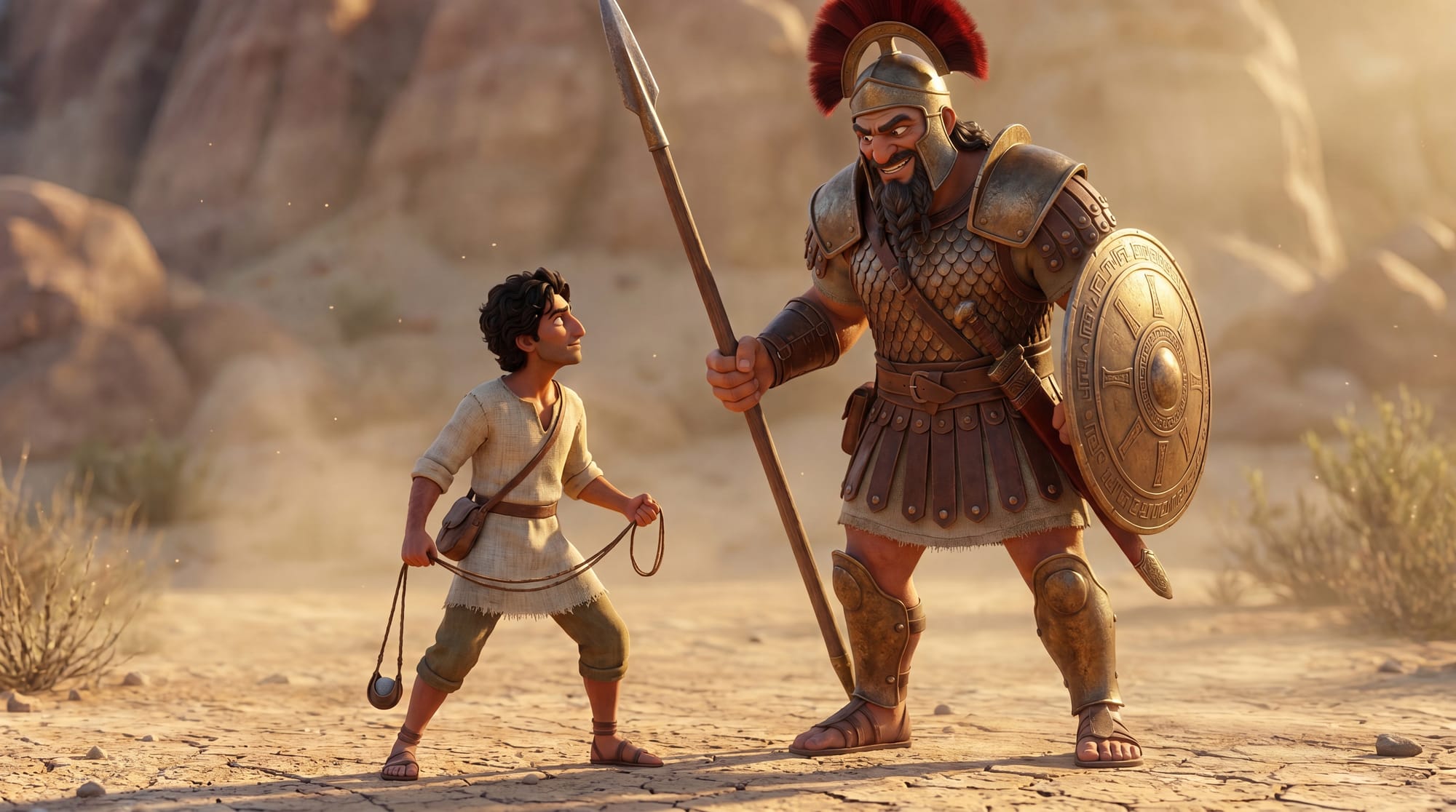
King Saul had an army. He had armor. He had a throne. What he didn't have, apparently, was anyone willing to walk down into that valley and face Goliath. For forty days — forty — the giant from Gath had been strutting out every morning and every evening, bellowing his challenge across the Elah Valley, and for forty days the entire army of Israel, king included, had been "greatly afraid" (1 Samuel 17:11). Nobody moved.
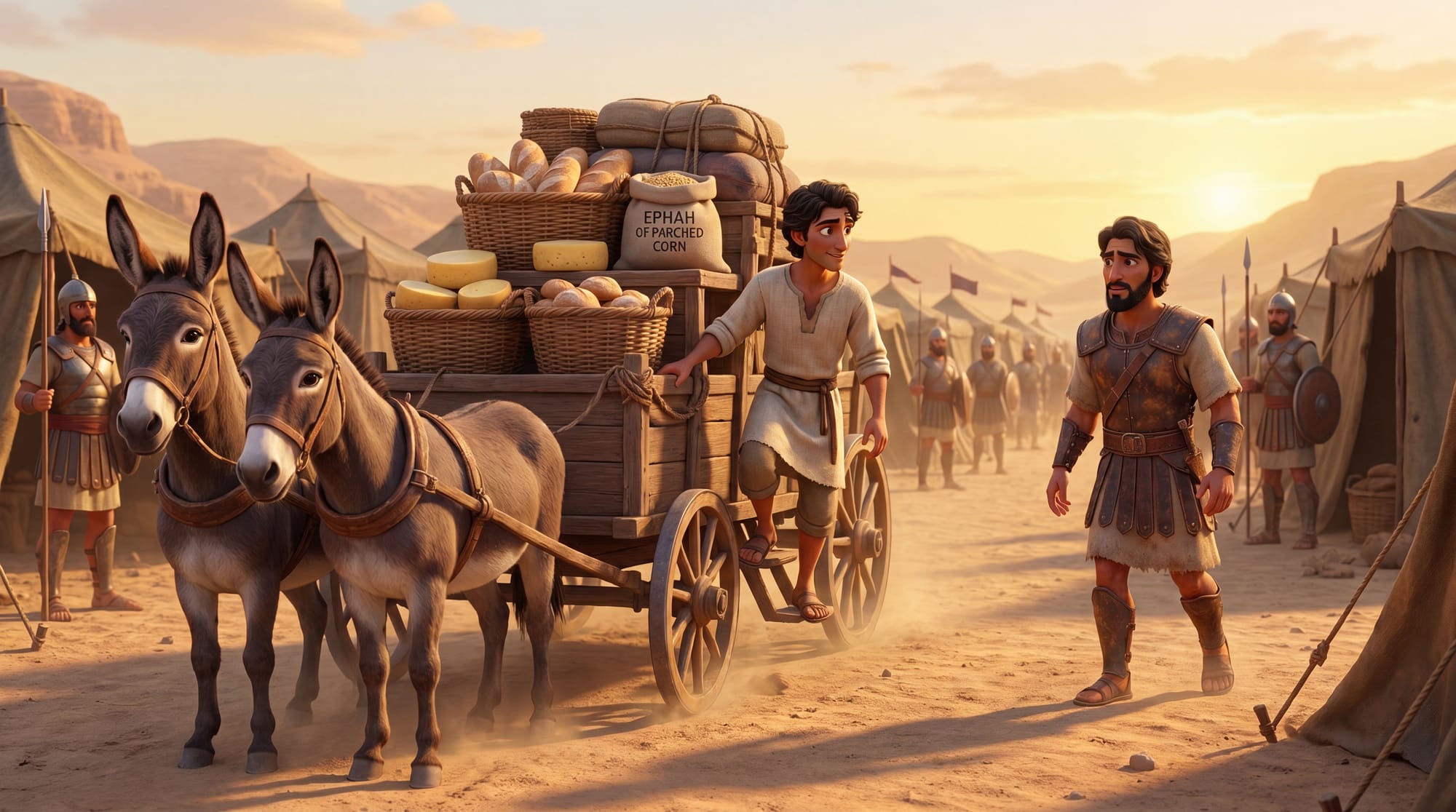
Then Jesse sent his youngest son to bring bread and cheese to his brothers at the front. David wasn't there as a soldier. He was there as a delivery boy. And when he heard Goliath's speech, his first reaction wasn't fear — it was offense. "Who is this uncircumcised Philistine, that he should defy the armies of the living God?" (1 Samuel 17:26). His brother Eliab immediately tried to put him back in his place — "I know thy pride, and the naughtiness of thine heart" (v. 28). Saul told him he was too young. Goliath looked at him and laughed.
Nobody in that story read David correctly except David — and the Lord.
Here's the detail that tends to get glossed over: David didn't just show up with blind bravado. He made a case. He told Saul about the lion and the bear he'd already killed protecting his flock. He had a track record with the Lord. He knew from personal experience that the God who delivered him from the paw of the lion would deliver him from this Philistine. That's not recklessness — that's a faith built on evidence.
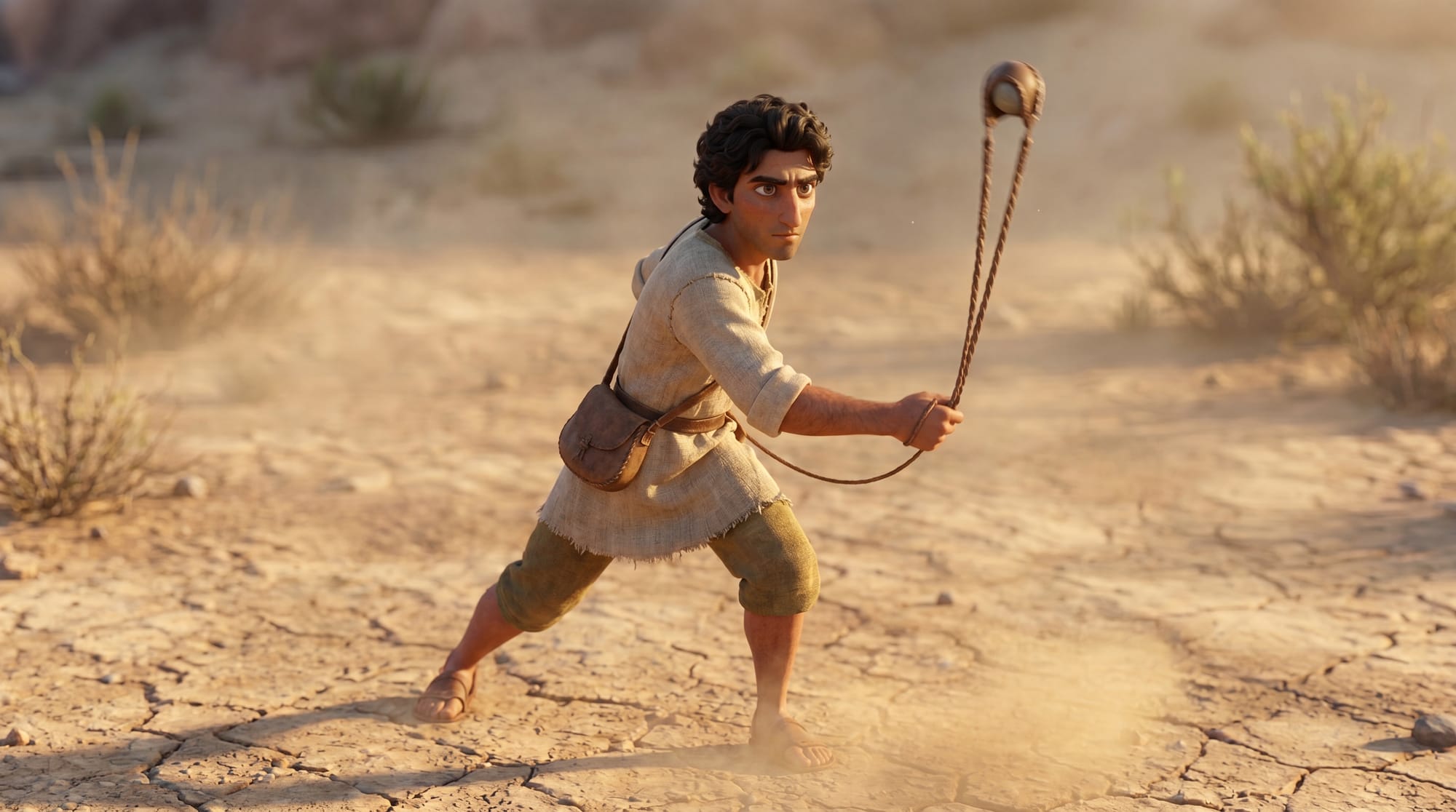
He refused Saul's armor because he hadn't tested it. He went to the brook and chose five smooth stones. He ran — ran — toward Goliath. One stone. One throw. The giant fell face-forward into the dirt, and the Philistine army scattered.
The Come, Follow Me lesson makes a point worth sitting with: the whole reason Israel wanted a king in the first place was so someone could "fight our battles" (1 Samuel 8:20). Saul was supposed to be that guy. But on the day it mattered, it wasn't the king who saved Israel — it was a shepherd boy with a sling and a settled conviction that "the battle is the Lord's" (1 Samuel 17:47). Alma 26:12 says it a different way: "I know that I am nothing; as to my strength I am weak; therefore I will not boast of myself, but I will boast of my God." David would have understood that completely.
For your family today: The Goliaths in your kids' lives probably don't wear bronze helmets. But they're real, and they're loud, and they're designed to make everyone freeze. David's example isn't just inspiring — it's instructional. You build faith in the Lord by remembering the lions and bears He already helped you survive.
Dive Deeper: Slay the Giant
Lyric Scripture Blueprint
Open +
Lyric Highlight
Scripture Bridge
Why It Matters
"(Yeah.) / (Check it out.) / (Just watch this.)"
1 Samuel 17:26 "And David spake to the men that stood by him, saying, What shall be done to the man that killeth this Philistine, and taketh away the reproach from Israel? for who is this uncircumcised Philistine, that he should defy the armies of the living God?"
Alma 56:47 "Now they never had fought, yet they did not fear death; and they did think more upon the liberty of their fathers than they did upon their lives; yea, they had been taught by their mothers, that if they did not doubt, God would deliver them."
D&C 6:36 "Look unto me in every thought; doubt not, fear not."
Fearless Entry: The intro is a taunt aimed at fear itself — a young voice stepping forward when everyone else stepped back. David's first recorded words in 1 Samuel 17:26 carry exactly this energy: not bravado, but genuine bewilderment that no one else is stepping up for the living God. The Stripling Warriors in Alma 56 echo the same posture — not fearlessness born of ignorance, but confidence born of covenant. D&C 6:36 is the Lord's standing invitation into that same headspace. For families: before the song even starts, ask your kids — what does it feel like to be the only one willing to step forward? That is exactly where David stood.
"Everybody's shaking in their armor and boots / Talking 'bout how big he is and how he's gonna shoot."
1 Samuel 17:11 "When Saul and all Israel heard those words of the Philistine, they were dismayed, and greatly afraid."
1 Samuel 17:24 "And all the men of Israel, when they saw the man, fled from him, and were sore afraid."
Helaman 4:26 "And we see that these promises have been verified to the people of Nephi; for it has been their quarrelings and their contentions, yea, their murderings, and their plunderings, their idolatry, their lasciviousness, and their abominations, which were among themselves, which brought upon them their wars and their destructions."
The Paralysis of Fear: The entire Israelite army — including their king — was frozen by what they could see. The lyric captures the contagious nature of fear: when people talk more about the size of the problem than the power of God, fear spreads. Both 1 Samuel 17:11 and 17:24 document this collective paralysis with painful specificity. The Book of Mormon repeatedly shows that spiritual defeat precedes military defeat — when a people lose their faith, they lose their footing. For families: talk about how fear can be contagious in a classroom, a team, or a family — and how one person's faith can reverse that current.
"King Saul tried to give me a helmet and a sword / I said 'No thank you, sir, I'm trusting in the Lord.' / I'm just a shepherd with a sling in my hand / But I'm about to do something you won't understand."
1 Samuel 17:38–40 "And Saul armed David with his armour, and he put an helmet of brass upon his head; also he armed him with a coat of mail. And David girded his sword upon his armour, and he assayed to go; for he had not proved it. And David said unto Saul, I cannot go with these; for I have not proved them. And David put them off him. And he took his staff in his hand, and chose him five smooth stones out of the brook, and put them in a shepherd's bag which he had, even in a scrip; and his sling was in his hand: and he drew near to the Philistine."
2 Nephi 4:34 "O Lord, I have trusted in thee, and I will trust in thee forever. I will not put my trust in the arm of flesh; for I know that cursed is he that putteth his trust in the arm of flesh."
D&C 1:19 "The weak things of the world shall come forth and break down the mighty and strong ones."
Refusing the Arm of Flesh: David's refusal of Saul's armor is one of the most theologically loaded moments in the entire chapter. Saul's armor represented the world's solution — human strategy, human protection, human strength. David's rejection of it was not stubbornness; it was a declaration of where his trust actually lived. Nephi's cry in 2 Nephi 4:34 is the doctrinal commentary on this moment — cursed is the one who trusts the arm of flesh. D&C 1:19 confirms that God has always preferred to work through the weak and overlooked. For families: ask your children what 'armor' the world offers them when they face hard things — and what it looks like to set it down and trust God instead.
"He's big and tall, yeah he's really tall / But the bigger they are, the harder they fall."
1 Samuel 17:4 "And there went out a champion out of the camp of the Philistines, named Goliath, of Gath, whose height was six cubits and a span."
Isaiah 40:23–24 "That bringeth the princes to nothing; he maketh the judges of the earth as vanity. Yea, they shall not be planted; yea, they shall not be sown: yea, their stock shall not take root in the earth: and he shall also blow upon them, and they shall wither."
1 Nephi 22:14 "And every nation which shall war against thee, O house of Israel, shall be turned one against another, and they shall fall into the pit which they digged to ensnare the people of the Lord."
The Smallness of Giants Before God: Goliath's height — six cubits and a span, roughly nine feet — is recorded in scripture not to impress us but to set up the contrast. The pre-chorus reframes the math: size is irrelevant when God is the variable. Isaiah 40 is the great equalizer passage — the God who measures the oceans in the hollow of His hand makes princes into nothing. The Book of Mormon echoes this in 1 Nephi 22: the pits dug for the righteous become the graves of the wicked. For families: what looks like a Goliath in your life right now? How does remembering who God is change the size of the problem?
"I'm gonna slay the giant, just you wait and see / It won't be my muscle, it won't be me. / I've got five smooth stones and a heart full of faith / I'm staring fear right in the face. / Yeah, the battle is the Lord's, and the victory is mine / I'm gonna slay the giant, it's just a matter of time!"
1 Samuel 17:47 "And all this assembly shall know that the Lord saveth not with sword and spear: for the battle is the Lord's, and he will give you into our hands."
1 Samuel 17:45 "Then said David to the Philistine, Thou comest to me with a sword, and with a spear, and with a shield: but I come to thee in the name of the Lord of hosts, the God of the armies of Israel, whom thou hast defied."
Alma 2:28 "And behold, this was done in the midst of the night, so that when the Lamanites awoke in the morning they beheld that the Nephites had surrounded them; and the Lamanites, seeing this, they were struck with great fear, insomuch that they did flee before the Nephites."
D&C 105:14 "For behold, I do not require at their hands to fight the battles of Zion; for, as I said in a former commandment, even so will I fulfil — I will fight your battles."
The Battle Belongs to the Lord: The chorus is a direct lyrical echo of 1 Samuel 17:47 — one of the most theologically precise declarations in the entire Old Testament. David does not say the victory is his because he is skilled; he says it because the battle belongs to God. This is not false modesty — it is covenant theology in action. D&C 105:14 confirms that this is not an ancient principle but a living promise: the Lord will fight the battles of Zion. The five smooth stones are not a lucky charm; they are the tools of a person who has done their part and then trusted God with the outcome. For families: the chorus is worth memorizing together — 'the battle is the Lord's' is a phrase your children can carry into any hard moment.
"I fought a lion and I fought a bear / God was with me then, and He's with me there. / So excuse me now, I've got a job to do / That big bad giant is about to be through."
1 Samuel 17:34–37 "And David said unto Saul, Thy servant kept his father's sheep, and there came a lion, and a bear, and took a lamb out of the flock: And I went out after him, and smote him, and delivered it out of his mouth: and when he arose against me, I caught him by his beard, and smote him, and slew him. Thy servant slew both the lion and the bear: and this uncircumcised Philistine shall be as one of them, seeing he hath defied the armies of the living God. David said moreover, The Lord that delivered me out of the paw of the lion, and out of the paw of the bear, he will deliver me out of the hand of this Philistine."
Alma 36:3 "For I do know that whosoever shall put their trust in God shall be supported in their trials, and their troubles, and their afflictions, and shall be lifted up at the last day."
D&C 122:7–8 "And if thou shouldst be cast into the pit, or into the hands of murderers, and the sentence of death passed upon thee; if thou be cast into the deep; if the billowing surge conspire against thee; if fierce winds become thine enemy; if the heavens gather blackness, and all the elements combine to hedge up the way; and above all, if the very jaws of hell shall gape open the mouth wide after thee, know thou, my son, that all these things shall give thee experience, and shall be for thy good."
The Testimony of Past Deliverance: David's argument to Saul is not theoretical — it is a testimony. He does not say 'I believe God can help me.' He says 'God helped me with the lion, God helped me with the bear, therefore I know He will help me now.' This is the pattern of covenant memory: past deliverance becomes the foundation for present faith. Alma 36:3 generalizes this principle across all of scripture — trust in God produces support through trials. D&C 122 shows that even the Prophet Joseph, in Liberty Jail, was being prepared by his trials rather than abandoned in them. For families: encourage each family member to name one time God helped them through something hard — that memory is their lion and bear testimony.
"Round and round the sling goes. / Where it lands, nobody knows. / Except for God, He guides the stone... / He guides the stone."
1 Samuel 17:49–50 "And David put his hand in his bag, and took thence a stone, and slang it, and smote the Philistine in his forehead, that the stone sunk into his forehead; and he fell upon his face to the earth. So David prevailed over the Philistine with a sling and with a stone, and smote the Philistine, and slew him; but there was no sword in the hand of David."
Proverbs 16:9 "A man's heart deviseth his way: but the Lord directeth his steps."
2 Nephi 27:20–21 "And the Lord God will say unto him: The learned shall not read them, for they have rejected them, and I am able to do mine own work; wherefore thou shalt read the words which I shall give unto thee. Touch not the things which are sealed, for I will bring them forth in mine own due time; for I will show unto the children of men that I am able to do mine own work."
D&C 58:26–27 "For behold, it is not meet that I should command in all things; for he that is compelled in all things, the same is a slothful and not a wise servant; wherefore he receiveth no reward. Verily I say, men should be anxiously engaged in a good cause, and do many things of their own free will, and bring to pass much righteousness."
God Guides the Stone: The bridge is the theological heart of the song. The sling goes round and round — David does his part, he acts, he moves — but the landing belongs to God. This is the perfect picture of the divine-human partnership at the center of Restoration theology. Proverbs 16:9 captures it in one line: we devise our way, but the Lord directs our steps. D&C 58 adds the crucial nuance — God does not want robots who wait for every instruction; He wants people who act in faith and then trust Him to guide the stone. For families: the bridge is a great moment to talk about what it means to do your part and then let God do His — in school, in friendships, in hard decisions.
"Just a matter of time. / (The victory is mine.)"
1 Samuel 17:47 "And all this assembly shall know that the Lord saveth not with sword and spear: for the battle is the Lord's, and he will give you into our hands."
Moroni 9:25 "My son, be faithful in Christ; and may not the things which I have written grieve thee, to weigh thee down unto death; but may Christ lift thee up, and may his sufferings and death, and the showing his body unto our fathers, and his mercy and long-suffering, and the hope of his glory and of eternal life, rest in your mind forever."
D&C 121:7–8 "My son, peace be unto thy soul; thine adversity and thine afflictions shall be but a small moment; And then, if thou endure it well, God shall exalt thee on high."
Victory Is Certain: The outro does not end in doubt — it ends in settled confidence. 'Just a matter of time' is not wishful thinking; it is covenant certainty. The battle is already the Lord's, which means the outcome is already decided for those who trust Him. Moroni's final words to his son in Moroni 9:25 carry this same tone — not triumphalism, but deep, quiet assurance that Christ is sufficient. D&C 121 echoes it from Liberty Jail: the affliction is real, but it is a small moment, and endurance leads to exaltation. For families: end the song by asking — what giant in your life do you need to hand over to the Lord today, trusting that the victory is just a matter of time?
Before David ever stood in the valley of Elah, he had already fought for his flock. He told Saul about the lion and the bear — how he had gone after them, struck them, and delivered the lamb from their mouths. His case to Saul wasn't bravado. It was a resume. And the logic was simple: the same God who delivered the flock from the lion would deliver Israel from this Philistine.
What's easy to miss is what David didn't bring into that valley. No sword. No armor. No army. Just a staff, a sling, five stones, and a covenant. And that's precisely the point. God has a pattern in scripture of engineering deliverances that can only be explained one way. Gideon's three hundred men with lamps and jars against a Midianite army too numerous to count. David with a shepherd's sling against a giant in bronze armor. The method isn't incidental — it's the message. When God strips away every worldly explanation, what remains is His power alone.
But there's something even deeper here. David describes himself as a shepherd defending his flock at personal risk — going after the predator, not waiting for it to leave. That is the language of the Good Shepherd. Centuries before Jesus would say "I am the good shepherd: the good shepherd giveth his life for the sheep" (John 10:11), David was living out a type of that truth in the hills of Judah, and again in the valley below. He didn't send someone else. He went himself. He put himself between the danger and the flock. And he won — not because of his strength, but because of whose shepherd he was.
A Playful Aside: "I Know Thy Pride, and the Naughtiness of Thine Heart"
1 Samuel 16:7; 1 Samuel 17:28; Deuteronomy 6; Deuteronomy 8
Let's just pause on verse 28 for a moment. David's oldest brother Eliab hears David asking questions about Goliath, and he unloads: "I know thy pride, and the naughtiness of thine heart." Naughtiness. It's hard not to smile at that word. Eliab sounds less like a battle-hardened soldier and more like a frustrated babysitter telling a seven-year-old to stop touching things.
But here's what makes this moment genuinely interesting rather than just funny: Eliab is spectacularly, almost cosmically wrong. Samuel had stood in Eliab's presence not long before this — the Lord looked him over, took in his impressive height and appearance — and passed. "The Lord seeth not as man seeth; for man looketh on the outward appearance, but the Lord looketh on the heart" (1 Samuel 16:7). Eliab was rejected specifically because of what God found when He looked at his heart. And now here is Eliab, lecturing David about the condition of David's heart. The irony is so thick you could spread it on bread.
Which raises a fair question for all of us: if the Lord looked at our hearts today, what would He find? Not in a heavy, crushing way — but honestly. Eliab's mistake wasn't just pride; it was that he couldn't see his own heart clearly enough to recognize what God was actually looking for. The Deuteronomy passages Moses taught just weeks ago in our curriculum hit exactly this note — love the Lord with all your heart, don't let a full belly and a comfortable life make you forget Him, circumcise the heart and cut away the pride (Deuteronomy 6; 8:11–14). If there's some naughtiness in your heart that needs a good look, that's the prescription. In case you need a refresher, we wrote a song for that too.
Dive Deeper: The Spiritual Checkup — Deuteronomy 6 & 8
Keeping the rhythm of the heart — because a full belly and a comfortable life have a way of making us forget who got us there.
1 Samuel 18:1-4, 18:7; 1 Nephi 19:23; Mormon 9:31; John 15:13; Philippians 2:7
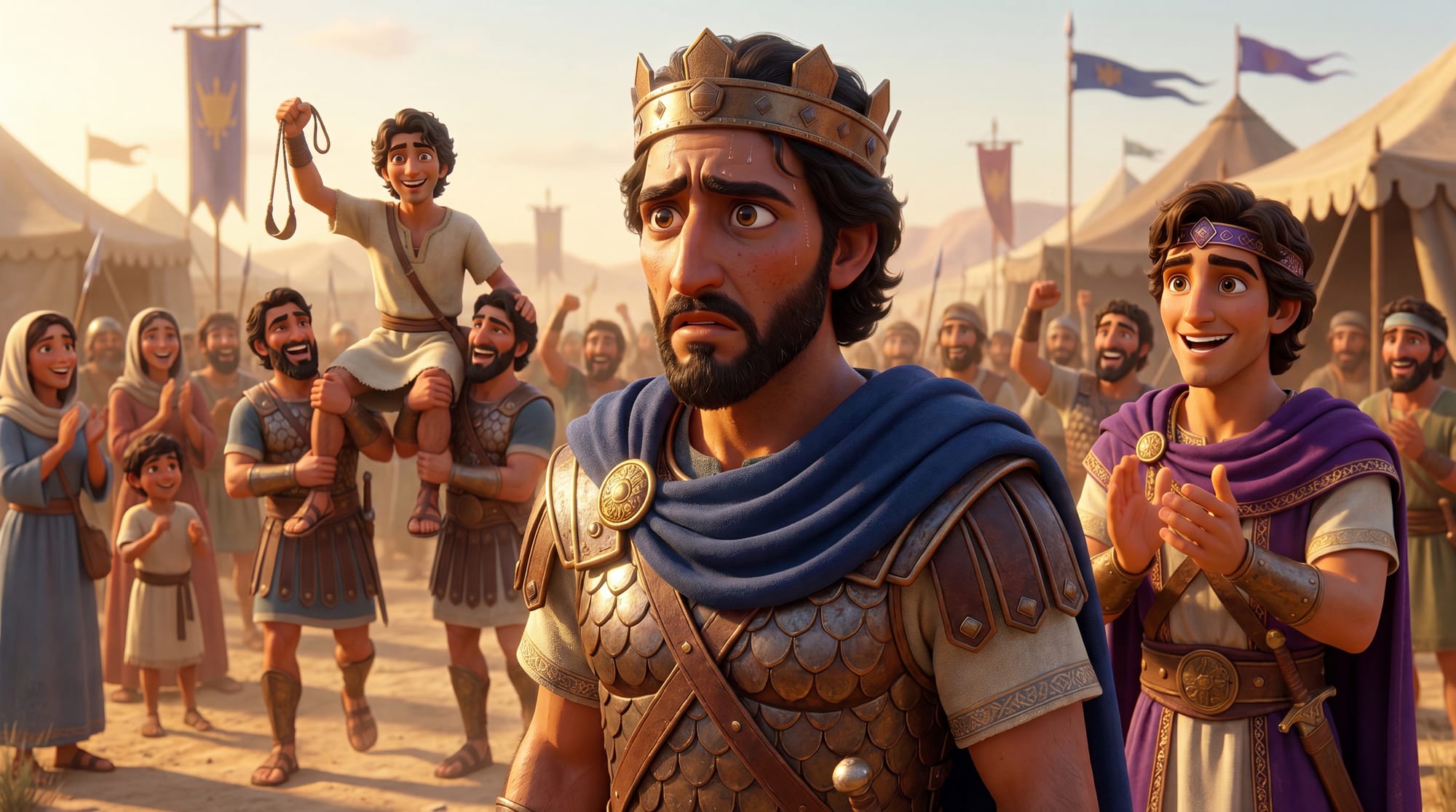
Jonathan had every reason to be threatened by David. He was the king's son. He was next in line. He was a proven warrior in his own right — 1 Samuel 14 shows him pulling off his own miracle against the Philistines, just him and his armor-bearer against a garrison. Jonathan was not a small figure. And then David walks in from the valley with Goliath's head, the crowd goes wild, and the women start singing songs comparing Saul's thousands to David's ten thousands (1 Samuel 18:7).
The text says Jonathan "loved him as his own soul" (1 Samuel 18:1, 3). And he didn't just feel it — he acted on it. He took off his own robe and gave it to David. He gave him his sword, his bow, his belt. These weren't trinkets. A prince's robe and weapons were symbols of rank and succession. Jonathan was, in a very real sense, handing David the future that could have been his. No bitterness. No calculation. Just love.
Saul heard that same song and it ate him alive. From that day forward, he watched David with suspicion, hurled a spear at him twice, and eventually spent years hunting him across the wilderness. Jealousy is a corrosive thing. Jonathan heard the exact same song and loved David more.
The Come, Follow Me lesson asks a pointed question: what do you find in Jonathan's attitudes and actions that reminds you of Jesus Christ? It's worth actually stopping on that. Christ also laid down his glory, stripped himself of the honors of heaven, and gave everything — not because he had to, but because of love. Jonathan is one of the quieter types of Christ in the Old Testament, but he's one of the most human and therefore one of the most accessible.
The lesson also brings in 1 Nephi 19:23 — "liken the scriptures unto us." Nobody in scripture is flawless, and that includes David. The same chapter that shows Jonathan's generosity also sets up the tragic reality of Saul's jealousy spiraling into something dangerous. Both responses to David's success are on the table. The question the lesson invites is honest: when someone around you succeeds — your sibling, your coworker, your neighbor — which response do you recognize in yourself?
A Deeper Look: Jonathan as a Type of Christ
1 Samuel 18:1-4; 20:30-33; 23:17; Philippians 2:7
The Come, Follow Me lesson asks what Jonathan's attitudes remind you of in Jesus Christ. It's worth sitting with that question long enough to actually answer it. Jonathan isn't just a good friend — he's one of the most precise human types of Christ in the entire Old Testament.
What Jonathan Did
The Christlike Pattern
Scripture Reference
Principle over position — as crown prince, David was his direct rival for the throne, yet Jonathan chose covenant love over royal ambition
Christ set aside the honors of heaven and made himself of no reputation, taking on the form of a servant — not because he had to, but because of love
Philippians 2:7
"But made himself of no reputation, and took upon him the form of a servant, and was made in the likeness of men."
The transfer of regalia — he stripped himself of his royal robe, sword, bow, and belt and clothed David with them
Christ laid aside his heavenly glory to clothe us in his righteousness — he became what we are so we could receive what he had
Isaiah 61:10
"He hath clothed me with the garments of salvation, he hath covered me with the robe of righteousness."
2 Corinthians 5:21
"For he hath made him to be sin for us, who knew no sin; that we might be made the righteousness of God in him."
Absorbing the father's wrath — in 1 Samuel 20, Jonathan defended David at the royal table and Saul hurled a javelin at his own son in rage
Scarcely would one die for a righteous man — yet Christ stepped into the line of fire for the ungodly, absorbing what we deserved so we could go free
Romans 5:7–8
"For scarcely for a righteous man will one die: yet peradventure for a good man some would even dare to die. But God commendeth his love toward us, in that, while we were yet sinners, Christ died for us."
Serving another's flourishing — his final words to David in the wilderness: "Thou shalt be king over Israel, and I shall be next unto thee" (1 Samuel 23:17)
Before the world began, the Savior volunteered — not to claim glory but to give it away entirely to the Father. Zero anxiety about who received the credit
Abraham 3:27
"And the Lord said: Whom shall I send? And one answered like unto the Son of Man: Here am I, send me."
Moses 4:2
"Father, thy will be done, and the glory be thine forever."
For your family: Jonathan and David's friendship is a great conversation starter about what it actually looks like to celebrate someone else's win. Real friendship, the kind that lasts, looks a lot more like Jonathan than it does like Saul.
Dive Deeper: Like His Own Soul
Lyric Scripture Blueprint
Open +
Lyric Highlight
Scripture Bridge
Why It Matters
"(Instrumental/no lyrics — song opens on the scene of David's victory)"
1 Samuel 17:52 "And the men of Israel and of Judah arose, and shouted, and pursued the Philistines."
1 Samuel 18:6 "And it came to pass as they came, when David was returned from the slaughter of the Philistine, that the women came out of all cities of Israel, singing and dancing, to meet king Saul."
Alma 56:47 "Now they never had fought, yet they did not fear death; and they did think more upon the liberty of their fathers than they did upon their lives."
Victory Sets the Scene: The intro drops us into the aftermath of one of scripture's most electric moments — the valley of Elah, the crowd erupting, a shepherd boy holding a giant's sword. The song doesn't start with a lesson; it starts with a celebration, because that is exactly what 1 Samuel 18 describes. The women of Israel poured into the streets singing. Alma 56 echoes the same spirit in the Book of Mormon — young warriors whose faith produced outcomes that defied every military calculation. For families: before the first lyric lands, ask your kids what they think the crowd was feeling. Joy? Shock? Relief? That emotional entry point is exactly where Jonathan's story begins.
"David just came walking from the valley below / He defeated the giant and he put on a show! / King Saul is looking nervous 'cause the people all cheer / But Jonathan is smiling from ear to ear."
1 Samuel 18:6–7 "And it came to pass as they came, when David was returned from the slaughter of the Philistine, that the women came out of all cities of Israel, singing and dancing, to meet king Saul, with tabrets, with joy, and with instruments of musick. And the women answered one another as they played, and said, Saul hath slain his thousands, and David his ten thousands."
1 Samuel 18:8–9 "And Saul was very wroth, and the saying displeased him; and he said, They have ascribed unto David ten thousands, and to me they have ascribed but thousands: and what can he have more but the kingdom? And Saul eyed David from that day and forward."
1 Samuel 18:1 "And it came to pass, when he had made an end of speaking unto Saul, that the soul of Jonathan was knit with the soul of David, and Jonathan loved him as his own soul."
Two Responses to Another's Glory: The lyric captures the fork in the road with perfect economy — Saul nervous, Jonathan smiling. First Samuel 18 records both reactions in the same breath. Saul's envy would eventually consume him; Jonathan's joy would define him. The contrast is not incidental — it is the entire moral architecture of 1 Samuel 18. The Book of Mormon's Alma 28:14 warns that pride and envy are among the great causes of human misery, while Mosiah 18:21 describes Zion-level community as being 'of one heart and one mind.' For families: ask which reaction feels more natural when a sibling or friend gets praised — and then talk honestly about why Jonathan's response was so rare and so Christlike.
"He doesn't feel jealous, he doesn't feel mad / He is looking at his brother and he's feeling so glad!"
1 Samuel 18:1 "And it came to pass, when he had made an end of speaking unto Saul, that the soul of Jonathan was knit with the soul of David, and Jonathan loved him as his own soul."
Moroni 7:45 "And charity suffereth long, and is kind, and envieth not, and is not puffed up, seeketh not her own, is not easily provoked, thinketh no evil."
Romans 12:15 "Rejoice with them that do rejoice, and weep with them that weep."
D&C 88:123 "See that ye love one another; cease to be covetous; learn to impart one to another as the gospel requires."
Charity Does Not Envy: Jonathan had every worldly reason to resent David — he was the crown prince, and David's rising star threatened his inheritance. Yet the text says his soul was knit to David's. Moroni 7:45 is the New Testament's 1 Corinthians 13 rendered in Book of Mormon language, and it names envy as the precise opposite of charity. Jonathan's gladness was not passive tolerance — it was active, covenant-level love. D&C 88 frames it as a gospel requirement, not a personality trait. For families: this is a great moment to name a time when someone in your family genuinely celebrated another person's win — and to talk about what made that possible.
"He took off his robe and he gave it away / He handed him his sword and he started to say... / 'I'm gonna be the one who is guarding your back! / Whenever you are weary, I'll pick up the slack!'"
1 Samuel 18:3–4 "Then Jonathan and David made a covenant, because he loved him as his own soul. And Jonathan stripped himself of the robe that was upon him, and gave it to David, and his garments, even to his sword, and to his bow, and to his girdle."
Mosiah 18:8–9 "And it came to pass that he said unto them: Behold, here are the waters of Mormon... and now, as ye are desirous to come into the fold of God, and to be called his people, and are willing to bear one another's burdens, that they may be light; Yea, and are willing to mourn with those that mourn; yea, and comfort those that stand in need of comfort."
John 15:13 "Greater love hath no man than this, that a man lay down his life for his friends."
D&C 82:19 "Every man seeking the interest of his neighbor, and doing all things with an eye single to the glory of God."
Covenant Friendship as Consecration: Jonathan's gesture was not sentimental — it was covenantal. In the ancient Near East, giving your robe and weapons to another person was a formal act of loyalty, essentially saying: my identity and my protection are now yours. This is the exact language Alma uses at the waters of Mormon in Mosiah 18 — bearing burdens, mourning together, standing in for one another. John 15:13 and D&C 82:19 confirm that this pattern of self-giving is the Lord's own definition of love. For families: the pre-chorus is a great place to ask, 'What would it look like to give your armor to a friend today?' — not literally, but in terms of time, attention, or standing up for them.
"'Cause a really good friend is a gift from above! / Filling up the world with a brotherly love! / Yeah, he loved him like his own soul, tried and true / That's the kind of friend that I wanna be to you! / When you're walking through the dark and you're feeling alone / I'll be standing right beside you till you make it safely home! / (Yeah!) / Loved him like his own soul, tried and true!"
1 Samuel 18:1 "And it came to pass, when he had made an end of speaking unto Saul, that the soul of Jonathan was knit with the soul of David, and Jonathan loved him as his own soul."
Proverbs 17:17 "A friend loveth at all times, and a brother is born for adversity."
Mosiah 18:21 "And he commanded them that there should be no contention one with another, but that they should look forward with one eye, having one faith and one baptism, having their hearts knit together in unity and in love one towards another."
D&C 84:88 "And whoso receiveth you, there I will be also, for I will go before your face. I will be on your right hand and on your left, and my Spirit shall be in your hearts, and mine angels round about you, to bear you up."
Covenant Friendship Mirrors Christ: The chorus is built on the exact phrase from 1 Samuel 18:1 — 'loved him as his own soul' — and it earns every word. Proverbs 17:17 confirms that true friendship is not fair-weather; it is forged in adversity. Mosiah 18:21 uses the same 'knit together' language to describe the covenant community at the waters of Mormon, showing that Jonathan and David's bond is a type of Zion-level unity. D&C 84:88 reveals the ultimate source: the Lord Himself walks beside us on our right and left, and true friends are instruments of that divine accompaniment. For families: the line 'till you make it safely home' is worth pausing on — home here is both literal and eternal, and the Lord's promise in D&C 84 is that He is already walking that road with us.
"It isn't about the glory, it isn't about the fame / It's about holding up the pieces when they're calling your name. / Jonathan knew that David was the chosen king / So he lifted up his voice and he started to sing. / He wanted him to win, he wanted him to fly / That's the kind of friendship money just can't buy!"
1 Samuel 23:16–17 "And Jonathan Saul's son arose, and went to David into the wood, and strengthened his hand in God. And he said unto him, Fear not: for the hand of Saul my father shall not find thee; and thou shalt be king over Israel, and I shall be next unto thee; and that also Saul my father knoweth."
Alma 17:2–3 "Now these sons of Mosiah... had waxed strong in the knowledge of the truth; for they were men of a sound understanding and they had searched the scriptures diligently, that they might know the word of God. But this is not all; they had given themselves to much prayer, and fasting; therefore they had the spirit of prophecy, and the spirit of revelation, and when they taught, they taught with power and authority of God."
John 3:30 "He must increase, but I must decrease."
Moroni 7:48 "Wherefore, my beloved brethren, pray unto the Father with all the energy of heart, that ye may be filled with this love, which he hath bestowed upon all who are true followers of his Son, Jesus Christ."
Selfless Loyalty as Discipleship: Verse 2 moves the story forward to 1 Samuel 23, where Jonathan finds David hiding in the wilderness and 'strengthened his hand in God' — one of the most quietly heroic acts in all of scripture. Jonathan knew the throne was going to David, not him, and he said so out loud. John 3:30 is the New Testament echo: 'He must increase, but I must decrease.' The sons of Mosiah in Alma 17 model the same spirit — men who gave up a kingdom to serve others. Moroni 7:48 frames this as the fruit of charity, which must be prayed for and received as a gift. For families: ask your kids if they can think of a time they helped someone else succeed at something they also wanted — and what that felt like.
"Cheer 'em on! (Cheer 'em on!) / Lift 'em up! (Lift 'em up!) / Fill 'em with the spirit from a loving cup! / Be a Jonathan today, give your armor away! / Stand beside your friends every single day! / (1-2-3-JUMP!)"
1 Samuel 23:16 "And Jonathan Saul's son arose, and went to David into the wood, and strengthened his hand in God."
Mosiah 18:8–9 "And now, as ye are desirous to come into the fold of God, and to be called his people, and are willing to bear one another's burdens, that they may be light; Yea, and are willing to mourn with those that mourn; yea, and comfort those that stand in need of comfort, and to stand as witnesses of God at all times and in all things."
Hebrews 10:24 "And let us consider one another to provoke unto love and to good works."
D&C 108:7 "Therefore, strengthen your brethren in all your conversation, in all your prayers, in all your exhortations, and in all your doings."
The Call to Action Is a Covenant Call: The bridge is the song's most direct invitation — stop watching and start doing. 'Be a Jonathan today' is not a motivational slogan; it is a covenant description. Mosiah 18 is the foundational baptismal covenant text of the Book of Mormon, and 'bearing one another's burdens' is its first listed obligation. Hebrews 10:24 uses the word 'provoke' — meaning to actively stir up — love and good works in others. D&C 108:7 makes it personal and specific: strengthen your brothers and sisters in every conversation, every prayer, every action. For families: the '1-2-3-JUMP!' is a physical cue — use it. Have everyone jump and then name one specific person they will 'be a Jonathan' to this week.
"'Cause a really good friend is a gift from above! / Filling up the world with a brotherly love! / Yeah, he loved him like his own soul, tried and true / That's the kind of friend that I wanna be to you! / When you're walking through the dark and you're feeling alone / I'll be standing right beside you till you make it safely home! / (Yeah!) / Loved him like his own soul, tried and true!"
1 Samuel 20:42 "And Jonathan said to David, Go in peace, forasmuch as we have sworn both of us in the name of the Lord, saying, The Lord be between me and thee, and between my seed and thy seed for ever."
3 Nephi 18:22 "And behold, ye shall meet together oft; and ye shall not forbid any man from coming unto you when ye shall meet together, but suffer them that they may come unto you and forbid them not."
D&C 84:88 "And whoso receiveth you, there I will be also, for I will go before your face. I will be on your right hand and on your left, and my Spirit shall be in your hearts, and mine angels round about you, to bear you up."
John 14:18 "I will not leave you comfortless: I will come to you."
The Covenant Holds: The reprise of the chorus lands differently after the bridge's call to action — now it is not just a description of Jonathan and David, it is a personal declaration. First Samuel 20:42 records the formal covenant Jonathan made with David, invoking the Lord as witness across generations. The phrase 'till you make it safely home' now carries the full weight of D&C 84:88 and John 14:18 — the Lord's own promise that no one walks home alone. Third Nephi 18:22 extends this to the community of disciples: gather often, leave no one out, forbid no one from coming. For families: sing this reprise slowly and let the kids hear it as a promise they are making to each other — not just a song about Jonathan and David, but about this family, right now.
"(Like my own soul.) / Better together! / (Yeah, yeah.)"
1 Samuel 18:1 "And it came to pass, when he had made an end of speaking unto Saul, that the soul of Jonathan was knit with the soul of David, and Jonathan loved him as his own soul."
Ecclesiastes 4:9–10 "Two are better than one; because they have a good reward for their labour. For if they fall, the one will lift up his fellow: but woe to him that is alone when he falleth; for he hath not another to help him up."
Mosiah 18:21 "And he commanded them that there should be no contention one with another, but that they should look forward with one eye, having one faith and one baptism, having their hearts knit together in unity and in love one towards another."
D&C 38:27 "I say unto you, be one; and if ye are not one ye are not mine."
Unity Is the Lord's Signature: The outro distills the entire song into two phrases — 'like my own soul' and 'better together' — and both are scripturally precise. First Samuel 18:1 is the source text; Ecclesiastes 4:9–10 is the wisdom literature confirmation that two are genuinely stronger than one. Mosiah 18:21 uses the same 'knit together' language to describe the covenant community, and D&C 38:27 makes it a divine standard: 'if ye are not one ye are not mine.' The outro is not a fade-out — it is a declaration of covenant identity. For families: end your listening session by having everyone put a hand in the center and say 'better together' — and mean it as a family covenant, not just a song lyric.
The Rest of the Story: The Priest Who Paid for David's Escape
1 Samuel 21–22
When David fled from Saul, he stopped at Nob and asked the priest Ahimelech for bread and a weapon. Ahimelech gave him the showbread and Goliath's own sword — not knowing David was a fugitive. An Edomite named Doeg was watching. He reported back to Saul, and Saul ordered the execution of Ahimelech and every priest at Nob — eighty-five men, along with their families and livestock. Doeg carried it out when Saul's own soldiers refused. Only one of Ahimelech's sons, Abiathar, escaped and ran straight to David. David received him, protected him, and kept him close — Abiathar served as priest throughout David's entire reign. When David heard what had happened at Nob, he said plainly: "I have occasioned the death of all the persons of thy father's house" (1 Samuel 22:22). He owned it. The curriculum doesn't linger here, but the story does — and it raises a question worth sitting with your family: how many people in scripture played a supporting role that made everything else possible? Ahimelech didn't know he was part of the story. He just did the right thing when someone showed up at his door. That's often how it works.
Christlike Poise in the Cave — and the Woman Who Stopped a War
1 Samuel 24:6, 24:12; 1 Samuel 25:2-35; 3 Nephi 12:39; D&C 64:10; Romans 12:19
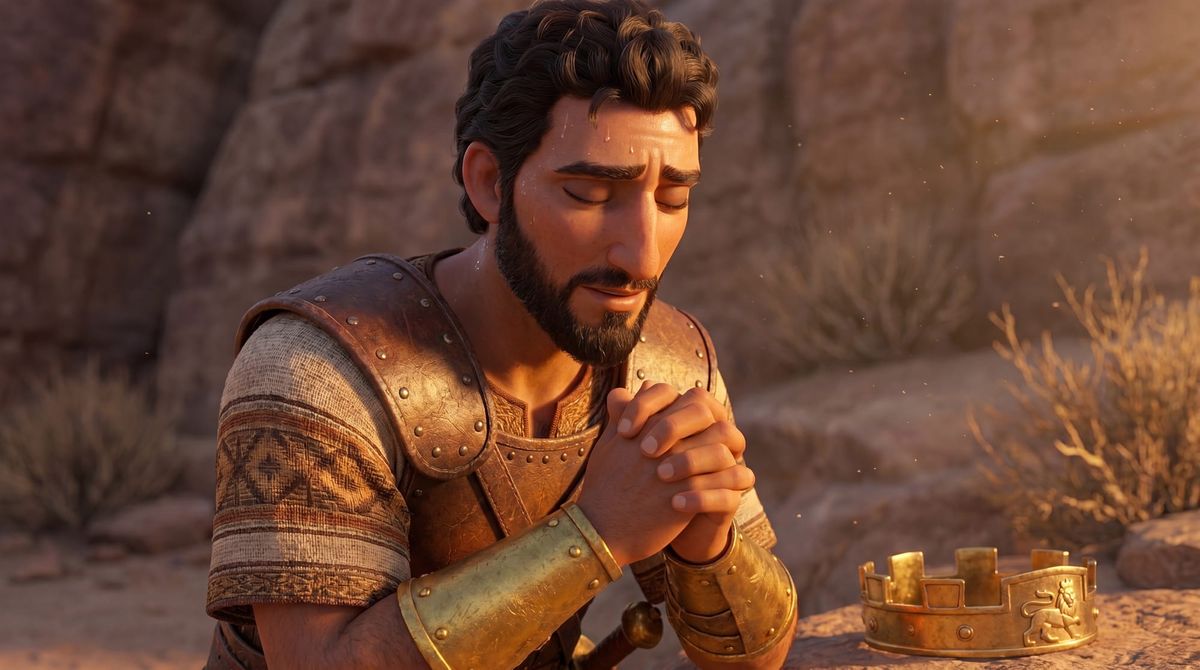
Saul is hunting David with three thousand chosen men. David and his small band are hiding in a cave at En-gedi. Saul walks into that exact cave — alone — to rest. David's men whisper that this is the moment the Lord has delivered his enemy into his hands. David creeps forward in the dark and cuts off the corner of Saul's robe. And then — this is the part that matters — he feels bad about it. "The Lord forbid that I should do this thing unto my master, the Lord's anointed" (1 Samuel 24:6). He holds his men back. He lets Saul walk out.
When Saul is safely away, David calls out to him, holds up the piece of robe, and essentially says: I could have killed you. I didn't. Judge between us. Saul weeps. He acknowledges David is more righteous than he is. Yet, because Saul remains consumed by insecurity, we know this pattern of pursuit will eventually repeat itself.
Chapter 25 shifts the scene entirely, and it introduces one of the most underrated figures in the Old Testament: Abigail. Her husband Nabal (whose name literally means "fool") has just insulted David's messengers and refused to share provisions, even though David's men had been protecting his flocks. David is furious and riding out with four hundred armed men to settle it. Nabal is about to get his household destroyed.
Abigail doesn't wait for permission. She loads up donkeys with bread, wine, sheep, grain, raisins, and figs, rides out to intercept David, and delivers one of the most remarkable speeches in the entire Old Testament — humble, wise, and completely disarming. She takes the blame. She appeals to David's better nature. She essentially tells him: don't let this fool drag you down to his level. Don't let a rash act stain your record before you become king. David stops. He thanks her. He goes home.
The Come, Follow Me lesson draws a direct line between Abigail and Jesus Christ — she intercedes, she absorbs the consequences of someone else's foolishness, she prevents destruction through wisdom and sacrifice. Sister Kristen Yee's conference message on forgiveness uses Abigail as a model of the healing path. That's not a stretch. It's right there in the text.
For your family: These two chapters together are a masterclass in what Elder Mark Bragg called "Christlike poise" — the ability to hold your power in check, to not retaliate when you could, to let the Lord be the judge. That's a hard skill at any age. It's worth naming it out loud with your kids.
The King Who Still Asked
1 Samuel 23; 1 Samuel 30:8; 2 Samuel 2:1; 2 Samuel 5:17-25; 2 Samuel 21:1; D&C 8:2-3; D&C 9:8; Alma 37:37
David is finally king. After years of running, hiding in caves, living among the Philistines, watching Saul spiral, losing Jonathan — after all of it — he is anointed king over all Israel. He captures Jerusalem. He's consolidating power. He has an army, a throne, and a track record of military success that is, frankly, unmatched.
And then the Philistines come back.
Here's what's remarkable: David doesn't assume. He doesn't look at his resume and decide he's got this. Unlike Saul — who repeatedly acted on panicked impulse, tried to save face, and relied on conventional wisdom — David treated the Lord like his true command center. The Hebrew phrase is sha'al b'YHVH: to inquire of the Lord. It appears across David's life not as a one-time spiritual moment but as a practice, a habit, a posture. It is one of the primary reasons scripture describes him as a man after God's own heart.
A Deeper Look: The Nine Inquiries
1 Samuel 23; 30:8; 2 Samuel 2:1; 5:19; 5:23; 21:1
Across 1 and 2 Samuel, there are nine recorded moments where David explicitly stopped to inquire of the Lord before a major decision. The pattern is worth seeing all at once.
#
Situation
The Question
The Lord's Answer
Scripture (LDS KJV)
1
Philistines are looting Keilah
"Shall I go and smite these Philistines?"
Go, and smite the Philistines, and save Keilah.
1 Samuel 23:2
"Therefore David inquired of the Lord, saying, Shall I go and smite these Philistines? And the Lord said unto David, Go, and smite the Philistines, and save Keilah."
2
His own men are terrified of the plan
David inquires again to confirm the plan to his doubting men
Arise, go down to Keilah; for I will deliver the Philistines into thine hand.
1 Samuel 23:4
"Then David inquired of the Lord yet again. And the Lord answered him and said, Arise, go down to Keilah; for I will deliver the Philistines into thine hand."
3
Rumors that Saul is marching to trap him inside Keilah
"Will Saul come down, as thy servant hath heard?"
He will come down.
1 Samuel 23:11
"Will the men of Keilah deliver me up into his hand? will Saul come down, as thy servant hath heard? O Lord God of Israel, I beseech thee, tell thy servant. And the Lord said, He will come down."
4
Will the city he just saved betray him to Saul?
"Will the men of Keilah deliver me and my men into the hand of Saul?"
They will deliver thee up. David and his men slip away immediately.
1 Samuel 23:12
"Then said David, Will the men of Keilah deliver me and my men into the hand of Saul? And the Lord said, They will deliver thee up."
5
Amalekites burn Ziklag — families captured, men talk of stoning him
"Shall I pursue after this troop? shall I overtake them?"
Pursue: for thou shalt surely overtake them, and without fail recover all.
1 Samuel 30:8
"And David inquired at the Lord, saying, Shall I pursue after this troop? shall I overtake them? And he answered him, Pursue: for thou shalt surely overtake them, and without fail recover all."
6
Saul is dead — power vacuum opens
"Shall I go up into any of the cities of Judah?"
Go up unto Hebron. David is anointed king over Judah.
2 Samuel 2:1
"And it came to pass after this, that David inquired of the Lord, saying, Shall I go up into any of the cities of Judah? And the Lord said unto him, Go up. And David said, Whither shall I go up? And he said, Unto Hebron."
7
Philistines deploy the moment David is crowned king over all Israel
"Shall I go up to the Philistines? wilt thou deliver them into mine hand?"
Go up: for I will doubtless deliver the Philistines into thine hand.
2 Samuel 5:19
"And David inquired of the Lord, saying, Shall I go up to the Philistines? wilt thou deliver them into mine hand? And the Lord said unto David, Go up: for I will doubtless deliver the Philistines into thine hand."
8
Same enemy, same valley — Philistines regroup after their first defeat
David asks again — rather than assuming yesterday's answer covers today
Completely different strategy: circle behind them, wait for the sound in the tops of the mulberry trees — then the Lord goes out before thee.
2 Samuel 5:23–24
"And when David inquired of the Lord, he said, Thou shalt not go up; but fetch a compass behind them, and come upon them over against the mulberry trees. And let it be, when thou hearest the sound of a going in the tops of the mulberry trees, that then thou shalt bestir thyself: for then shall the Lord go out before thee, to smite the host of the Philistines."
9
Three-year famine strikes all Israel
David seeks the Lord to understand the spiritual root cause of the drought
It is for Saul, and for his bloody house, because he slew the Gibeonites.
2 Samuel 21:1
"Then there was a famine in the days of David three years, year after year; and David inquired of the Lord. And the Lord answered, It is for Saul, and for his bloody house, because he slew the Gibeonites."
The second Philistine inquiry is the one worth pausing on with your family: David had just won using one strategy. The same enemy is back in the same location. He could have assumed the same playbook would work. He didn't. He asked again — and got a completely different answer. That's not just military wisdom. That's the discipline of a man who understood that yesterday's revelation doesn't cover today's battle.
This is where the Restoration framing is genuinely helpful. We live in a time when personal revelation isn't just available — it's expected. D&C 8:2-3 describes the spirit of revelation as something that comes to the mind and heart. D&C 9:8 talks about studying it out first. David's pattern — stop, ask, listen, act on what you receive — is exactly the pattern the Lord has been teaching His people across every dispensation.
The Come, Follow Me lesson also notes that David's problems with the Philistines didn't end after Goliath. That's worth saying plainly to your kids: beating one giant doesn't mean giants stop showing up. What changes is your relationship with the One who helps you face them.
For your family: The word "inquired" shows up again and again across David's life, and the children's lesson actually has kids fold their arms every time they hear it. That's a good instinct. The word is doing real work. A king who still asks is a king worth learning from.
Dive Deeper: I'm Gonna Inquire
Lyric Scripture Blueprint
Open +
Lyric Highlight
Scripture Bridge
Why It Matters
"(Ooh, yeah!) / (What are we gonna do now?) / (Hold on, let me ask.)"
1 Samuel 23:2 "Therefore David enquired of the Lord, saying, Shall I go and smite these Philistines? And the Lord said unto David, Go, and smite the Philistines."
Alma 37:37 "Counsel with the Lord in all thy doings, and he will direct thee for good; yea, when thou liest down at night lie down unto the Lord, that he may watch over you in your sleep; and when thou risest in the morning let thy heart be full of thanks unto God."
D&C 9:8 "But, behold, I say unto you, that you must study it out in your mind; then you must ask me if it be right."
Pause Before You Move: The intro captures the entire doctrinal posture of the song in three short lines. The instinct to stop and ask before acting is not timidity — it is the pattern David modeled repeatedly in 1 Samuel 23, and the pattern the Lord explicitly commanded in D&C 9. Alma 37:37 frames this as a daily, ongoing orientation of the heart, not just a crisis response. For families: post the phrase 'Hold on, let me ask' somewhere visible this week as a household motto for decision-making.
"David is the king, he's wearing the crown / But the Philistine army is coming to town. / They're spreading through the valley, ready for a fight / Looking for a battle in the middle of the night."
2 Samuel 5:17–18 "But when the Philistines heard that they had anointed David king over Israel, all the Philistines came up to seek David; and David heard of it, and went down to the hold. The Philistines also came and spread themselves in the valley of Rephaim."
1 Samuel 17:1 "Now the Philistines gathered together their armies to battle, and were gathered together at Shochoh, which belongeth to Judah, and pitched between Shochoh and Azekah, in Ephesdammim."
2 Nephi 2:11 "For it must needs be, that there is an opposition in all things."
Opposition Is Guaranteed: The song opens by grounding us in the historical reality of 2 Samuel 5 — David is newly crowned and the Philistines immediately mobilize. This is not coincidence; it is the pattern of opposition that follows covenant advancement. Lehi's teaching in 2 Nephi 2:11 confirms that opposition is structural to mortal life, not a sign that something has gone wrong. For families: talk about how new responsibilities — a new school year, a new calling, a new commitment — often bring new challenges, and that this is normal and expected.
"Now David has an army, David has a sword / But he doesn't make a move 'til he talks to the Lord!"
2 Samuel 5:19 "And David enquired of the Lord, saying, Shall I go up to the Philistines? wilt thou deliver them into mine hand? And the Lord said unto David, Go up: for I will doubtless deliver the Philistines into thine hand."
D&C 30:2 "Behold, I say unto you, David, that you have feared man and have not relied on me for strength as you ought."
Proverbs 3:5–6 "Trust in the Lord with all thine heart; and lean not unto thine own understanding. In all thy ways acknowledge him, and he shall direct thy paths."
1 Nephi 3:7 "And it came to pass that I, Nephi, said unto my father: I will go and do the things which the Lord hath commanded, for I know that the Lord giveth no commandments unto the children of men, save he shall prepare a way for them to accomplish the thing which he commandeth them."
Resources Are Not the Point: David had military resources — an army, a sword, a crown — and still stopped to inquire. This is the song's central doctrinal punch: capability does not replace revelation. Proverbs 3 and D&C 30 both warn against leaning on our own strength. Nephi's pattern in 1 Nephi 3:7 mirrors David's exactly — move only after the Lord has spoken. For families: ask your kids, 'When do you feel like you already know the answer and don't need to pray about it?' That feeling is exactly when inquiry matters most.
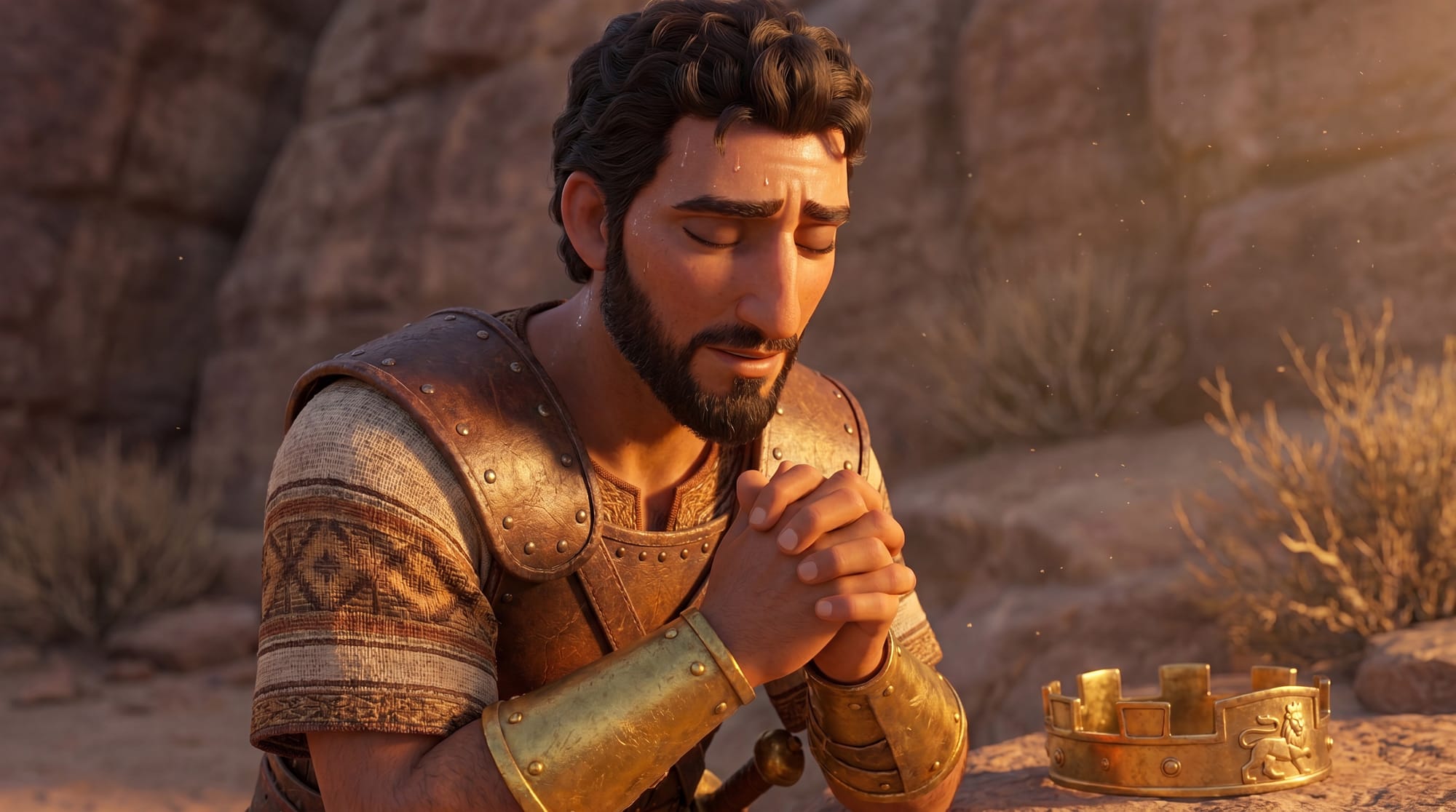
"He could've rushed in, he could've been proud / He could've just shouted to the rest of the crowd. / But he stopped in his tracks, got down on his knees / Saying, 'Heavenly Father, can You answer me please?'"
2 Samuel 5:19 "And David enquired of the Lord, saying, Shall I go up to the Philistines?"
Alma 34:26 "But this is not all; ye must pour out your souls in your closets, and your secret places, and in your wilderness."
Matthew 6:6 "But thou, when thou prayest, enter into thy closet, and when thou hast shut thy door, pray to thy Father which is in secret; and thy Father which seeth in secret shall reward thee openly."
Helaman 3:35 "Nevertheless they did fast and pray oft, and did wax stronger and stronger in their humility, and firmer and firmer in the faith of Christ, unto the filling their souls with joy and consolation."
Humility Over Momentum: The pre-chorus highlights the road not taken — pride, noise, crowd energy. David chose the opposite: stillness, kneeling, private petition. Matthew 6:6 and Alma 34:26 both locate genuine prayer in the private, unhurried place. Helaman 3:35 shows the long-term fruit of that pattern: souls that grow stronger through consistent humble prayer, not occasional crisis prayer. For families: practice the physical posture this week — fold arms, bow head, go quiet — and talk about how the body posture of prayer can help the heart follow.
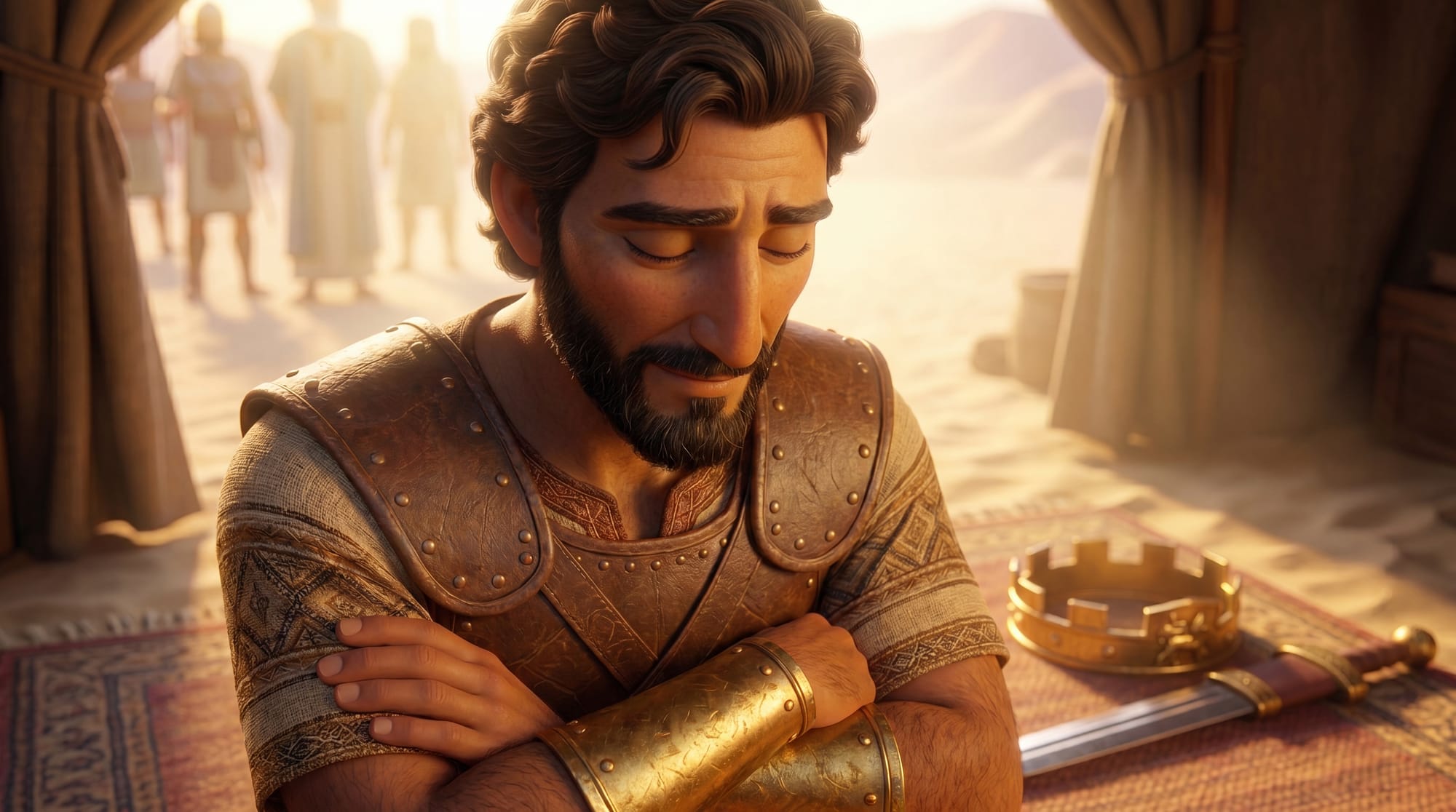
"Before I take a step, before I light the fire... / I'm gonna fold my arms and I'm gonna INQUIRE! / Should I go left? Should I go right? / Should I go stepping out into the night? / I don't wanna guess and I don't wanna assume / I need a little revelation filling the room!"
2 Samuel 5:19 "And David enquired of the Lord, saying, Shall I go up to the Philistines? wilt thou deliver them into mine hand?"
D&C 9:8–9 "But, behold, I say unto you, that you must study it out in your mind; then you must ask me if it be right, and if it is right I will cause that your bosom shall burn within you; therefore, you shall feel that it is right. But if it be not right you shall have no such feelings, but you shall have a stupor of thought."
James 1:5 "If any of you lack wisdom, let him ask of God, that giveth to all men liberally, and upbraideth not; and it shall be given him."
Moroni 10:4 "And when ye shall receive these things, I ask that ye would ask God, the Eternal Father, in the name of Christ, if these things are not true; and if ye shall ask with a sincere heart, with real intent, having faith in Christ, he will manifest the truth of it unto you, by the power of the Holy Ghost."
Revelation Is Available to Everyone: The chorus is a declaration of personal revelation as a lived practice, not a rare event. James 1:5 — the verse that launched the Restoration — promises that God gives wisdom liberally to anyone who asks. D&C 9 gives the mechanics: study, ask, feel. Moroni 10:4 extends the same promise to every sincere seeker. The chorus is not just a catchy hook; it is a child-accessible summary of the Restoration's most radical claim — that heaven answers. For families: let each family member name one real decision they are facing and practice the chorus posture together: fold arms, ask, listen.
"The Lord said, 'Go, I will give 'em to your hand.' / So David went down and he rescued the land. / But a few days later, they were coming back again! / Bringing all the chariots and all the strong men."
2 Samuel 5:19–20 "And the Lord said unto David, Go up: for I will doubtless deliver the Philistines into thine hand. And David came to Baal-perazim, and David smote them there."
2 Samuel 5:22 "And the Philistines came up yet again, and spread themselves in the valley of Rephaim."
Alma 26:27 "Now when our hearts were depressed, and we were about to turn back, behold, the Lord comforted us, and said: Go amongst thy brethren, the Lamanites, and bear with patience thine afflictions, and I will give unto you success."
Victory Does Not End the Battle: Verse 2 introduces one of the most important and underappreciated details in 2 Samuel 5 — the Philistines came back. Winning one battle does not retire the war. Ammon's testimony in Alma 26 reflects the same pattern: discouragement returns, the enemy regrouped, and the Lord's answer was to keep going. For families: this is a powerful conversation starter about spiritual resilience — ask your kids, 'Have you ever felt like you already beat something and then it came back?' That is a normal part of the covenant journey, not a failure.
"David didn't rely on the victory of the past / He knew that he needed to go back and ask!"
2 Samuel 5:23 "And when David enquired of the Lord, he said, Thou shalt not go up; but fetch a compass behind them, and come upon them over against the mulberry trees."
D&C 46:7 "But ye are commanded in all things to ask of God, who giveth liberally; and that which the Spirit testifies unto you even so I would that ye should do in all holiness of heart."
2 Nephi 32:8–9 "For if ye would hearken unto the Spirit which teacheth a man to pray, ye would know that ye must pray; for the evil spirit teacheth not a man to pray, but teacheth him that he must not pray. But behold, I say unto you that ye must pray always, and not faint."
Alma 37:37 "Counsel with the Lord in all thy doings, and he will direct thee for good."
Past Revelation Does Not Replace Present Inquiry: This is the doctrinal crown jewel of the entire song. David had a confirmed answer from God — and he still went back to ask again when circumstances changed. Crucially, the Lord gave a different answer the second time (2 Samuel 5:23 — a flanking maneuver, not a frontal assault). D&C 46:7 and 2 Nephi 32:8–9 both frame ongoing prayer as a commandment, not a suggestion. Alma 37:37 makes it a daily posture. For families: talk about how 'I already prayed about this' can become a trap — the Lord's guidance is fresh and specific, not a one-time download.
"He could've rushed in, he could've been proud / He could've just shouted to the rest of the crowd. / But he stopped in his tracks, got down on his knees / Saying, 'Heavenly Father, can You answer me please?'"
2 Samuel 5:23 "And when David enquired of the Lord, he said, Thou shalt not go up."
D&C 112:10 "Be thou humble; and the Lord thy God shall lead thee by the hand, and give thee answer to thy prayers."
Ether 2:23 "And the Lord said unto the brother of Jared: What will ye that I should do that ye may have light in your vessels?"
Philippians 4:6 "Be careful for nothing; but in every thing by prayer and supplication with thanksgiving let your requests be made known unto God."
Humility Repeated Is Humility Deepened: The pre-chorus returns here with added weight — David is not inquiring for the first time out of uncertainty; he is inquiring for the second time out of disciplined humility. D&C 112:10 promises that the Lord leads by the hand those who remain humble. The brother of Jared in Ether 2 models the same pattern: he brought his problem to the Lord and waited for direction rather than assuming his previous experience was sufficient. For families: the repetition of this pre-chorus in the song is itself a teaching tool — ask your kids why they think the songwriter repeated it.
"When you need a little help... (Inquire!) / When you're feeling kind of lost... (Inquire!) / No matter what it takes, no matter the cost. / He is listening to you, He is ready to speak! / He gives a lot of power to the humble and meek!"
Matthew 5:5 "Blessed are the meek: for they shall inherit the earth."
D&C 136:32–33 "Let him that is ignorant learn wisdom by humbling himself and calling upon the Lord his God, that his eyes may be opened that he may see, and his ears opened that he may hear; For my Spirit is sent forth into the world to enlighten the humble and contrite."
Moroni 7:26 "And after that he came men also were saved by faith in his name; and by faith, they become the sons of God. And as surely as Christ liveth he spake these words unto our fathers, saying: Whatsoever thing ye shall ask the Father in my name, which is good, in faith believing that ye shall receive, behold, it shall be done unto you."
1 Samuel 17:47 "And all this assembly shall know that the Lord saveth not with sword and spear: for the battle is the Lord's, and he will give you into our hands."
Power Flows to the Humble: The bridge makes the theological claim explicit — God does not give power to the strongest or the loudest; He gives it to the humble and meek. Matthew 5:5 and D&C 136:32–33 both confirm that the Spirit is specifically sent to enlighten the contrite. David's own declaration in 1 Samuel 17:47 — 'the battle is the Lord's' — is the original source of the week's theme and lands here as the bridge's doctrinal anchor. Moroni 7:26 extends the promise to every generation: ask in faith, and it shall be done. For families: ask each person to share a time they felt weak or lost and then felt helped — that is the bridge lived out.
"Before I take a step, before I light the fire... / I'm gonna fold my arms and I'm gonna INQUIRE! / Should I go left? Should I go right? / Should I go stepping out into the night? / I don't wanna guess and I don't wanna assume / I need a little revelation filling the room! / So before I take a step, before I light the fire... / I'm gonna fold my arms and I'm gonna INQUIRE!"
2 Samuel 5:19 "And David enquired of the Lord, saying, Shall I go up to the Philistines?"
D&C 8:2–3 "Yea, behold, I will tell you in your mind and in your heart, by the Holy Ghost, which shall come upon you and which shall dwell in your heart. Now, behold, this is the spirit of revelation; behold, this is the spirit by which Moses brought the children of Israel through the Red Sea on dry ground."
James 1:5 "If any of you lack wisdom, let him ask of God, that giveth to all men liberally, and upbraideth not; and it shall be given him."
3 Nephi 14:7–8 "Ask, and it shall be given unto you; seek, and ye shall find; knock, and it shall be opened unto you. For every one that asketh, receiveth; and he that seeketh, findeth; and to him that knocketh, it shall be opened."
The Closing Declaration: The final chorus lands as a personal covenant statement, not just a catchy repeat. D&C 8:2–3 defines revelation as something that comes to the mind and heart — it is intimate, personal, and available. The Savior's own words in 3 Nephi 14 — the Book of Mormon version of the Sermon on the Mount — promise that asking, seeking, and knocking are never wasted. The song ends with the chorus rather than a resolution, which is theologically perfect: inquiry is not a one-time event but an ongoing posture. For families: close your family night by having everyone fold their arms and silently ask one question of Heavenly Father — then talk about what it felt like to pause and listen.
2 Samuel 7:1-3, 7:11-16; Matthew 1:1; Luke 1:32-33; John 18:33-37; Revelation 19:16; 2 Nephi 10:14; Psalm 89:3-4
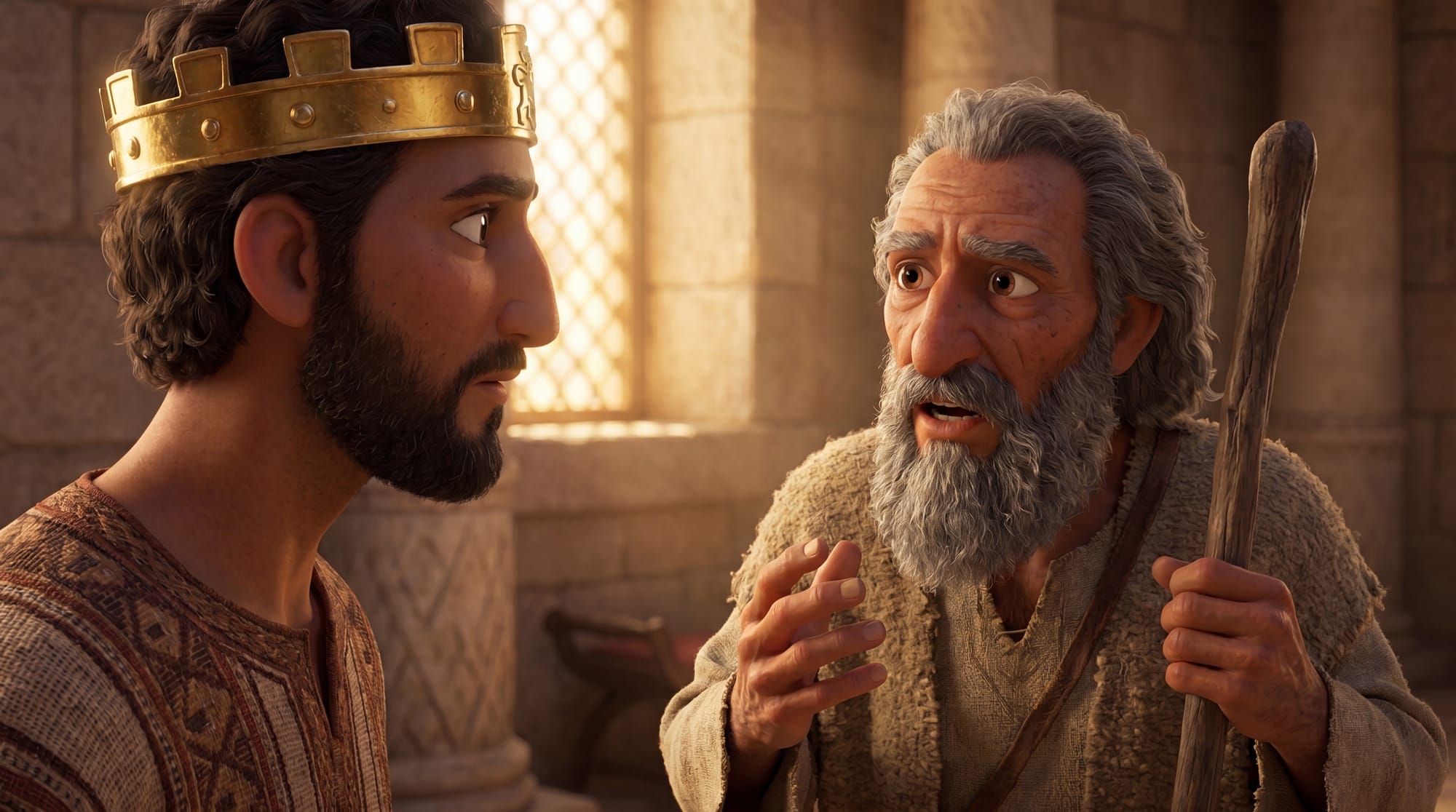
David has settled into his palace in Jerusalem, the wars are quieting down, and he has a thought: it doesn't feel right that he lives in a house of cedar while the ark of the covenant sits in a tent. He wants to build a temple. He tells the prophet Nathan, and Nathan's initial reaction is essentially, "Sounds great, go for it." But that night the Lord corrects Nathan and sends him back to David with a different message.
The Lord's response is one of the most layered passages in the Old Testament. He doesn't say the temple is a bad idea — He says David's son will build it (2 Samuel 7:12-13). But then the Lord pivots and makes David a promise that reframes the entire conversation: you wanted to build Me a house? I'm going to build you one. Not a building — a dynasty. A lineage. A throne that will endure forever (2 Samuel 7:16).
The Come, Follow Me lesson is careful to trace where that promise lands: in Jesus Christ. Matthew 1:1 opens the New Testament by identifying Jesus as "the son of David." Luke 1:32-33 has the angel Gabriel telling Mary that the Lord God will give her son "the throne of his father David: and he shall reign over the house of Jacob for ever; and of his kingdom there shall be no end." John 18:33-37 has Pilate asking Jesus directly, "Art thou the King of the Jews?" — and Jesus doesn't deny it. He reframes it.
Every earthly king in these chapters — Saul, David, the kings to come — is a partial, flawed sketch of something the world was waiting for. The kings of Israel couldn't save themselves, let alone their people. But the promise made to David in 2 Samuel 7 was pointing forward to a King who would be different in kind, not just degree. A King whose kingdom wouldn't end because He conquered the one enemy no earthly army ever has.
Revelation 19:16 calls Him "King of Kings and Lord of Lords." That title has roots in this chapter.
For your family: The Old Testament kings are a great teaching tool precisely because they're so human — brilliant and broken, faithful and foolish, sometimes in the same chapter. They show us what we need. And then the New Testament, the Book of Mormon, and the Restoration show us who actually fills that need. That's the whole arc.
The Rest of the Story: The Hill of Gilboa — and the Boy at the Table
1 Samuel 31; 2 Samuel 1; 2 Samuel 9
The curriculum moves from David becoming king straight into his reign, but it skips the moment that made it possible — and the grief that came with it. After roughly a decade of exile, hiding in caves, living as a fugitive while Saul hunted him with armies, David wasn't there when it ended. Saul and his sons, including Jonathan, died fighting the Philistines on Mount Gilboa. When David heard the news, he didn't celebrate. He tore his clothes, fasted, and wept. Then he composed a lament — one of the most beautiful pieces of poetry in the entire Old Testament — and in it he wrote: "I am distressed for thee, my brother Jonathan: very pleasant hast thou been unto me" (2 Samuel 1:26).
But the story doesn't end on the hill. Years later, after David was established as king, he asked a question almost nobody in his position would think to ask: "Is there yet any that is left of the house of Saul, that I may shew him kindness for Jonathan's sake?" (2 Samuel 9:1). He was told about Mephibosheth — Jonathan's son, disabled in both feet from a childhood fall, living in obscurity. David sent for him, restored all of Saul's lands to him, and insisted he eat at the king's table for the rest of his life — as one of the king's own sons. The friendship that began with a robe and a covenant didn't end on a battlefield. David carried it forward into the next generation.
🛡️ The Tragedy of the Fractured Shield: What Cost Saul the Battle? When you look at the tragic scene on Mount Gilboa, it's worth asking a hard strategic question: Did it have to end this way? For over a decade, David had been quietly building an elite special operations force — ambidextrous warriors, shield-bearing commandos, and captains of thousands who were secretly defecting to him because of Saul's erratic behavior (1 Chronicles 12). His original band of 600 elite fighters had grown into what the Chronicles describes as "a great host, like the host of God." In the days leading up to Gilboa, David and his men were marching with the Philistine army because Saul had driven them into exile. The Philistine generals panicked and sent David away, terrified that the moment the fighting started, David would turn on them to reconcile with Saul.
🏠 Modern-Day Application The ultimate irony of Saul's life is that the very man he spent years trying to destroy was the exact commander who had the tactical genius to save his life and protect his son Jonathan on the battlefield. Saul didn't lose on Mount Gilboa because the Philistines were too strong; he lost because his own jealousy had systematically dismantled his nation's defense network. For our families today, the warning is clear: Unresolved jealousy and internal friction will always compromise our armor. When we allow contention to drive wedges between the people God has sent to walk with us, we leave ourselves fighting life's heaviest battles completely isolated.
 Shout for Joy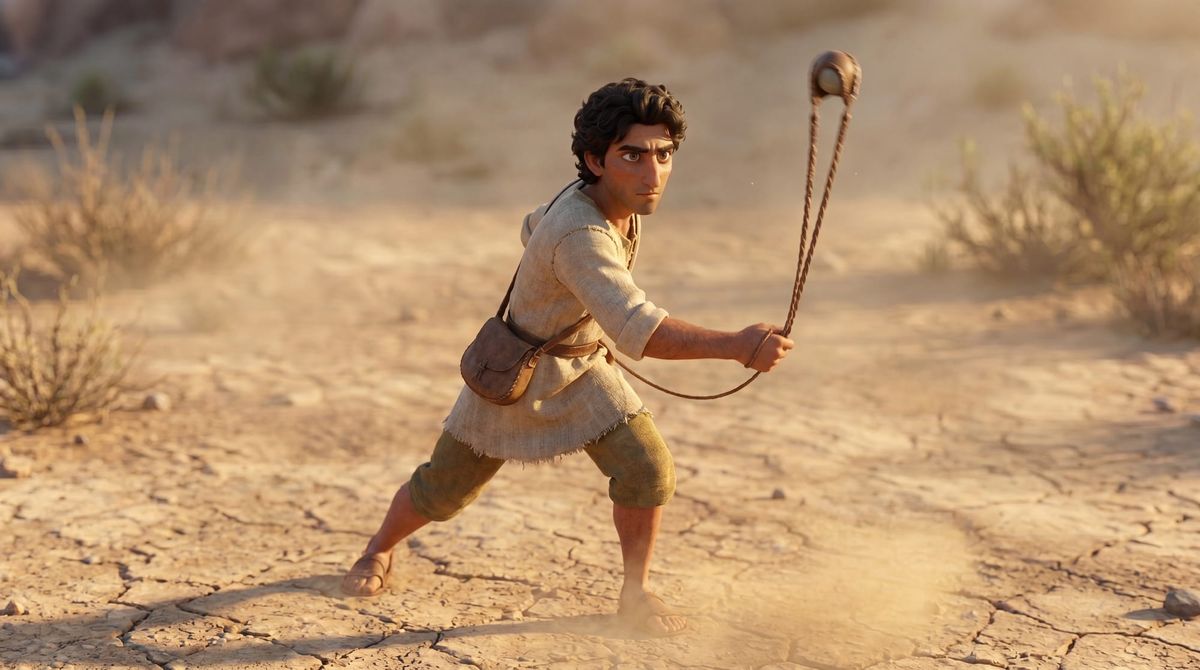

 Shout for Joy

 Shout for Joy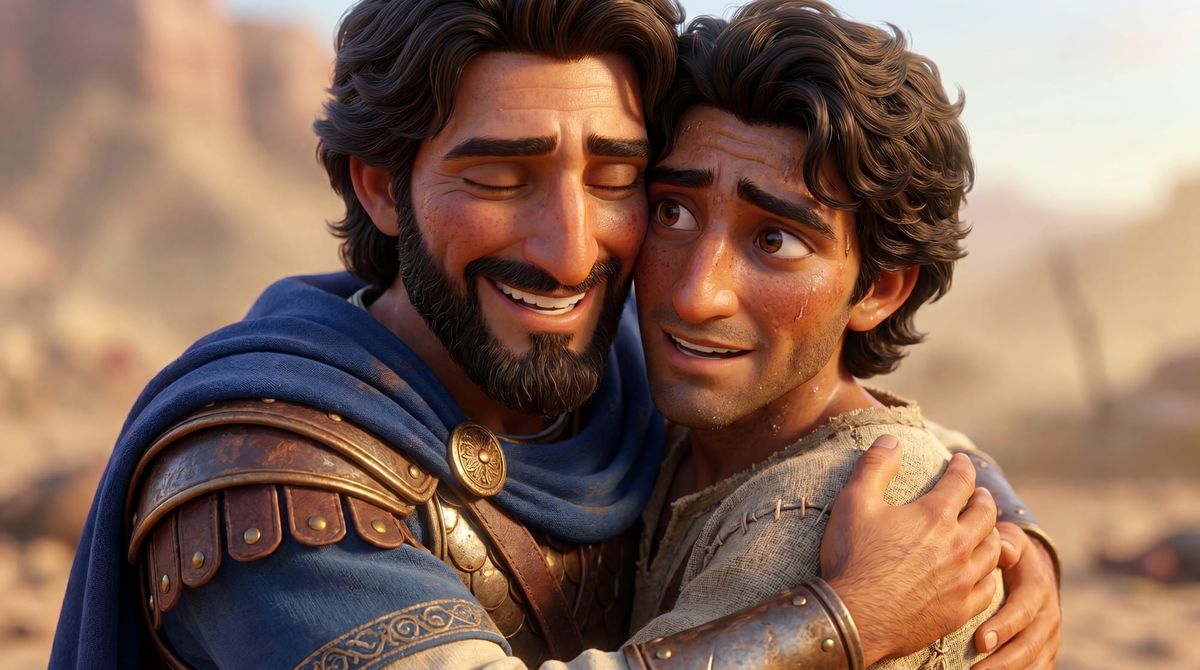
 Shout for Joy