July 13–19: "He Trusted in the Lord God of Israel" (2 Kings 16–25)
When the enemy was at the gate, Hezekiah didn't fight back — he spread the problem before the Lord. When the scriptures were rediscovered, Josiah didn't just read them — he walked. This week, your family learns what it looks like to trust God with everything and then move.
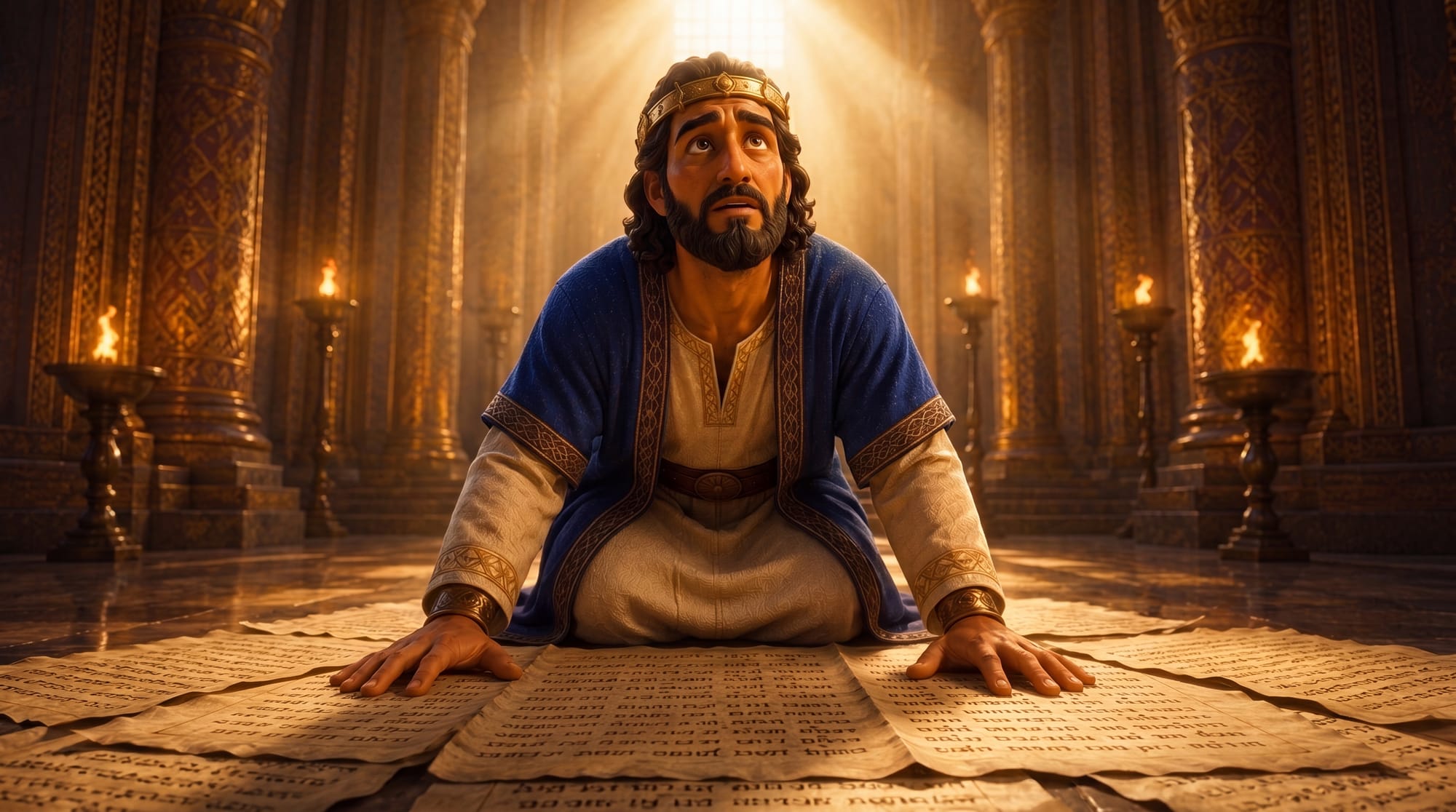
Spread It Out Before the Throne
He went into the temple where the world is quiet and still,
And laid it on the floor to seek the Father's will.
Spread it out, spread it out before the Lord,
He's the shield and the spirit and the double-edged sword.
Just spread it out before the throne.
When the Assyrian army was at the gate and the taunts were getting louder, Hezekiah didn't strategize or panic — he walked into the temple and laid his problem before God. That one move changed everything.
Set the Stage: The Letter at the Altar
The letter arrived like a punch to the gut. Sennacherib, king of Assyria — the most terrifying military force on earth — had already swallowed up nation after nation. Now he was outside Jerusalem's walls, and his messengers were shouting in plain Hebrew so every soldier on the ramparts could hear: 'Don't let your God fool you. No god has ever stopped us. What makes you think yours will?' It was psychological warfare at its finest, and it was working. Inside the city, people were terrified. Hezekiah had every reason to negotiate, surrender, or despair. Instead, he did something that looked almost foolish from the outside. He took that letter — every threatening word of it — walked into the temple, and spread it out on the floor before the Lord. No grand speech. No military strategy. Just a king on his knees, laying his worst problem at the feet of the only One who could actually do something about it. What happened next is one of the most stunning reversals in all of scripture.
The Big Idea: Lay It Down, Then Walk the Line
This week's scripture gives us two kings, two moments, and one consistent message: the Lord can be trusted with everything — your fears, your failures, your family, your future. Hezekiah shows us what to do when the pressure is external. The enemy is loud, the odds are terrible, and the anxiety is real. His answer? Don't fight the letter. Spread it out. 'Spread It Out' captures that moment with a kind of holy simplicity — you don't have to carry the weight on your own. You just have to bring it to the right place.
Josiah shows us the other side of the same coin. His pressure was internal — a kingdom that had drifted so far from the Lord that the scriptures had literally been lost in the temple. When they were rediscovered, Josiah didn't just read them and nod. He wept, he repented, and then he walked. 'The Covenant Line' is that walk — steady, deliberate, not turning left or right, one foot in front of the other in the direction of the Savior.
For your family this week, the invitation is both: bring your hard things to the Lord like Hezekiah, and then walk faithfully forward like Josiah. The covenant isn't a one-time event — it's a daily direction. And the good news is that the Lord who answered Hezekiah's prayer and honored Josiah's covenant is the same Lord who is listening and walking with your family right now.

Scripture Bridge
Lyric Highlight
When the world sends a letter trying to make you afraid,
Remember all the promises the Savior has made.
You don't have to carry the weight on your own —
Just spread it out before the throne.
Reflect: What's one thing your family is carrying right now that you could literally or symbolically 'spread out before the Lord' this week?
Family Activity
Try This: Write a fake 'threatening letter' on a piece of paper (something silly like 'You must eat broccoli forever or else!'). One person plays the Assyrian messenger and chases the others around the room trying to hand them the letter. If you get tagged with the letter, you have to freeze — UNLESS someone else runs to you, grabs the letter out of your hand, and shouts 'Spread it out!' Then you both run to a designated 'temple spot' (a couch, a rug, anywhere cozy) and lay the letter on the floor together. Keep going until everyone has made it to the temple spot at least once.
Reflect: Hezekiah didn't panic and he didn't fight back with words — he literally walked to the temple and laid the problem down. What's one thing your family is carrying right now that you could 'spread out before the Lord' this week?
2 Kings 19:14
Watch & Listen
Spread It Out
Hezekiah read it. And then he did something that has no military or political precedent: he walked to the temple, spread the letter out on the floor in front of the ark of the covenant, and prayed. Not a polished, composed prayer — a raw one. 'Lord, bow down thine ear and hear. Open, Lord, thine eyes and see.' He named the threat specifically. He didn't dress it up or minimize it. He just laid it before God and said, in effect, You see this. I need You to handle it. By the next morning, 185,000 Assyrian soldiers were dead. Sennacherib retreated and was later killed by his own sons. Jerusalem never fell.
Spread It Out takes that single, extraordinary moment — a king on his knees with an enemy's letter on the temple floor — and turns it into a practice for the rest of us. The song walks through the fear honestly: the army at the gate, the doubt that climbs, the shadows that whisper you're running out of time. It doesn't skip the hard part. But it keeps pointing back to the same answer Hezekiah found: you don't have to carry it. You just have to know where to take it.
Every family has a letter on the floor right now. This song is permission to spread it out before the Lord.
👀 Did You Notice?
At the beginning of the video, the man praying is King Hezekiah, wearing sackcloth to symbolize humility and complete dependence upon the Lord during a national crisis. He also sends his servants—also clothed in sackcloth—to seek counsel from the prophet Isaiah, the white-haired prophet who appears several times throughout the video.
After Isaiah delivers the Lord’s message of hope, Hezekiah returns to the temple with the threatening letter from the king of Assyria and spreads it out before the Lord. That quiet, deeply personal moment of prayer is the heart of this entire story—and the inspiration behind this song.
Later that night, the Lord miraculously delivers Jerusalem without Hezekiah ever having to fight the battle himself, reminding us that God is able to accomplish what we cannot when we place our trust in Him.
Want the full story? Read the complete Fireside Moment or explore the Lyric-Scripture Blueprint in our Joy Tier Deep Dive.
Lyric–Scripture Blueprint (Preview)
Did you know these lyrics come straight from the scriptures?
Explore the full Lyric–Scripture Blueprints and deeper activities in the Joy Tier.
 Bob LeBaron
The Covenant Line
What Josiah did with it is one of the Old Testament's most quietly stunning stories. He didn't wait until things were easier or until the culture caught up with him. At sixteen he started seeking the Lord. At twenty he started tearing down the idols — personally, city by city. At twenty-six, when workers repairing the temple found a lost copy of the law of Moses and read it aloud, Josiah wept. Then he gathered every person in Judah and renewed the covenant publicly. The scriptures record that no king before or after him turned to the Lord so completely, with all his heart and soul and might.
The Covenant Line takes that story and turns it into a daily practice. The chorus isn't a highlight reel — it's a compass. Don't turn left, don't turn right, keep the Savior in your line of sight. One foot in front of the other. That's it. That's the whole strategy, and it's the same one that kept a young king walking straight through decades of cultural pressure.
For your family this week, the song is a reminder that covenant living isn't a single dramatic moment — it's a direction you choose every morning. Josiah chose it young. So can your kids.
Want the full story? Read the complete Fireside Moment or explore the Lyric-Scripture Blueprint in our Joy Tier Deep Dive.
 Bob LeBaron
Miss last week?
Every lesson stands on its own — but together, they tell one continuous story.
 Bob LeBaron
Don’t Stop the Music
The Joy Tier starts right here. Go deeper into this week’s scripture story and explore the meaning behind the songs.
Inside Joy you’ll find:
- A weekly Fireside Moment overview of the Come, Follow Me lesson
- Expanded Set the Stage teaching guides for every song
- Choose Your Adventure family activities and simple weekly habits
- Lyric–Scripture Blueprints, printable coloring pages, and lyric sheets
- Cinematic reflection videos designed for quiet viewing and discussion
Access Joy below to turn this week’s song into a weeklong experience of scripture, music, and family conversation.