July 20–26: "Our Eyes Are upon Thee" (2 Chronicles 14–20; 26; 30)
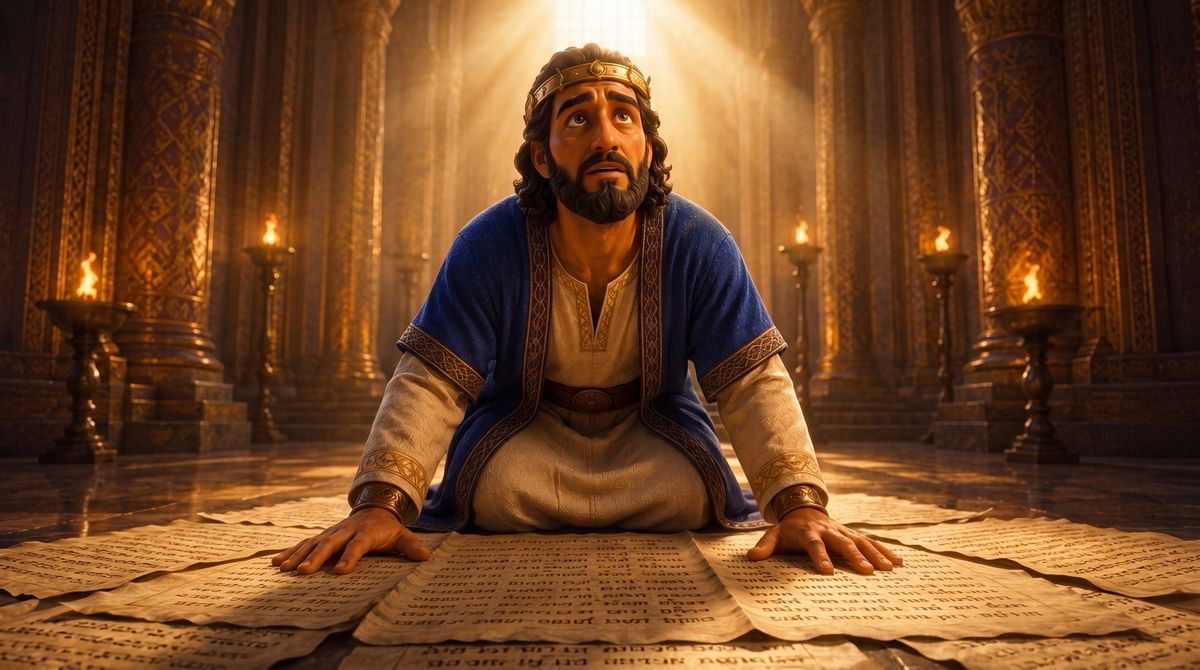
When three armies surrounded Jerusalem, King Jehoshaphat's only strategy was an honest prayer — and it was enough. This week's songs and scriptures ask your family the same question: what does it look like to keep your eyes on God when the problem is bigger than your plan?
Your Game Plan for This Week
There's a moment most of us know — when the problem in front of you is genuinely bigger than anything you can solve on your own. The job loss, the diagnosis, the relationship that's fracturing, the kid who's drifting. That's exactly where Jehoshaphat stood, and his response is the whole lesson this week: stop trying to out-strategize the impossible and start fixing your eyes on the One who isn't limited by it. Eyes on You captures that moment with a kind of raw honesty that feels less like a worship song and more like a dispatch from the front lines — "I ain't got a sword that can match what they're gonna bring." That's not defeat talking. That's faith clearing its throat.
For families, this is an invitation to build a shared vocabulary around surrender — the good kind. Not giving up, but giving over. When your household faces something hard, what does it look like to gather, pray honestly, and then move forward before you can see the outcome? Jehoshaphat sent the singers first. Praise before the victory is the posture that invites it.
15-Minute Family Home Evening
Monday night — your launch for the week. Read together, then move.
-
Press play — watch or listen together while everyone gathers:3 min
🎵 Listen for: "The battle ain't mine, it's the battle that You do — I keep my eyes on You."
Dive Deeper: Eyes on You -
Read this story together — take turns by sentence, or one person reads aloud:2 minThree nations marched on Jerusalem at once, and King Jehoshaphat had no army big enough to stop any one of them, let alone all three. So he didn't try. He called the whole nation to the temple and prayed out loud, in front of everyone: "We have no power. We don't know what to do. But our eyes are on You." The Lord's answer came through a singer, not a general — "the battle is not yours, but God's." The next morning, Jehoshaphat sent the choir out ahead of the army. By the time they reached the valley, the three enemy nations had already turned on each other. Judah never swung a sword.2 Chronicles 20:12 "O our God, wilt thou not judge them? for we have no might against this great company that cometh against us; neither know we what to do: but our eyes are upon thee."
-
Read the Big Idea together:1 minBig Idea Jehoshaphat didn't win the battle — he didn't even fight it. He just told God the truth: no power, no plan, but eyes fixed on Him. The battle was never his to win. It was his to trust.
-
Do this activity together:6 minEyes Up Freeze Tag Play a quick round of freeze tag in your living room or backyard — but with a twist. Whoever is "it" can only unfreeze frozen players by making eye contact and saying "Eyes on You!" Frozen players must keep their eyes lifted upward (toward the ceiling or sky) until someone comes to free them. Play for 5 minutes, then gather everyone together.
-
Ask this question — go around and let every person answer:3 minAsk Your Family "When you were frozen and waiting, what did it feel like to keep your eyes up instead of looking around in a panic? Jehoshaphat's whole army was 'frozen' by fear — surrounded with no plan. What changed when they stopped looking at the problem and started looking at God instead?"
20-Minute Primary / Sunday School
Lead with All Me — Uzziah's story is this week's clearest classroom anchor.
-
Press play as class arrives — no intro needed, just let it run:3 min
🎵 Listen for: "I said it was all me — the kingdom and the victory, the strength I could see. Forgot to say a name that I should've put on every page."
Dive Deeper: All Me -
Ask this to open. Take 2–3 responses, then move on.3 minOpening Question "Has anyone ever worked really hard for something, won it, and then forgot to thank the people who actually helped you get there?"
-
Read this to the class:2 minUzziah became king at sixteen and turned out to be one of the best builders Judah ever had — towers, wells, a massive army, even early war machines. His fame spread all the way to Egypt. Then comes the verse that changes everything: he was strong, and his heart was lifted up to his own destruction. He walked into the temple and tried to burn incense on the altar — a job that belonged only to the priests. When eighty priests stood in front of him and told him to stop, he got angry instead of listening. In the middle of his rage, leprosy broke out on his forehead, and he spent the rest of his life cut off from the temple he'd tried to take over.2 Chronicles 26:16, 18 "But when he was strong, his heart was lifted up to his destruction: for he transgressed against the Lord his God, and went into the temple of the Lord to burn incense upon the altar of incense. ... It appertaineth not unto thee, Uzziah, to burn incense unto the Lord."
-
Ask this. Give the class a moment before taking responses.2 minPivot Question "Why do you think Uzziah got angry instead of listening to the priests?"
-
Keep the discussion going with this follow-up:5 minFollow-Up "Uzziah wasn't a bad king for most of his life — he was a genuinely great one. So what actually went wrong? What's the difference between having success and staying humble about it?"
-
Liken it unto yourself. Hand each student a slip of paper to write their answer and take home:4 minLiken Unto Yourself "When something goes really well for you — a win at school, a skill you've developed, a moment you're proud of — what's your first instinct: to feel good about yourself, or to feel grateful to God? What would it look like to do both at the same time?"
-
1 minClose With This "Every gift we have was given to us. The moment we forget that is the moment the fall begins — but the moment we remember it, out loud, is the moment we're safe."
Week Schedule
You don't have to do all six — pick what fits. Monday launches, Sunday caps. Tap any day to collapse or reopen it.
This Week's Fireside Moment
The full story behind the songs, in one sitting.
Watch & Listen
Eyes on You
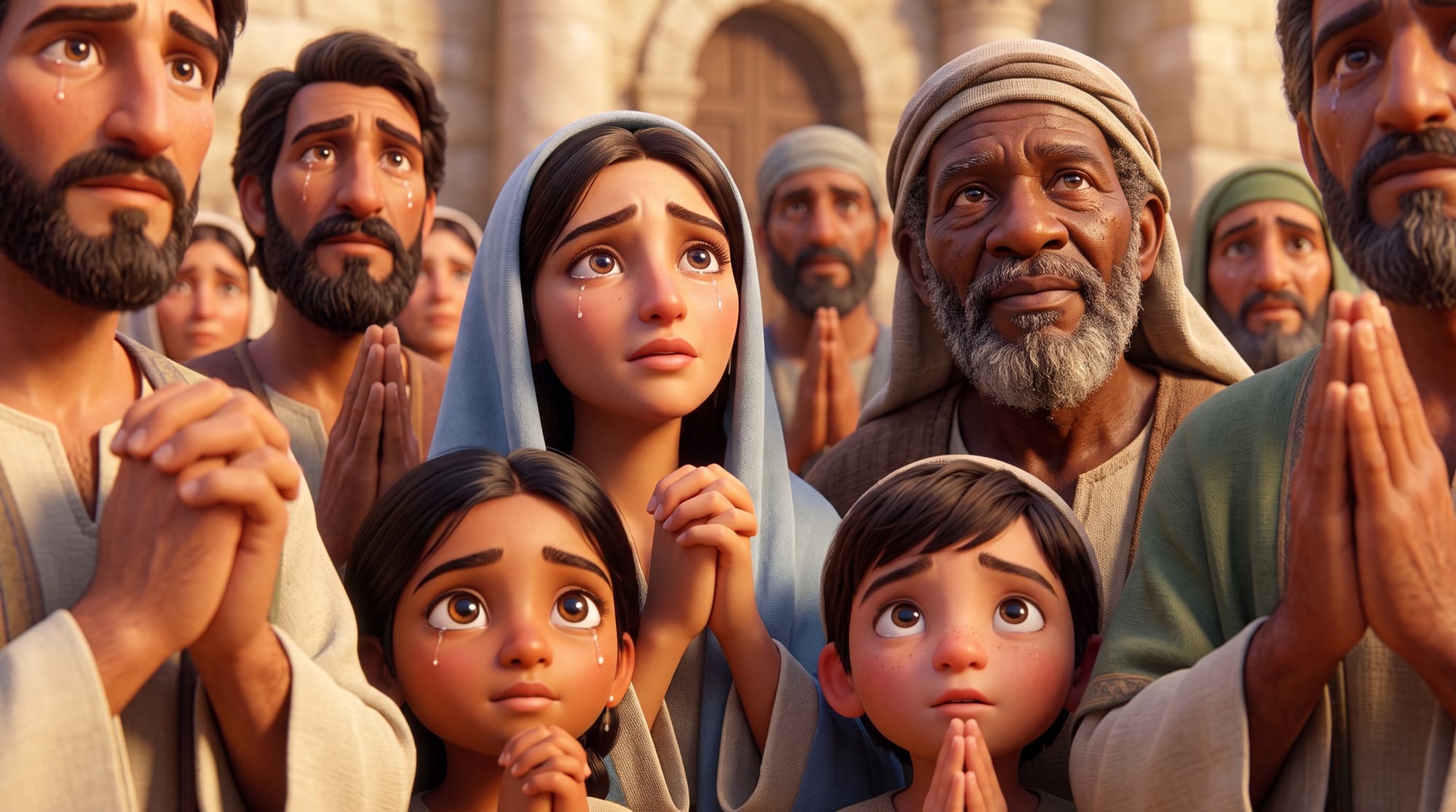
Not one enemy. Three. The Moabites, the Ammonites, and the Edomites (songs of Mount Seir) had formed a coalition, and they were already marching. King Jehoshaphat received the intelligence report and, by his own admission, was afraid. He had no military strategy that could answer this. So he did something that looked, from the outside, like giving up — he called the entire nation to fast, gathered them at the temple, and prayed in front of everyone. His prayer didn't project confidence. It said the quiet part out loud: 'We have no might against this great company that cometh against us; neither know we what to do: but our eyes are upon thee' (2 Chronicles 20:12).
What happened next is one of the strangest military victories in the Old Testament. God answered through a Levite singer — not a general — and the message was: the battle is not yours, it's Mine. Show up tomorrow. The next morning, Jehoshaphat sent the choir out ahead of the army. Singers first, soldiers second. When they arrived at the valley, the three enemy armies had turned on each other in the night. There was no one left to fight. It took three days just to gather the spoils.
Eyes on You plants your family right inside that story — the fear, the honesty, the decision to look up anyway, and the discovery that God doesn't lose battles when His people learn to pray. The song doesn't skip the hard part. It starts with the army on the hill and the admission that you don't have what it takes. That honesty is the whole point.
When your kids feel outmatched — by a hard friendship, a scary diagnosis in the family, a world that feels too big — this song gives them a vocabulary for the only move that actually works: eyes up.
Want the full story? Read the complete Fireside Moment or explore the Lyric-Scripture Blueprint in our Joy Tier Deep Dive.
Lyric–Scripture Blueprint (Preview)
Did you know these lyrics come straight from the scriptures?
Explore the full Lyric–Scripture Blueprints and deeper activities in the Joy Tier.
 Bob LeBaron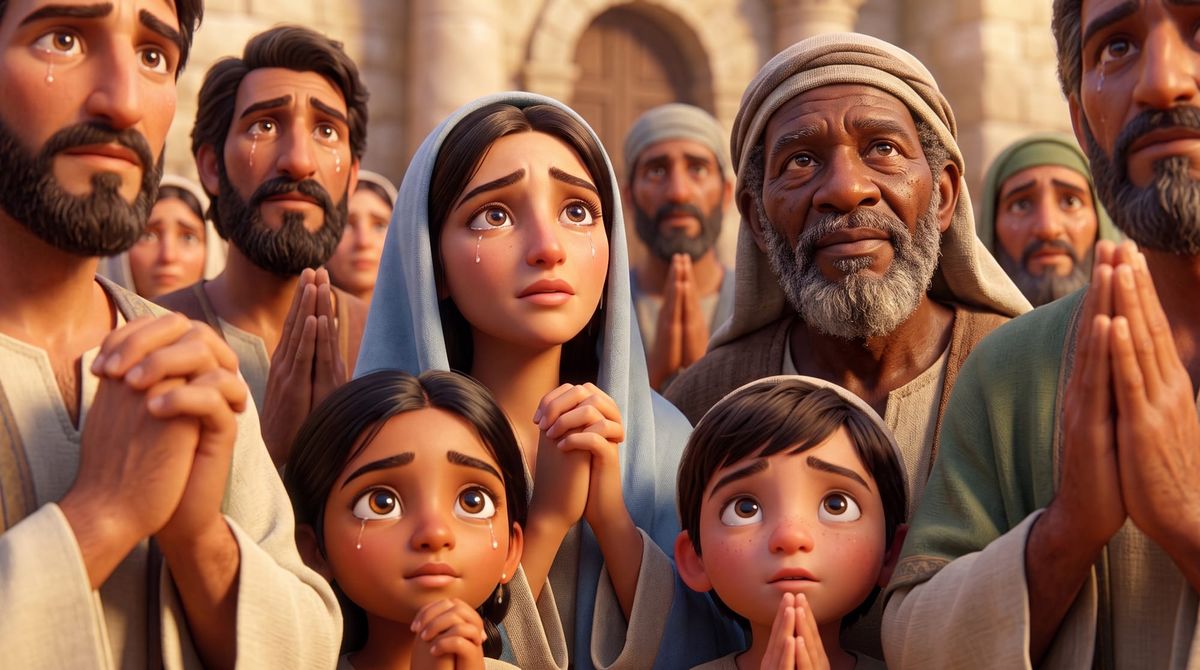
All Me
That's where the story turns. Uzziah walked into the temple and tried to burn incense on the altar — a role that belonged only to the consecrated priests. When they confronted him, he didn't back down. He got angry. And in that moment, leprosy broke out on his forehead. He spent the rest of his life in a separate house, cut off from the temple, cut off from his people, cut off from the God he had once genuinely sought. The victories were real. The gifts were real. He just stopped crediting the One who gave them.
All Me gives Uzziah a voice — a first-person confession from the edge of the land, looking back at a crown he forgot to hold humbly. The song captures the slow drift from gratitude to self-congratulation with a line that hits every time: 'Forgot to say a name that I should've put on every page.' It's not a lecture. It's a lament.
Most of us will never burn incense in a temple. But most of us know what it feels like to quietly take credit for something God built. That's why this song exists.
Want the full story? Read the complete Fireside Moment or explore the Lyric-Scripture Blueprint in our Joy Tier Deep Dive.
 Bob LeBaron
Listen Everywhere


Miss last week?
Every lesson stands on its own — but together, they tell one continuous story.
 Bob LeBaron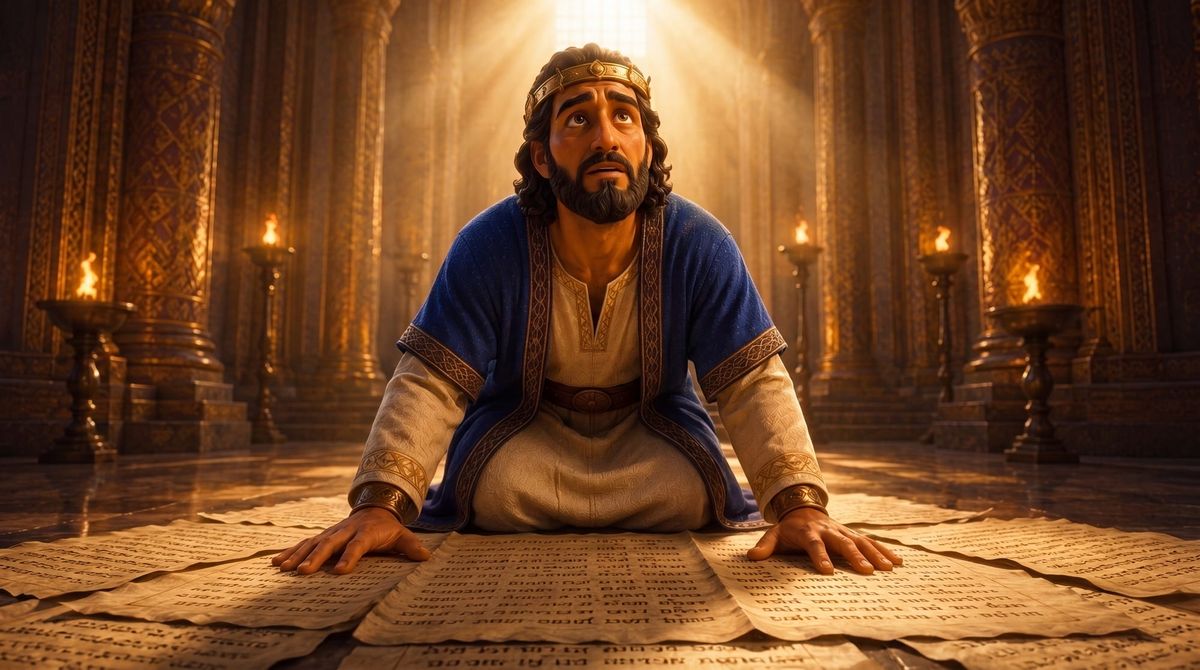
Don’t Stop the Music
The Joy Tier starts right here. Go deeper into this week’s scripture story and explore the meaning behind the songs.
Inside Joy you’ll find:
- A weekly Fireside Moment overview of the Come, Follow Me lesson
- Expanded Set the Stage teaching guides for every song
- Choose Your Adventure family activities and simple weekly habits
- Lyric–Scripture Blueprints, printable coloring pages, and lyric sheets
- Cinematic reflection videos designed for quiet viewing and discussion
Access Joy below to turn this week’s song into a weeklong experience of scripture, music, and family conversation.
Vibe Check: Dust Clouds and Mirrors
Each song has a different mood - here's what to expect before you press play.
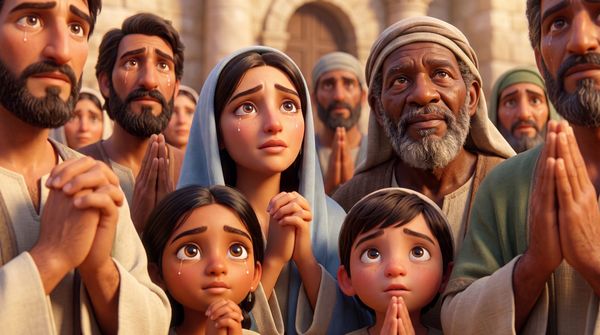
Eyes on You
Urgent and triumphant
Big, cinematic, and chest-expanding - opens with armies on the hill and ends with singers walking into a valley. Urgent but not anxious: the sound of someone who's found their footing because they know who's standing with them.
Best for: pump-up mornings, family sing-alongs

All Me
Confident, then convicted
A slower burn, more introspective, and quietly devastating. The groove is confident at first - almost cocky - and then it shifts. Reflective, cautionary, and ultimately redemptive in its honesty.
Best for: quiet car rides, conversations about pride
Before You Teach: A Fireside Moment
Before diving into individual lessons, here's a short fireside overview of this week's scriptures.
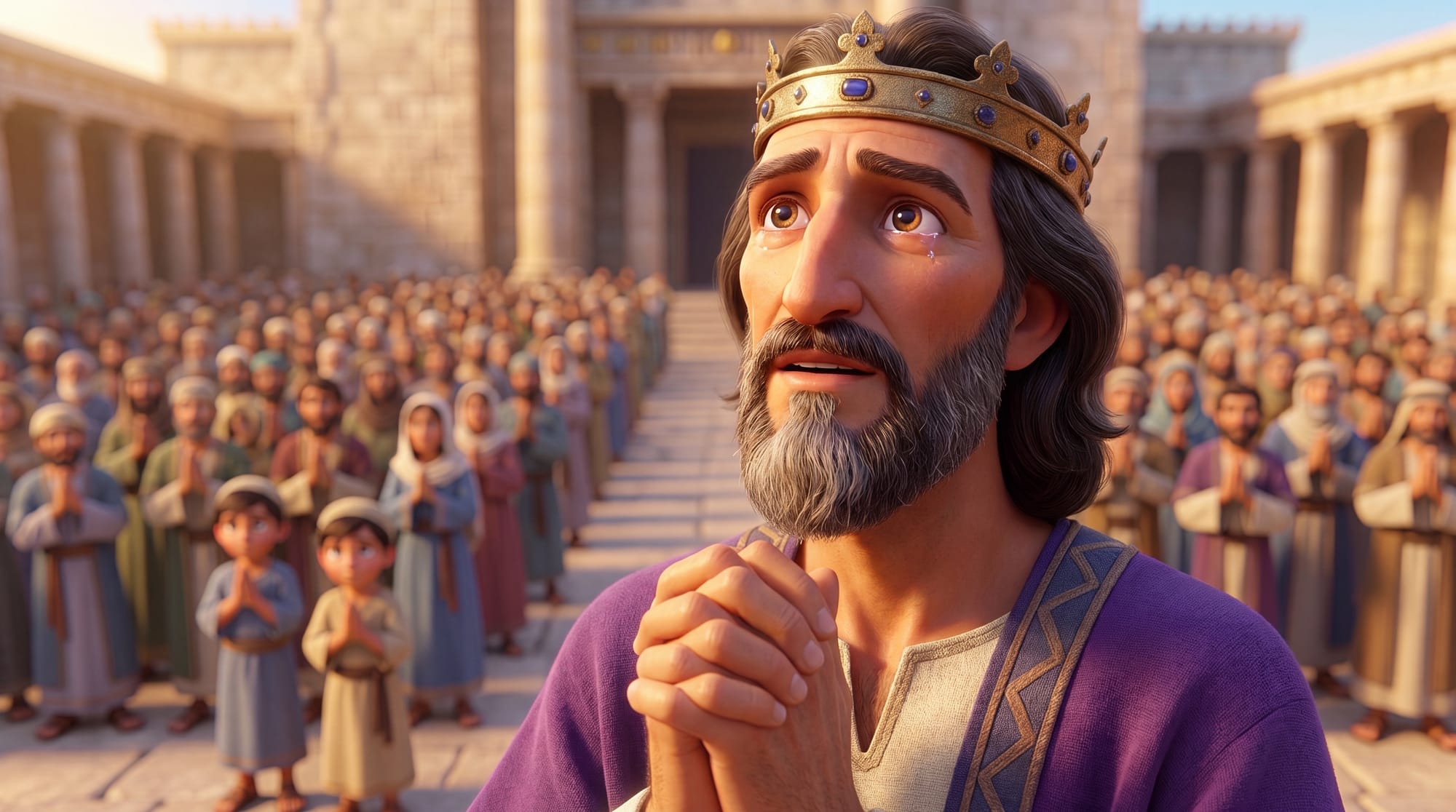
The King Who Prayed, the Prophet Who Wouldn't Lie, and the King Who Forgot to Say Thank You
2 Chronicles 14–20; 26; 30
Three Armies, One Prayer, Zero Panic
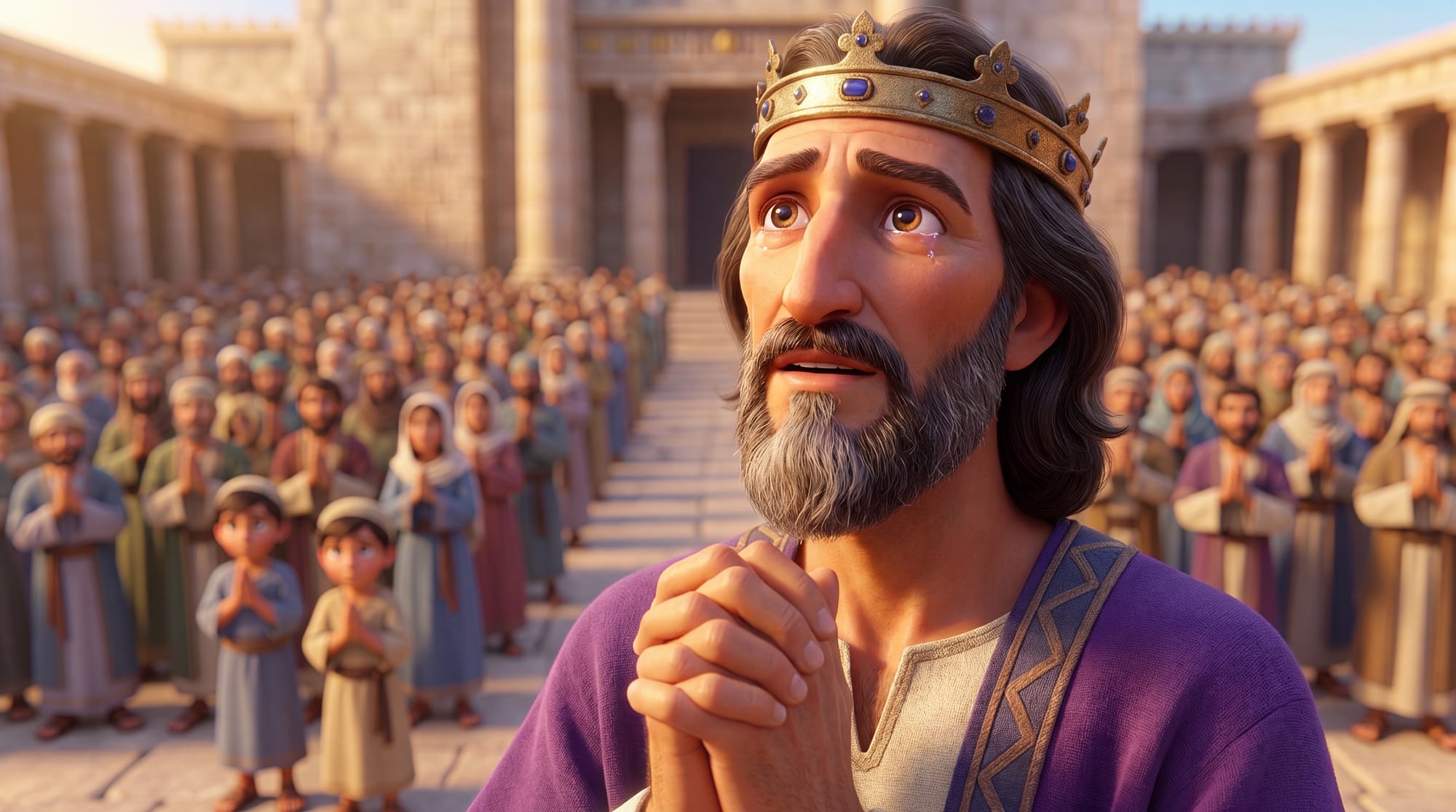
2 Chronicles 20:1-25; Alma 58:10-11; D&C 84:88; D&C 21:4-6
Three nations. At the same time. All marching toward Jerusalem. The Moabites, the Ammonites, and the Edomites (the sons of Mount Seir) had formed a coalition, and their combined forces were already past the Dead Sea and closing in fast. Jehoshaphat, king of Judah, got the intelligence report and had every reason to fall apart. He didn't. What he did instead is one of the most quietly stunning moments in all of the Old Testament.
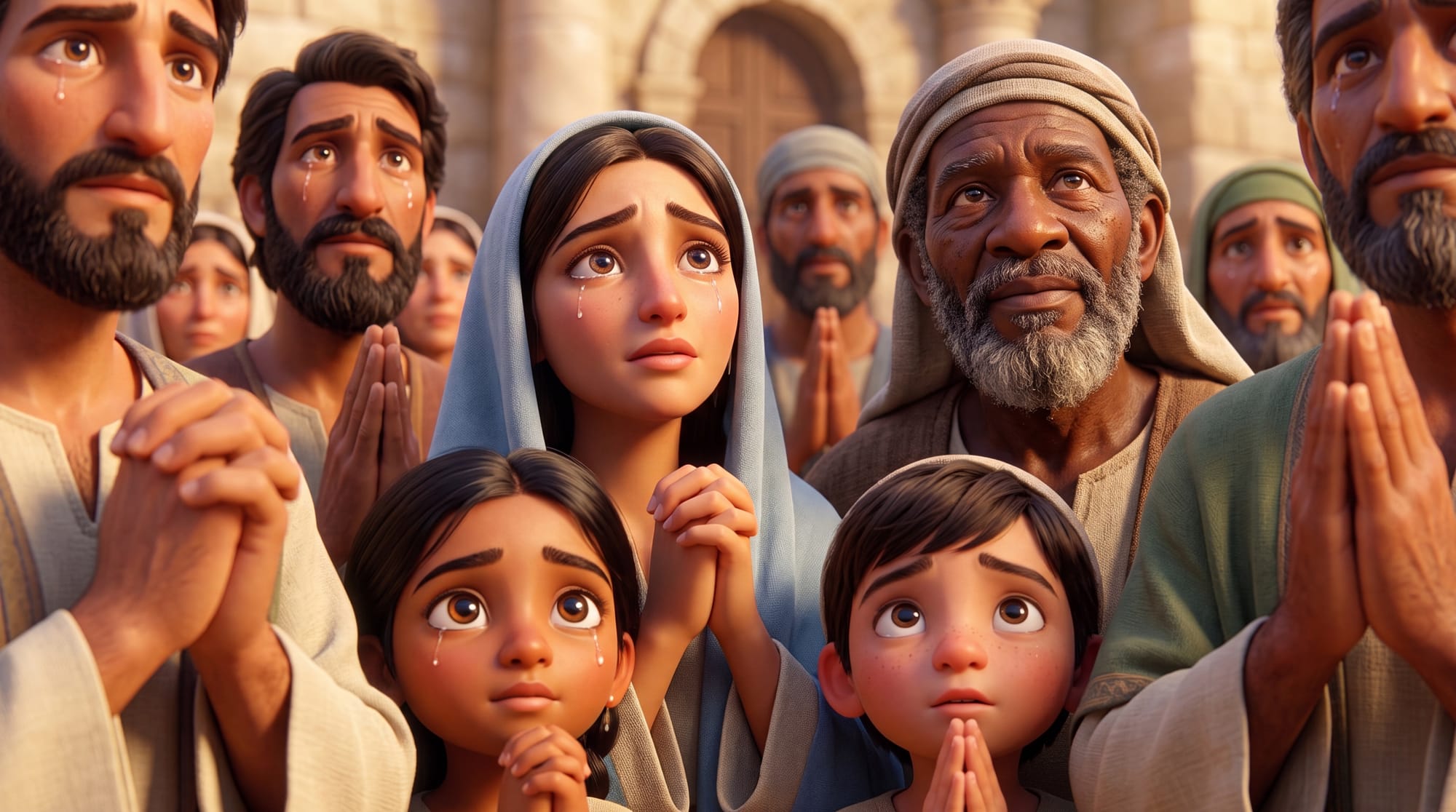
He called a fast. He gathered the people — every man, woman, and child in Judah — to the temple. And then he prayed out loud, in front of everyone, one of the most honest prayers in scripture. He didn't pretend to have a plan. He didn't project confidence he didn't feel. He said, essentially: 'Lord, we have no power. We don't know what to do. But our eyes are on You.' (2 Chronicles 20:12.) That's it. That's the whole prayer. Weakness acknowledged, trust declared.
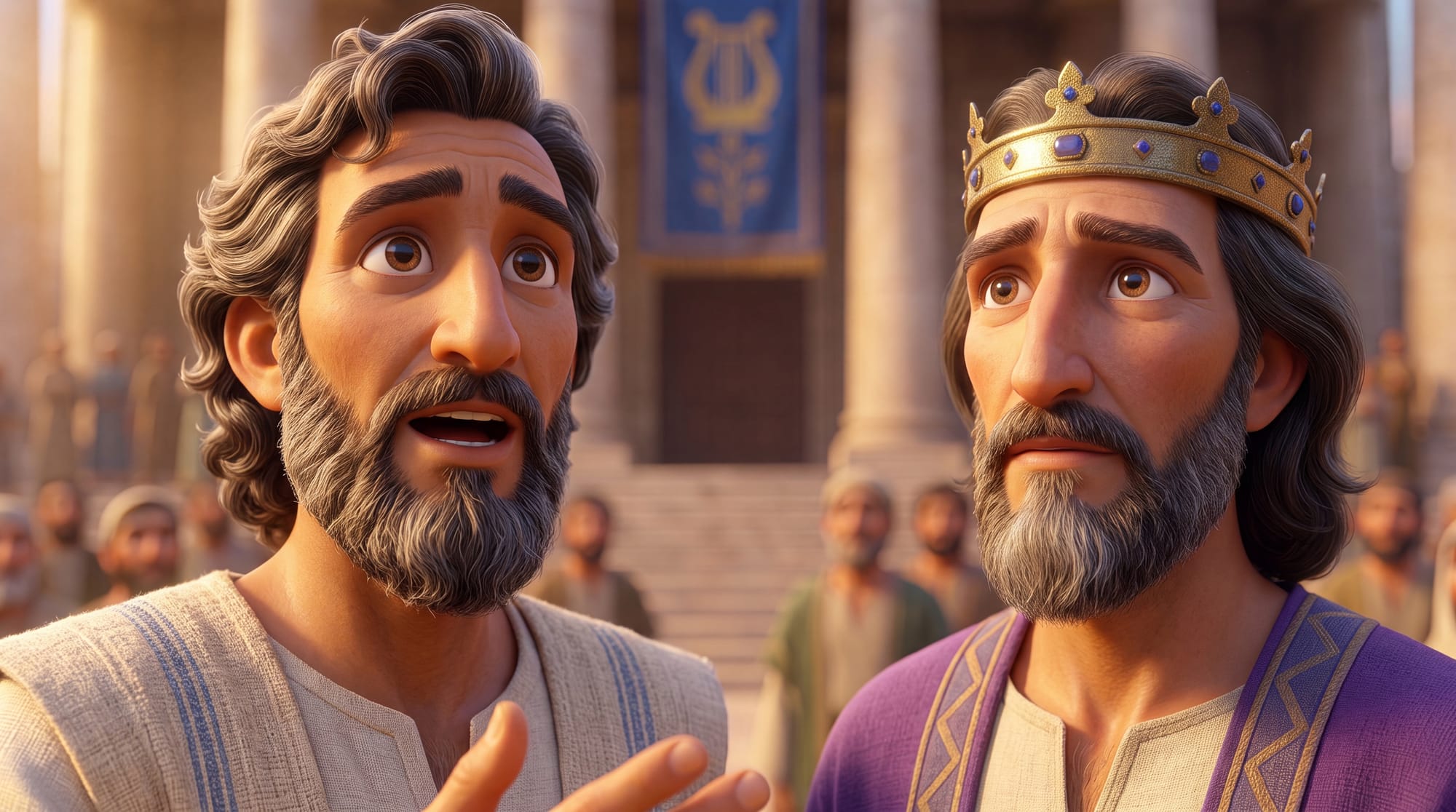
The Lord's answer came through a Levite named Jahaziel — not a general, not a military strategist, a singer. And the message was direct: 'Fear not, nor be dismayed... the battle is not yours, but God's.' (2 Chronicles 20:15, 17.) The next morning, Jehoshaphat did something that sounds completely backwards: he put the choir in front of the army. Singers leading soldiers. And as they began to praise, the three enemy nations turned on each other and destroyed themselves. Judah didn't swing a single sword.
This is the same pattern Alma describes in the Book of Mormon — that when we are humble and call on God, He fights our battles in ways we could never engineer ourselves (see Alma 58:10–11). And it's the same promise in D&C 84:88: 'I will be on your right hand and on your left, and my Spirit shall be in your hearts.'
For your family today: the armies at your door probably don't carry spears. They look more like anxiety, loneliness, a hard diagnosis, a relationship that's fracturing. The move Jehoshaphat made — gathering together, being honest about weakness, and fixing your eyes upward — is still the move. It still works.
Dive Deeper: Eyes on You
 Bob LeBaron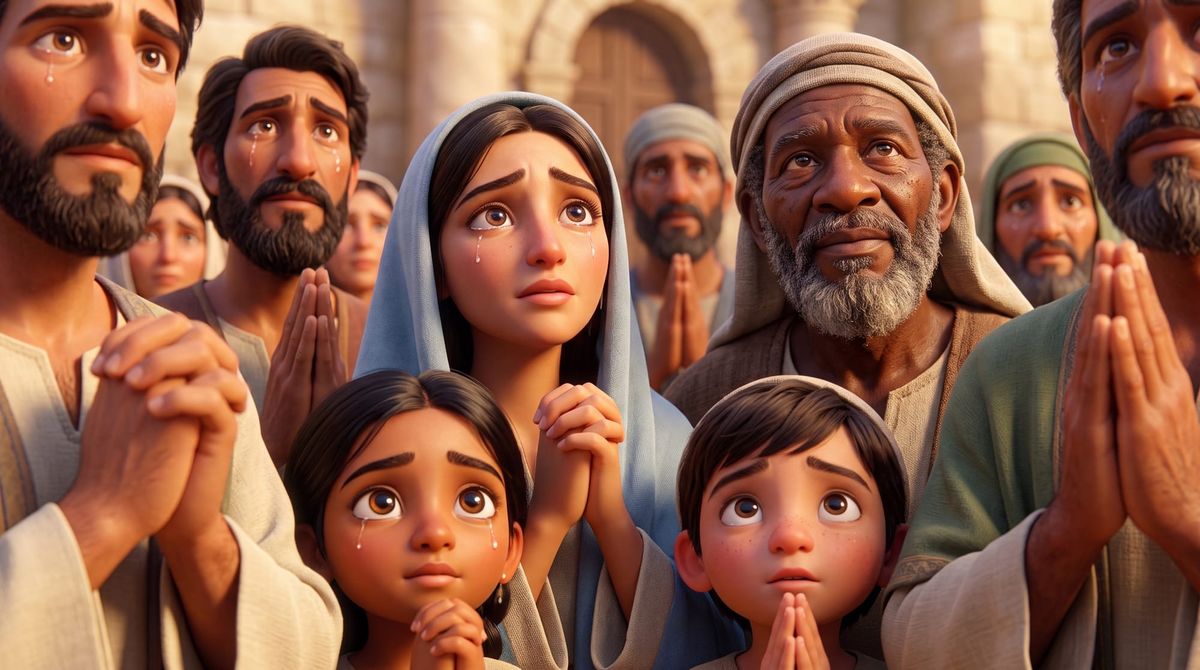
Asa's Slow Drift: How Trust Erodes
2 Chronicles 14:9-12; 2 Chronicles 15:1-8; 2 Chronicles 16:1-12; Helaman 12:2-3; D&C 93:39
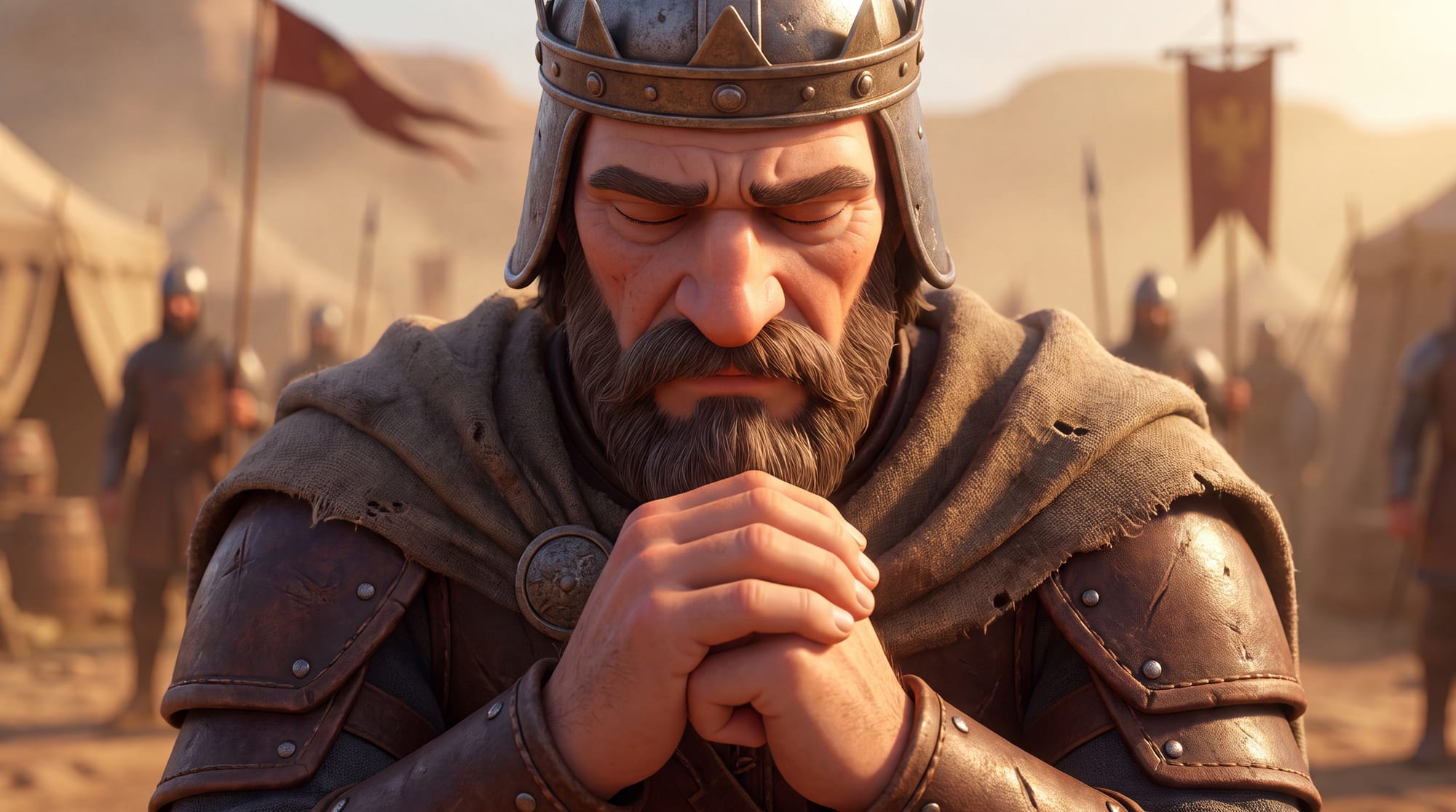
Asa started so well. When a massive Ethiopian army — a million soldiers, the text says, with 300 chariots — came against him, Asa's prayer was textbook faith: 'Lord, it is nothing with thee to help, whether with many, or with them that have no power: help us, O Lord our God.' (2 Chronicles 14:11.) And the Lord delivered him completely. Asa went on to lead a sweeping religious reform, tearing down idols and renewing the covenant. The kingdom had peace for decades.
Then something shifted. When the northern kingdom of Israel threatened Judah's border, Asa didn't pray. He raided the temple treasury and hired a pagan king, Ben-hadad of Syria, to solve the problem for him. When the prophet Hanani called him out on it — pointing out that the same God who defeated a million Ethiopians could have handled this too — Asa threw the prophet in prison. And then, when he got sick in his feet in his old age, the text notes with quiet sadness that 'he sought not to the Lord, but to the physicians.' (2 Chronicles 16:12.)
That detail is not a knock on doctors. It's a portrait of a man who had gradually stopped going to God first. The drift was so slow he probably didn't notice it happening.
This is one of the most relatable arcs in all of scripture, and it's worth sitting with as a family. Asa didn't abandon his faith in a dramatic moment of rebellion. He just... stopped trusting. Incrementally. Under pressure. Elder D. Todd Christofferson has written about how our relationship with God requires active, ongoing cultivation — it doesn't maintain itself on autopilot. (See 'Our Relationship with God,' Liahona, May 2022.)
The question Asa's story leaves on the table is a personal one: In the hard moments, where do you go first? And is that the same place you went five years ago?
Micaiah: The One Guy Who Told the Truth
2 Chronicles 18:1-34; Mosiah 17:9-10; Helaman 13:1-6; D&C 1:38
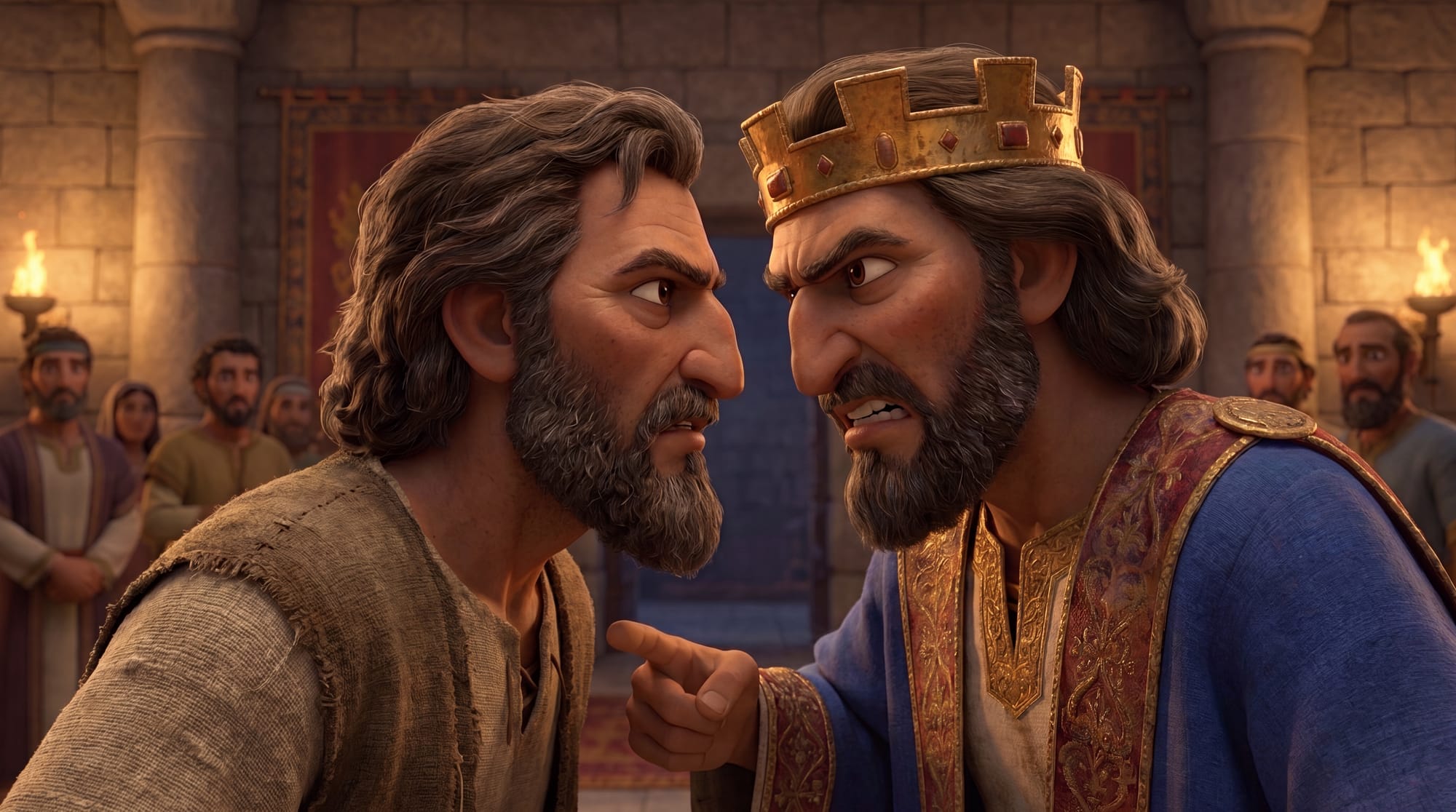
Four hundred prophets. All saying the same thing. All telling the kings exactly what they wanted to hear: 'Go to war against Syria. You'll win. God is with you.' The pressure on Micaiah to join the chorus must have been enormous — the messenger who went to fetch him literally pulled him aside and said, 'Look, everyone else is predicting victory. Just agree with them. Make it easy on yourself.' (2 Chronicles 18:12, paraphrased.)
Micaiah's response is one of the great one-liners in the Old Testament: 'As the Lord liveth, even what my God saith, that will I speak.' (2 Chronicles 18:13.) He then delivered a vision of Israel scattered like sheep without a shepherd — a clear prophecy of disaster. King Ahab, furious, had him thrown in prison on bread and water until the battle was over. Micaiah's parting shot: 'If thou certainly return in peace, then hath not the Lord spoken by me.' (2 Chronicles 18:27.)
Ahab died in the battle. An arrow fired at random — the text specifically says the archer wasn't even aiming at anyone in particular — found the one gap in Ahab's armor. Micaiah's word was fulfilled exactly.
The Book of Mormon is full of Micaiahs — Abinadi standing before Noah's court, Samuel the Lamanite on the wall, Nephi in the streets of Zarahemla. The pattern is consistent: the true messenger tells the truth, gets rejected, and is vindicated by events. The false messenger tells people what they want to hear, gets celebrated, and is eventually exposed.
For teenagers especially, this story hits close. The pressure to agree with the crowd — to not be the one voice saying something different — is real and constant. Micaiah's courage wasn't dramatic bravado. It was just a quiet, firm commitment: I will say what God says, and that's the end of the conversation. That kind of integrity is built in small moments long before the big test arrives.
Uzziah and the Tower That Fell
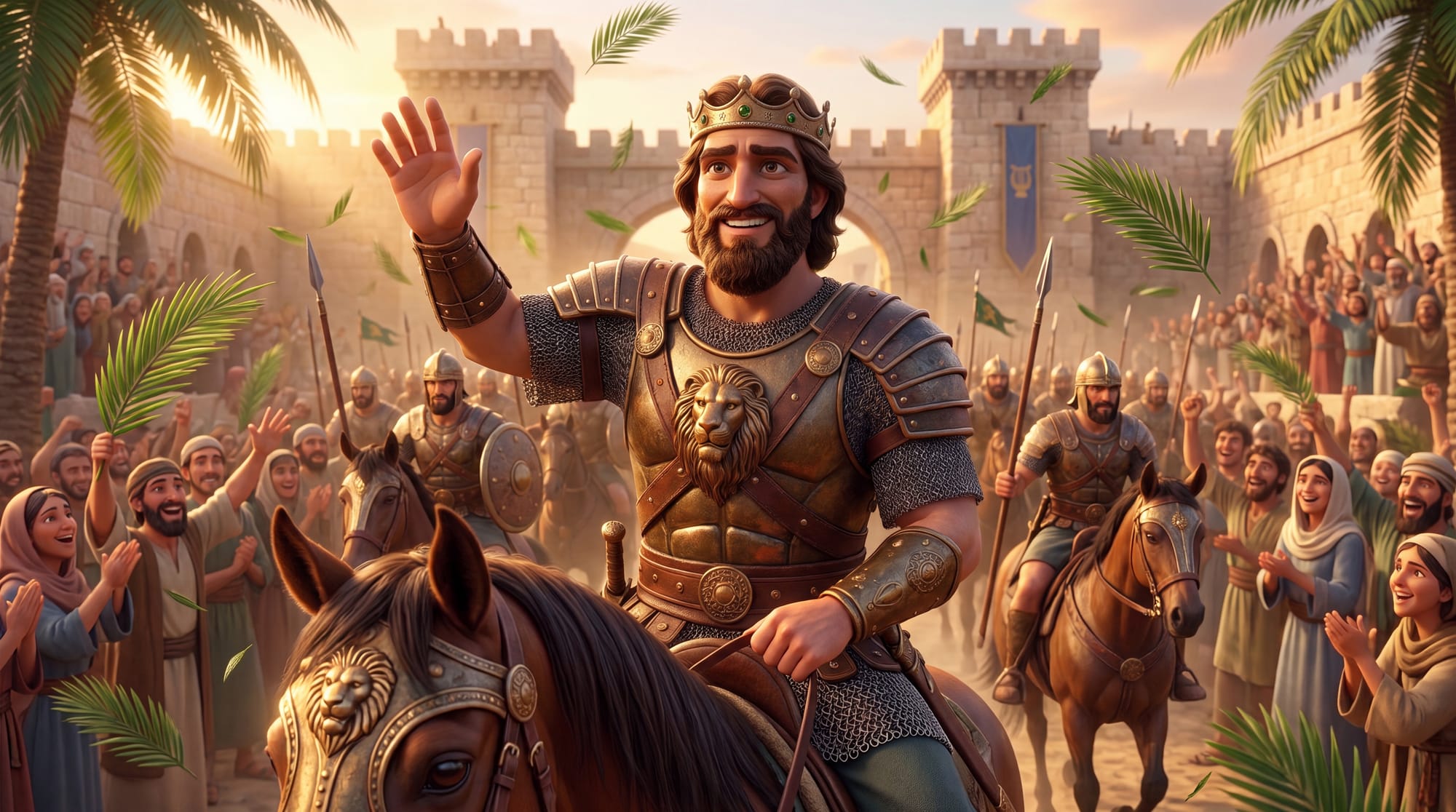
2 Chronicles 26:3-21; Ether 12:27; Helaman 4:12-13; Proverbs 16:18; D&C 121:39
Sixteen years old when he took the throne. By the time Uzziah was done building, he had fortified Jerusalem with towers at the corner gate, the valley gate, and the turning of the wall. He dug cisterns in the desert. He built up a professional army of 307,500 soldiers equipped with shields, spears, helmets, and bows.
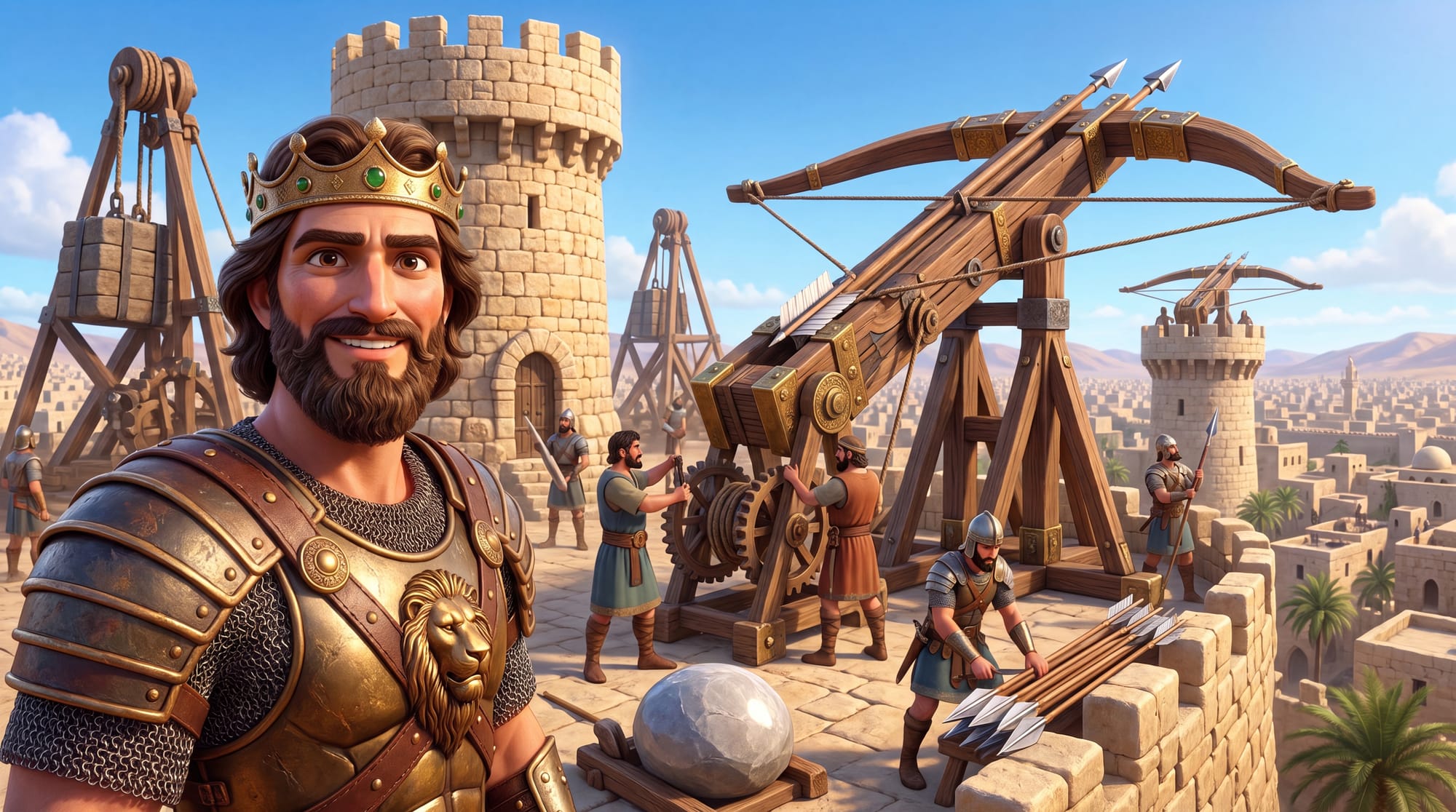
He invented war machines — catapults, essentially — to shoot arrows and hurl stones from the towers.
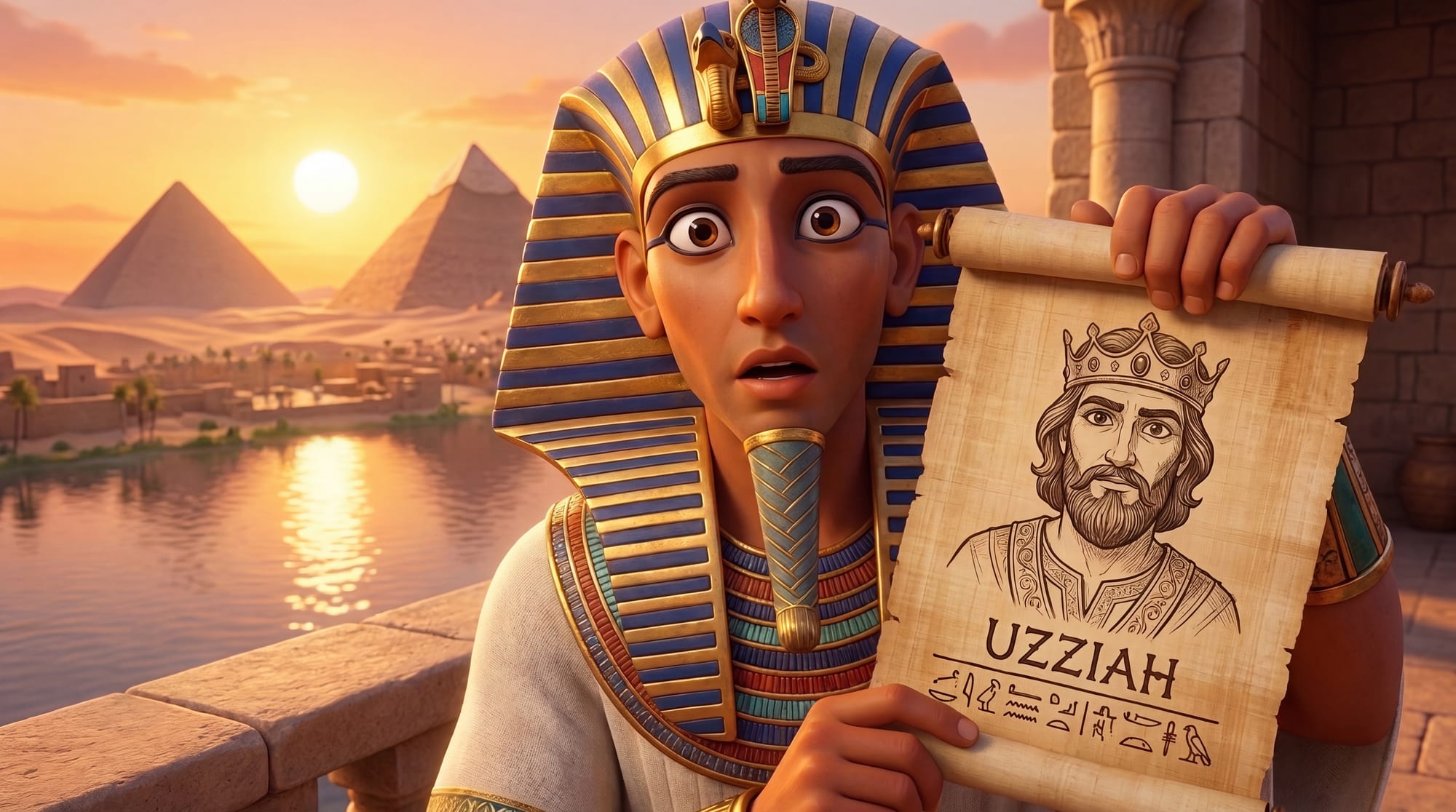
The text says his fame spread 'even to the entering in of Egypt.' (2 Chronicles 26:8.) By any measure, Uzziah was one of the most accomplished kings Judah ever had.
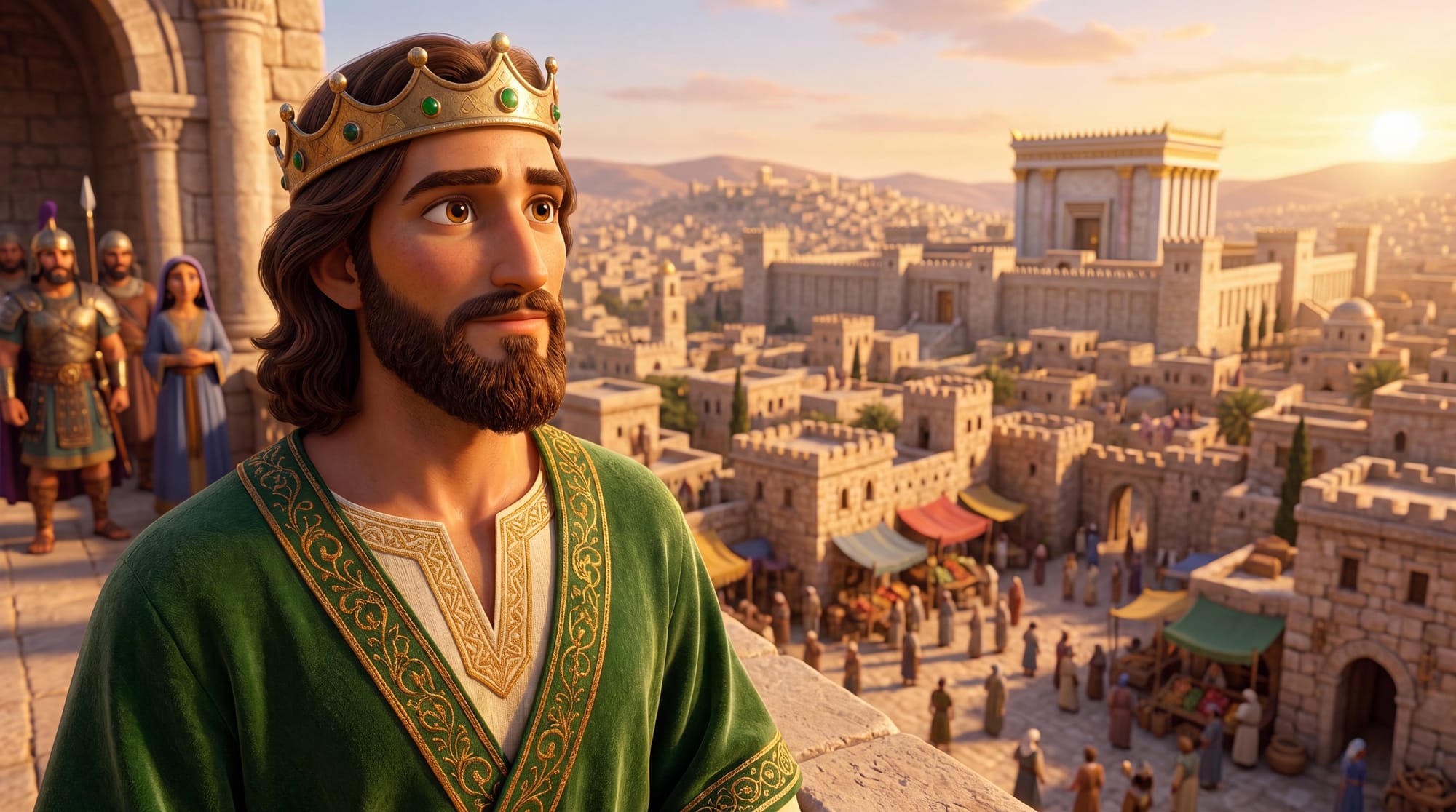
And then comes the verse that changes everything: 'But when he was strong, his heart was lifted up to his destruction.' (2 Chronicles 26:16.)
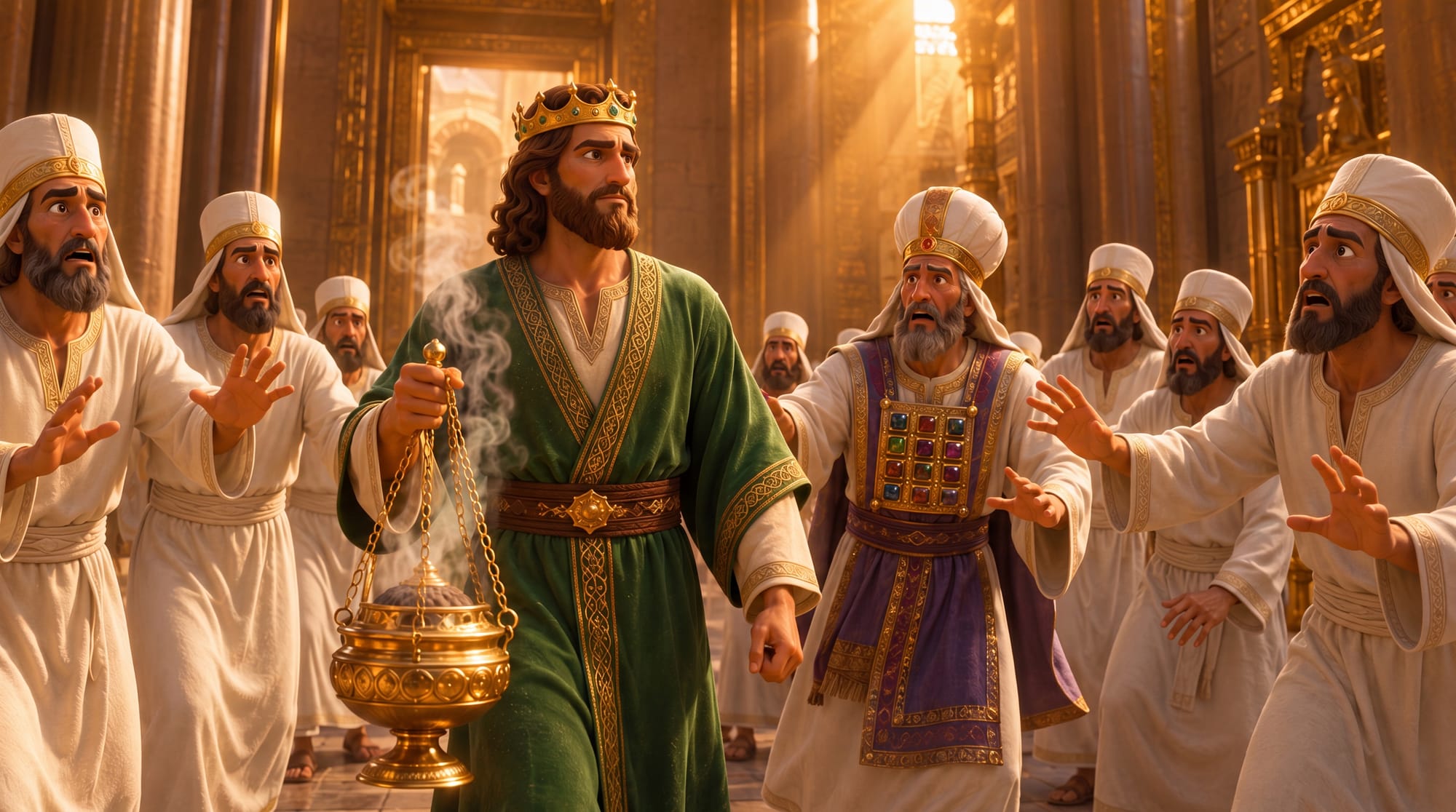
He walked into the temple and tried to burn incense on the altar — a role reserved exclusively for the priests, the sons of Aaron. Eighty priests confronted him. They didn't whisper. They stood in front of him and said directly: 'It appertaineth not unto thee, Uzziah, to burn incense unto the Lord.' (2 Chronicles 26:18.) Uzziah's response was rage. And in the middle of his anger, leprosy broke out on his forehead.
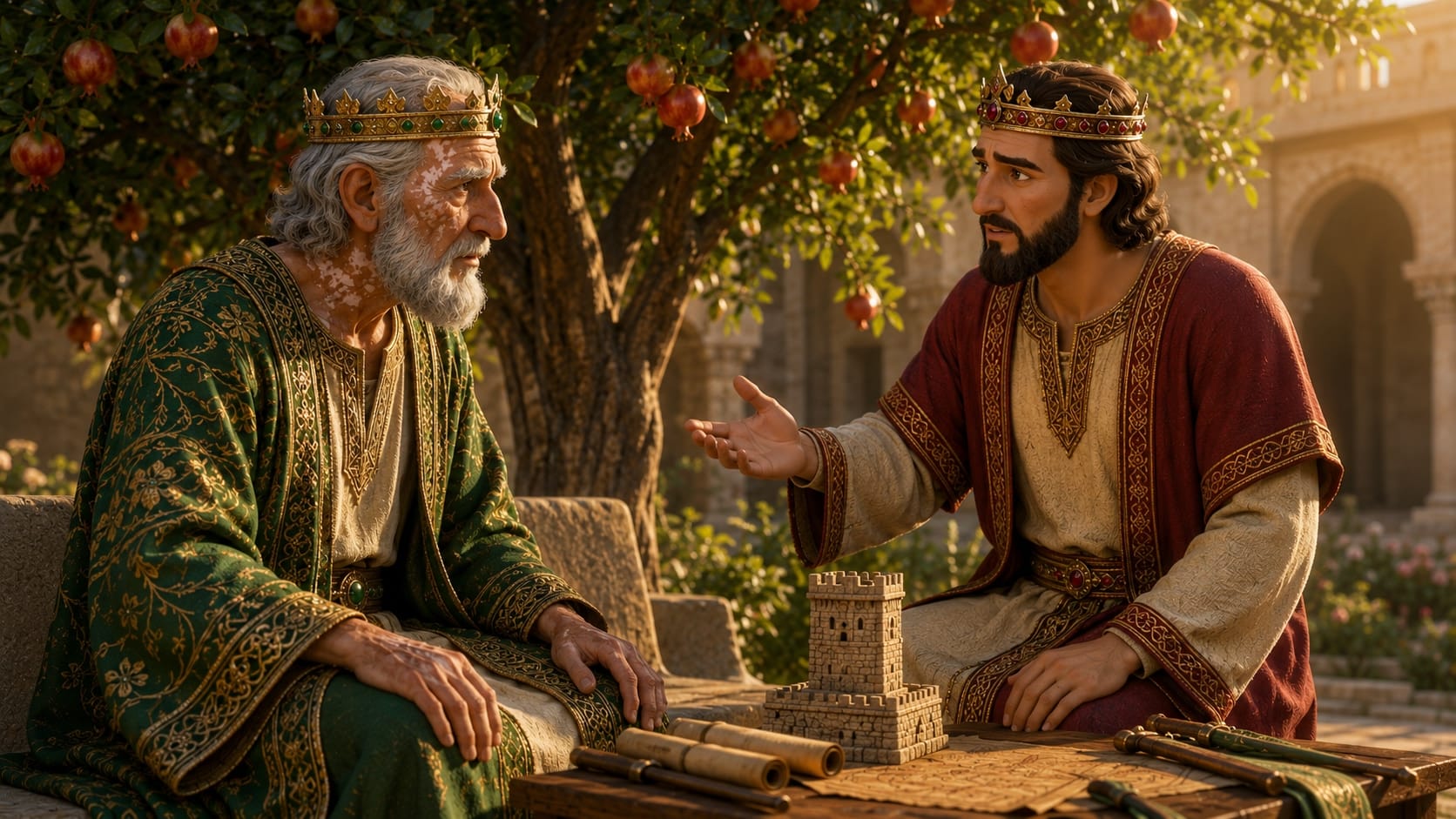
He spent the rest of his life in isolation, cut off from the temple he had tried to commandeer, unable to enter the house of the Lord until the day he died.
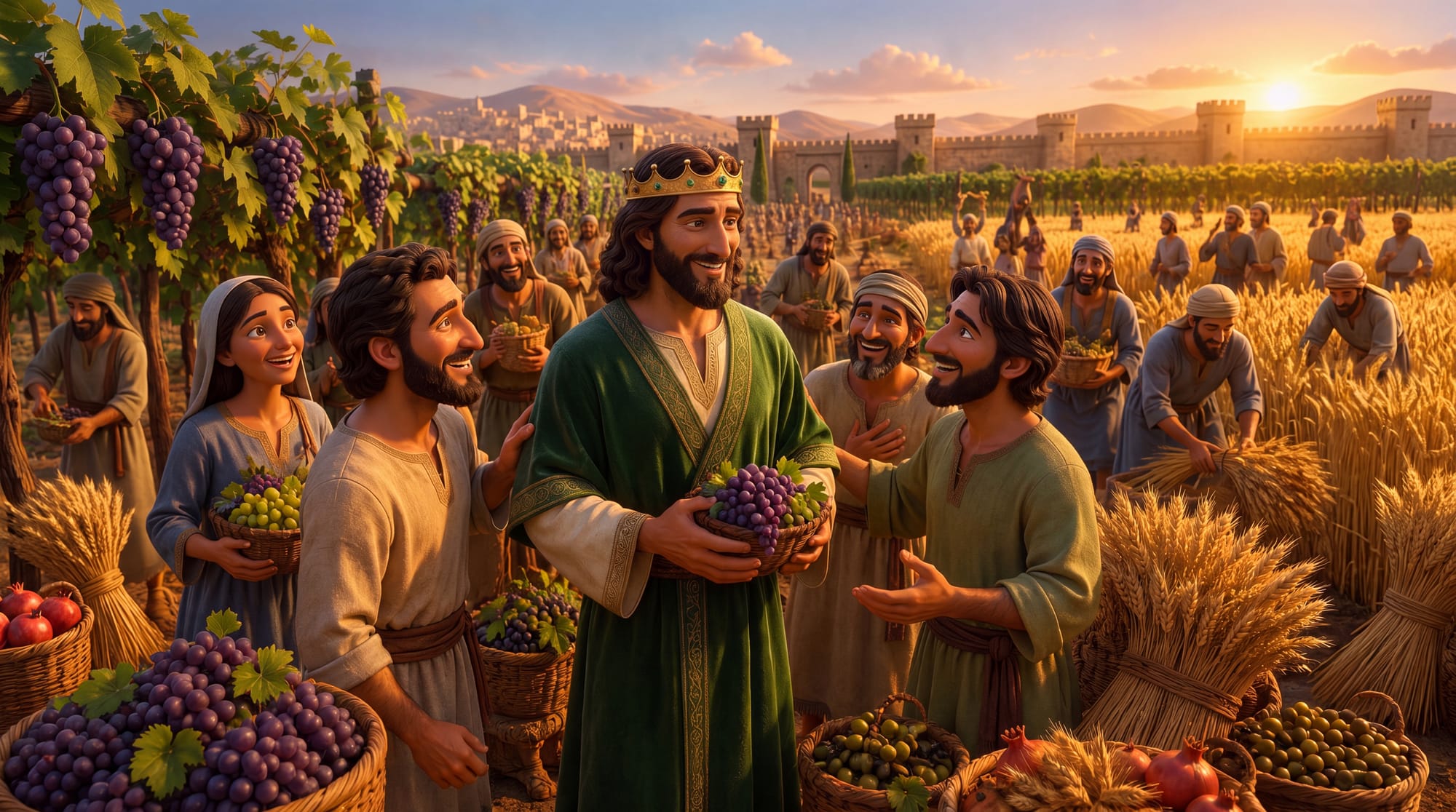
The tragedy isn't that Uzziah was a bad king. He was, for most of his reign, a genuinely great one. The tragedy is that success became the thing that undid him.

He stopped seeing his accomplishments as gifts and started seeing them as evidence of his own greatness. The axe forgot the hand that swung it.
Moroni's warning in Ether 12 and the Book of Mormon's recurring pride cycle both point to the same truth: the moment we stop attributing our blessings to God and start attributing them to ourselves, we've already started the fall. The tower looks tallest right before it tips.
Dive Deeper: All Me
 Bob LeBaron
Hezekiah's Passover: When the Welcome Mat Goes Out
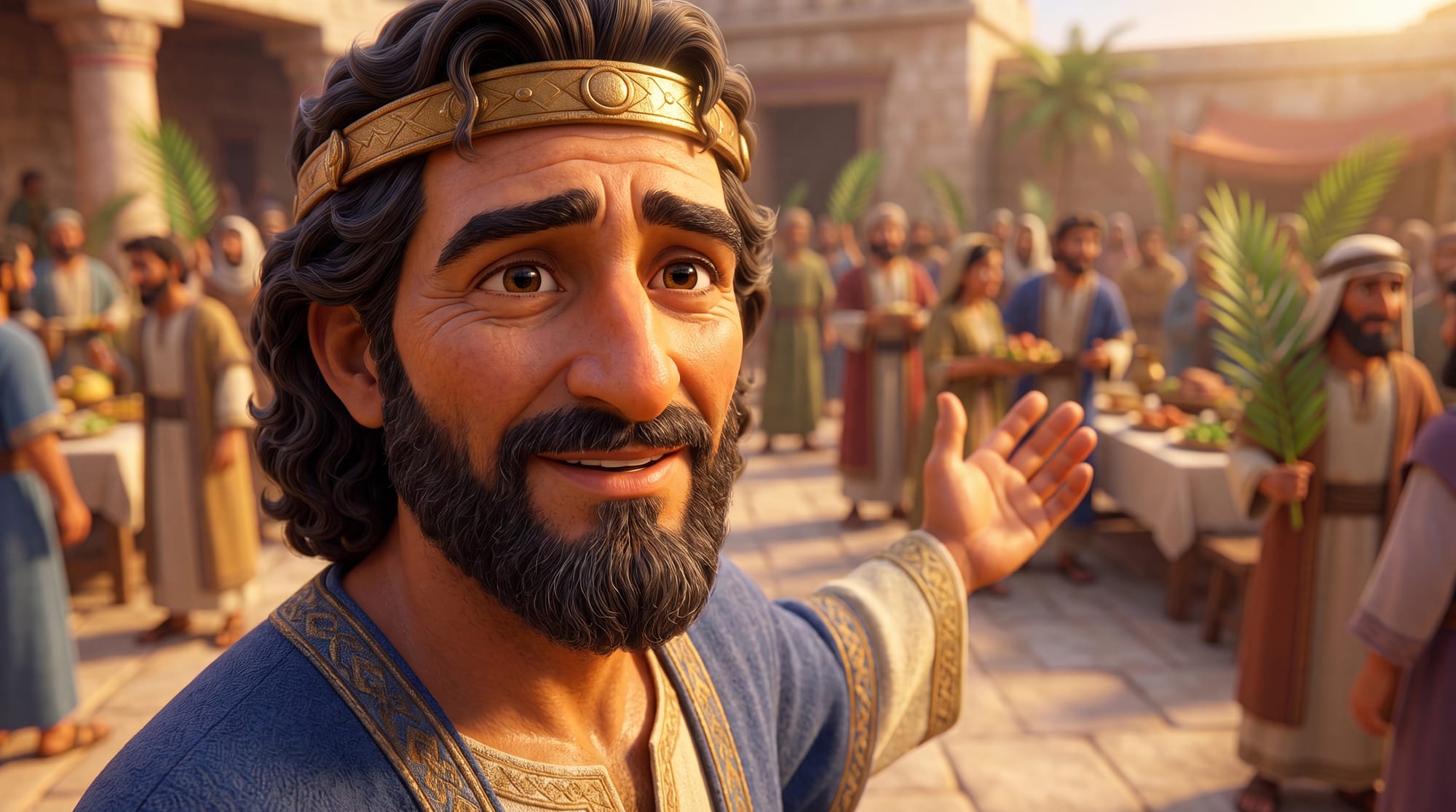
2 Chronicles 30:1-27; 3 Nephi 11:29-30; D&C 38:27; Russell M. Nelson, "Peacemakers Needed," Liahona, May 2023
The northern kingdom of Israel had been in spiritual freefall for generations. The two kingdoms — Israel in the north, Judah in the south — had been divided and often hostile for over two centuries. Celebrating Passover together in Jerusalem hadn't happened in so long that the text says there was nothing like it 'since the time of Solomon.' (2 Chronicles 30:26.)
Hezekiah sent letters throughout all of Israel and Judah — even into the northern territories that had been conquered by Assyria — inviting everyone to come to Jerusalem and keep the Passover. The response was mixed. Some people in the north laughed at the messengers and mocked them. But others humbled themselves and came.
Here's the detail that makes Hezekiah remarkable: when the guests arrived, many of them hadn't purified themselves according to the law of Moses. They were technically ineligible to participate. A strict reading of the rules would have excluded them. Hezekiah's response was to pray: 'The good Lord pardon every one that prepareth his heart to seek God... though he be not cleansed according to the purification of the sanctuary.' (2 Chronicles 30:18-19.) And the Lord healed the people.
The result was a celebration so joyful that they extended it for an extra seven days. The text says there was 'great joy in Jerusalem.' (2 Chronicles 30:26.)
President Russell M. Nelson's call to be peacemakers — to 'do the hard, holy work of peacemaking' — echoes exactly what Hezekiah modeled here. (See 'Peacemakers Needed,' Liahona, May 2023.) Hezekiah didn't wait for the northern tribes to get their act together before extending the invitation. He reached across a centuries-old divide, made room for people who didn't fully qualify, and trusted God to handle the rest.
For families today: Who's the person or group you've written off as too far gone, too different, too complicated to include? Hezekiah's Passover suggests the welcome mat goes out first, and the Lord takes care of the rest.
Dive Deeper: Spread It Out
 Bob LeBaron