August 31–September 6: "Let Every Thing That Hath Breath Praise the Lord" (Psalms 102–103; 110; 116–119; 127–128; 135–139; 146–150)
The book of Psalms moves from raw lament to the loudest praise in all of scripture — and this week's lesson invites your family to make that same journey, one breath and one footstep at a time.
Your Game Plan for This Week
There's a line in Every Little Thing That Breathes that hits differently once you sit with it: "I used to keep my gratitude bottled in a jar." That's not a quirky lyric — that's a confession most of us could make. Life gets loud, the hard stuff piles up, and somewhere along the way we stop noticing what God has actually done. The Psalms exist, in part, to fix that. They are memory aids. They rehearse the mercy, the healing, the rescue — out loud, in community, set to music — so that gratitude doesn't quietly evaporate.
The lesson this week draws a straight line from Psalm 103's 'He heals the brokenhearted' to Alma 7:11–13 in the Book of Mormon, where we learn that Jesus Christ took on our pains and afflictions so He would know exactly how to succor us. That's not ancient history. That's a present-tense promise for your family right now — whatever hard thing is sitting on your kitchen table this week. Praise isn't denial of the hard stuff. It's the declaration that the hard stuff doesn't get the last word.
And then there's A Lamp and a Light, which picks up Psalm 119:105 and runs with it — reminding us that God's word doesn't promise a stadium floodlight showing us the next ten years. It promises the very next footstep. That's enough. For families navigating big decisions, teenagers figuring out who they are, or parents who honestly don't know what comes next — that's the word for this week. One step. Lit up. Keep walking.
15-Minute Family Home Evening
Monday night — your launch for the week.
-
Ask this to open. Take 2–3 responses, then move on.2 minOpening QuestionHas anyone ever felt so grateful for something that you almost couldn't hold it in — like the feeling was too big for just one person to keep quiet about?
-
Read this together:2 minSet the StageSomewhere between three and three-and-a-half thousand years ago, poets and prophets in ancient Israel were writing songs about their real feelings — not polished ones. Grief, fear, loneliness, and gratitude so enormous it couldn't stay inside a single person. The book of Psalms is the collected songbook of a covenant people who had wandered through wilderness, faced enemy armies, and survived personal heartbreak — and who kept arriving at the same stubborn conclusion: God was still there, still listening, still worth singing about. Psalm 150, the grand finale of the entire collection, doesn't ease you in gently. It throws the doors open. Praise Him with the trumpet. Praise Him with dancing. Praise Him with loud cymbals. And then the capstone line that has echoed through three thousand years of worship: 'Let every thing that hath breath praise the Lord.'Psalm 150:6Let every thing that hath breath praise the Lord. Praise ye the Lord.
-
Press play — watch together:3 min
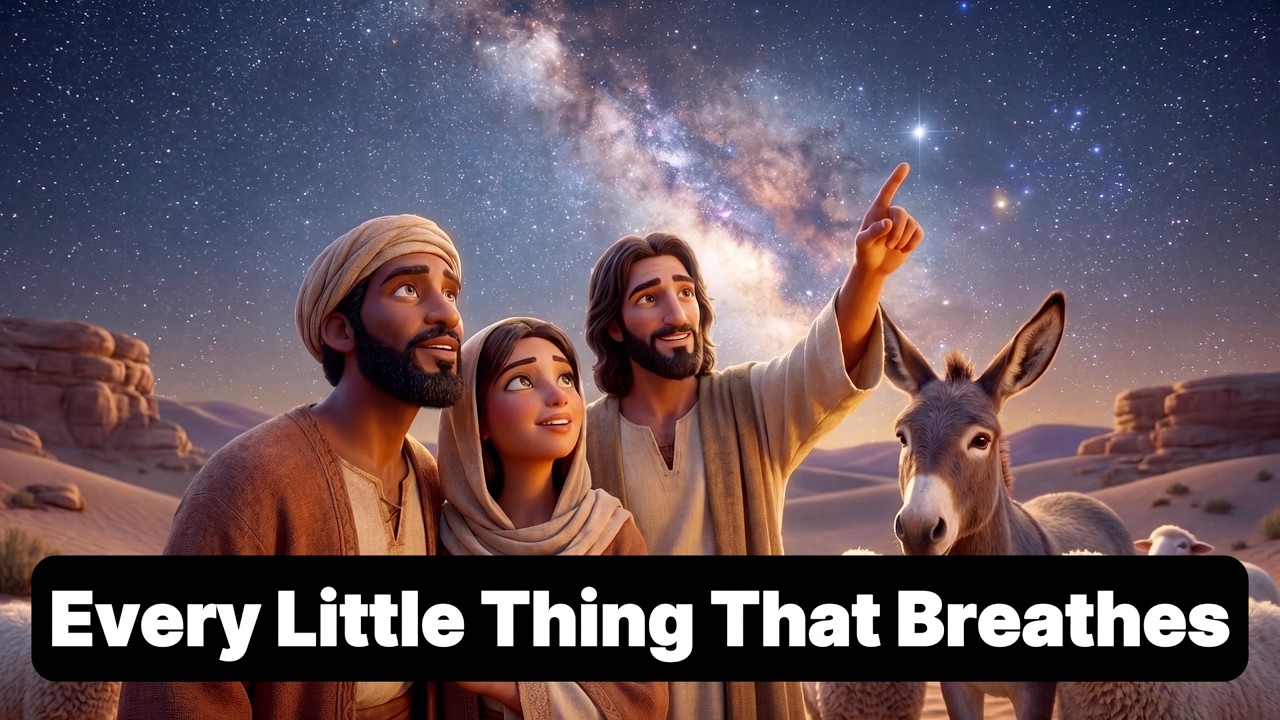
🎵 Let every little thing that hath breath praise the Lord! Singing out a song that cannot be ignored! From the valleys to the mountains, let the shout go high, Praise Him for His mercy underneath the sky!
Dive Deeper: Every Little Thing That Breathes -
Read the Big Idea together:2 minBig Idea Praise Is What Happens When You Remember
Human beings forget fast — we forget what it felt like to be desperate, and then we forget who showed up when we were. The Psalms exist as a deliberate, sometimes loud corrective to that tendency, and this song steps straight into that tradition with an honest confession: gratitude can get bottled up, hoarded, kept too quiet for too long. The answer is not guilt — it is praise, thrown open like a window, spoken and sung from exactly where your family is right now, valleys and all. This week is an invitation to make praise a daily practice, not a feeling you wait to have until everything is perfect. -
Ask your family:3 minReflect TogetherIs there something God has done for your family — recently or a long time ago — that maybe hasn't been said out loud in a while? What would it feel like to actually say it together right now?
-
Do this activity together:5 min
Breath & Freeze Praise Party
Try This: Clear a little space in your living room. One person is the 'Caller' and everyone else spreads out. The Caller shouts a way to praise — 'Sing it!', 'Jump it!', 'Clap it!', 'Spin it!' — and everyone does that action while belting out 'Hallelujah!' or any line from the song. The moment the Caller yells 'FREEZE!' everyone stops like a statue. Last one to freeze becomes the new Caller. Play until everyone has had a turn leading — or until someone collapses from laughing.
Reflect: When the music stopped and you had to freeze, what did it feel like to hold all that energy in? Now think — what would it feel like to hold your praise in ALL the time and never let it out? Psalm 150 says let EVERYTHING that has breath praise the Lord. What's one way you want to let your praise out this week?
-
Close together: Say a family prayer. Then enjoy a special treat as a family.2 min
20-Minute Primary / Sunday School
Lead with A Lamp and a Light.
-
Ask this to open. Take 2–3 responses, then move on.3 minOpening QuestionHas anyone ever been somewhere really dark — a power outage, a camping trip, a long hallway at night — and had just a small flashlight or candle? Did that tiny bit of light feel like enough, or did you wish you could see the whole room at once?
-
Read this together:2 minSet the StageThe ancient world was loud. Prophets competed with priests of Baal. Kings competed with the voice of God. And somewhere in the middle of all that clamor, a poet sat down in the dark — not a comfortable dark, but the kind that comes from a hard road with no map — and wrote one of the most quietly powerful lines in all of scripture. He wasn't asking for a floodlight. He wasn't demanding a five-year plan. He was holding a small, oil-fed flame that lit maybe three feet of ground in front of him, and he had to decide: is this enough? The world was full of competing voices promising shortcuts. The noise wasn't going away. And the lamp was very, very small.Psalm 119:105Thy word is a lamp unto my feet, and a light unto my path.
-
Press play — watch together:3 min
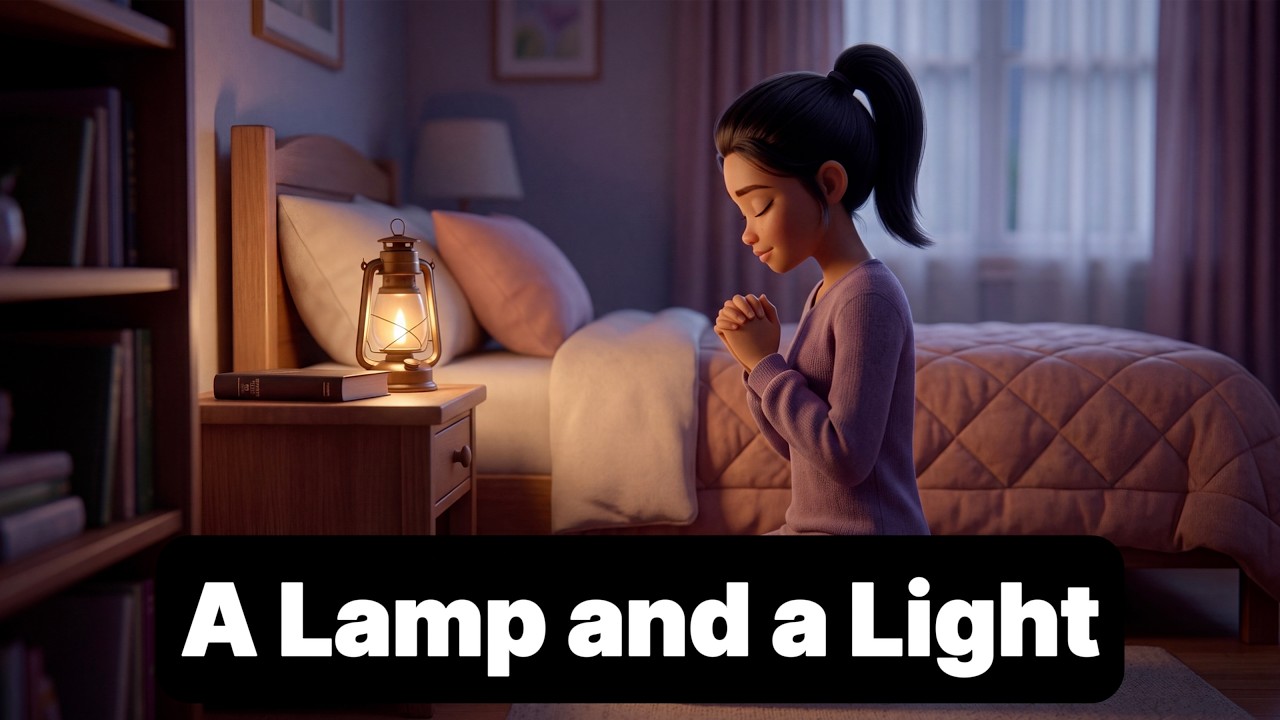
🎵 Thy word is a lamp unto my feet! / A light unto my path when the shadows start to meet! / I'm staying on the trail, I ain't gonna stray, / You're lighting up my footsteps all along the way!
Dive Deeper: A Lamp and a Light -
Ask this. Give the class a moment to think before taking responses.3 minPivot QuestionWhy do you think the Psalmist chose the image of a lamp — something small and close — instead of a sun or a beacon that lights up everything at once?
-
Keep going:4 minFollow-UpIf God showed you the entire path all at once — every hard moment, every detour, every outcome — do you think that would actually make it easier to follow Him, or is there something important about only seeing the next step? What do you think faith has to do with that?
-
Liken it unto yourself. Hand each student a slip of paper. Give 2 minutes to write, then 2–3 share with the class.5 minLiken Unto YourselfWhen you're facing a decision and you can't see how it all turns out, what does it actually look like for you to take the next faithful step — and what has God already given you to light that step?
-
2 minClose With ThisGod's word was never designed to hand you the full itinerary. It was designed to give you exactly enough light to take the next faithful step — and that has always been, and will always be, precisely enough.
-
Optional Activity — use if you have extra time or a younger class:5 min
Flashlight Freeze Tag
Try This: Grab one flashlight (that's your only supply — and yes, it counts as zero prep). One person is the 'Lamp Bearer' and holds the flashlight. Everyone else wanders around the room or yard in the dark or with eyes closed, taking slow steps like they genuinely cannot see where they are going. Whenever the Lamp Bearer shines the light on someone's feet, that person freezes and calls out one word that describes what helps them stay on God's path — 'scriptures,' 'prayer,' 'family,' whatever comes to mind. Keep rotating who holds the lamp. Play until everyone has been the Lamp Bearer at least once.
Reflect: What was it like trying to move without the light? How is that like trying to make good choices without reading the scriptures or praying? Psalm 119:105 says the word of God is a lamp to our FEET — not a spotlight on the whole road. Why do you think Heavenly Father gives us just enough light for the next step instead of showing us everything at once?
Week Schedule
You don't have to do all seven — pick what fits. Monday launches, Sunday caps. Tap any day to expand or collapse.
This Week's Fireside Moment
The full story behind the songs — in one sitting.
Watch & Listen
Every Little Thing That Breathes
The book of Psalms — called Tehillim in Hebrew, meaning "praises" — is one of the most emotionally honest books in all of scripture. It contains laments so raw they're almost uncomfortable to read (Psalm 102 opens with someone who feels like smoke, like a withered plant, like a lonely bird on a rooftop). And then, without apology, it pivots to some of the most jubilant worship ever written. Psalm 150 is the grand finale: praise Him with trumpets, with harps, with timbrels, with dancing, with everything you have, in every place you stand. The ancient Israelites weren't shy about this. Praise was loud. Praise was physical. Praise was the whole-body response of people who had genuinely reckoned with what God had done.
Every Little Thing That Breathes lives right in that tradition. It opens with someone who used to keep their gratitude quietly bottled up — and then had a reckoning. They looked at the galaxies. They felt the healing. They remembered the grace. And suddenly quiet wasn't an option anymore. The song moves through Psalm 150's instrument roll call, swings through Psalm 147's image of God healing the brokenhearted and counting the stars by name, and lands on the Bridge's simplest possible invitation: if you have breath today, open your mouth.
The Lord's instruction in Doctrine and Covenants 59:7 — to thank Him in all things — isn't a footnote to that invitation. It's the covenant version of it. Psalm 150 says praise with everything you have. D&C 59 says thank Him in everything you face. Together they describe the same posture: not worship reserved for the good days, but gratitude that holds its shape even when the season is hard.
For your family this week, that's the whole lesson. Praise isn't a feeling you wait for. It's a decision you make — and then the feeling follows.
Want the full story? Read the complete Fireside Moment or explore the Lyric-Scripture Blueprint in our Joy Tier Deep Dive.
Lyric–Scripture Blueprint (Preview)
Did you know these lyrics come straight from the scriptures?
Explore the full Lyric–Scripture Blueprints and deeper activities in the Joy Tier.

A Lamp and a Light
Notice what he didn't say. He didn't say a floodlight. He didn't say a satellite map. He said a lamp — the kind that throws just enough light to see the next stone on the path. Ancient lamps were small, oil-fed, and humble. They didn't illuminate the whole road. They illuminated the next step. That was the promise. That was enough.
A Lamp and a Light grabs that image and runs with it straight into the present moment. The song opens in a world drowning in megaphones — everyone selling a shortcut, everyone shouting a direction — and makes the case that God's word doesn't need to be the loudest voice in the room to be the truest one. The lyrics weave Psalm 119:105 together with Psalm 139's breathtaking portrait of a God who knows every thought, every sitting down, every rising up, and still holds out a lantern for a soul He intends to keep. The pre-chorus lands the theological punch cleanly: it's not about seeing ten miles ahead. It's about the very next footstep.
For families walking the covenant path together, this song is a weekly reminder that faith isn't a single dramatic moment — it's a thousand small, lit steps in the right direction.
Want the full story? Read the complete Fireside Moment or explore the Lyric-Scripture Blueprint in our Joy Tier Deep Dive.

Listen Everywhere


Miss last week?
Every lesson stands on its own — but together, they tell one continuous story.
 Bob LeBaron
Don’t Stop the Music
The Joy Tier starts right here. Go deeper into this week’s scripture story and explore the meaning behind the songs.
Inside Joy you’ll find:
- A weekly Fireside Moment overview of the Come, Follow Me lesson
- Expanded Set the Stage teaching guides for every song
- Choose Your Adventure family activities and simple weekly habits
- Lyric–Scripture Blueprints, printable coloring pages, and lyric sheets
- Cinematic reflection videos designed for quiet viewing and discussion
Access Joy below to turn this week’s song into a weeklong experience of scripture, music, and family conversation.