August 3–9: "Thou Art Come . . . for Such a Time as This" (Esther)
An orphaned Jewish girl on a Persian throne, a 500-year tribal feud coming to a head, and a question that still echoes today — what if you were placed exactly where you are, for exactly this moment?

Born Ready for This Moment
For such a time as this!
I was made to take a risk!
Not gonna bow, not gonna break
Everything is now at stake
Yeah, I was born for this moment, I can't miss
An orphaned Jewish girl sitting on a Persian throne wasn't an accident — it was an appointment. The book of Esther is the story of what happens when one person decides their moment matters more than their fear.
Set the Stage: The Law Is Already Signed
The law has already been signed. Sealed with the king's ring. Every Jewish man, woman, and child in the Persian empire is scheduled for slaughter — and the king who issued the decree doesn't even know his own queen is one of them. Esther has been living a careful double life inside the palace walls, keeping her identity quiet, staying safe. Then her cousin Mordecai sends word: the time for quiet is over. He asks her the question that will define the rest of her life — what if you were placed exactly here, in this palace, on this throne, next to this king, for this exact moment? What if none of this was luck? What if it was a calling? Esther has a choice: stay silent and hope someone else steps up, or walk through a door that could get her killed. The fate of an entire people hangs on which way she goes. And somewhere in that tension — between the fear and the faith — is a story that belongs to every one of us.
The Big Idea: You Were Placed Here on Purpose
Mordecai's words to Esther in chapter 4 are one of the most quietly stunning lines in all of scripture: 'Who knoweth whether thou art come to the kingdom for such a time as this?' He's not flattering her. He's reframing her entire situation. The palace isn't a coincidence — it's a position. The relationships she has, the access she holds, the moment she's living in — all of it was overseen by a God who works in the small details. Elder Ronald A. Rasband put it plainly: 'What may appear to be a random chance is, in fact, overseen by a loving Father in Heaven.' That's not just Esther's story. That's yours.
For Such a Time as This captures that exact turning point — the moment Esther stops seeing her circumstances as something that happened to her and starts seeing them as something prepared for her. 'I was born for this moment, I can't miss.' That line isn't bravado. It's covenant identity. It's what happens when someone finally believes that God doesn't make mistakes about where He places His people.
For your family this week, the invitation is personal. What relationships, what neighborhoods, what callings, what hard seasons has the Lord guided you into — not by accident, but by design? President Uchtdorf taught that each of us stands at a unique place with an important task only we can perform. There are people only you can reach, in quite the way only you can reach them. Esther's story isn't ancient history. It's a mirror.

Scripture Bridge
Lyric Highlight
If I keep silent, help will come from somewhere else
But I can't live with myself!
For such a time as this!
I was made to take a risk!
Reflect: Is there a situation in your life right now — a relationship, a calling, a hard conversation — where you might be exactly where God placed you on purpose?
Family Activity
Try This: One person is the King and sits in a chair at one end of the room. Everyone else lines up at the other end. The King secretly picks a 'mission' — something brave and good (like 'tell someone you love them' or 'stand up for a friend'). One at a time, players walk slowly toward the King with their head high and ask, 'Will you hold out the scepter?' The King either points a finger (scepter extended — you're in!) or crosses their arms (guards called — back to the line!). The King holds out the scepter only when the player can say WHY their mission matters — not just what it is. Switch Kings every few rounds. The twist: nobody gets to stay safe by staying quiet. You have to walk in.
Reflect: Esther didn't know for sure the King would hold out that scepter. What does it feel like to do the right thing when you don't know how it'll turn out? Has Heavenly Father ever helped you feel brave enough to take a step you were scared to take?
Esther 4:16; 5:2
Watch & Listen
For Such a Time as This
Here's what actually happened: Haman, the king's top official, had a personal grudge against Esther's cousin and father figure, Mordecai. Mordecai refused to bow to Haman and Haman decided to turn that grudge into a genocide. He convinced King Ahasuerus (who is also more famously known as King Xerxes) to sign an irrevocable law ordering the death of every Jewish person in the empire. When Mordecai found out, he sent Esther a message that cut straight to the bone: "Who knoweth whether thou art come to the kingdom for such a time as this?" (Esther 4:14). Esther's response was to call a three-day fast among all the Jews in the city, then walk uninvited into the king's throne room — an act that carried the death penalty unless the king chose to extend his golden scepter. He did. And through a series of carefully orchestrated dinners, revelations, and reversals, Haman ended up on the very gallows he had built for Mordecai, and the Jewish people were saved.
What the song For Such a Time as This captures is the interior of that story — the fear, the fasting, the moment of decision, and the release when the scepter goes up. It doesn't sanitize the stakes. It lets kids feel the weight of breaking the rules, could be my last before it lets them feel the triumph of THE KING SAYS YES!
The modern bridge is shorter than you think: every one of us has been placed somewhere specific, at a specific time, with specific people — and the question Mordecai asked Esther is the same one the Lord is quietly asking us.
Want the full story? Read the complete Fireside Moment or explore the Lyric-Scripture Blueprint in our Joy Tier Deep Dive.
Lyric–Scripture Blueprint (Preview)
Did you know these lyrics come straight from the scriptures?
Explore the full Lyric–Scripture Blueprints and deeper activities in the Joy Tier.
 Bob LeBaron
That Guy, Mordecai
Haman was the second most powerful man in the Persian Empire — second only to King Xerxes himself (King Xerxes is referred to as King Ahasuerus in the KJV Bible). Haman had the title, the ring, the royal authority, and the daily spectacle of an entire city dropping to the ground when he walked by. He had everything. Except the one thing his pride couldn't tolerate: a Jewish man named Mordecai, sitting at the king's gate, who looked at Haman and stayed seated. No bow. No prostration. Nothing. And rather than let it go, Haman decided that one man's refusal to bow was reason enough to destroy an entire people.
What Haman didn't know — and what makes this story so layered — is that Mordecai wasn't just being stubborn. He was a descendant of Kish, the same family line as King Saul, who five centuries earlier had faced Haman's ancestor King Agag and compromised. Saul bent. He spared Agag, kept the plunder, and lost his crown. Mordecai would not repeat that mistake. When the Jews later won their victory and refused to take the plunder — the text mentions it three separate times — they were completing what Saul left unfinished.
That Guy, Mordecai tells this whole story from Haman's perspective, which is both hilarious and quietly devastating. Haman narrates his own downfall with total confidence that he's the hero. Kids laugh. And then, somewhere in the laughter, they start to recognize what pride actually sounds like from the inside.
The person in your family who won't go along with the crowd might just be the one changing history.
Want the full story? Read the complete Fireside Moment or explore the Lyric-Scripture Blueprint in our Joy Tier Deep Dive.
 Bob LeBaron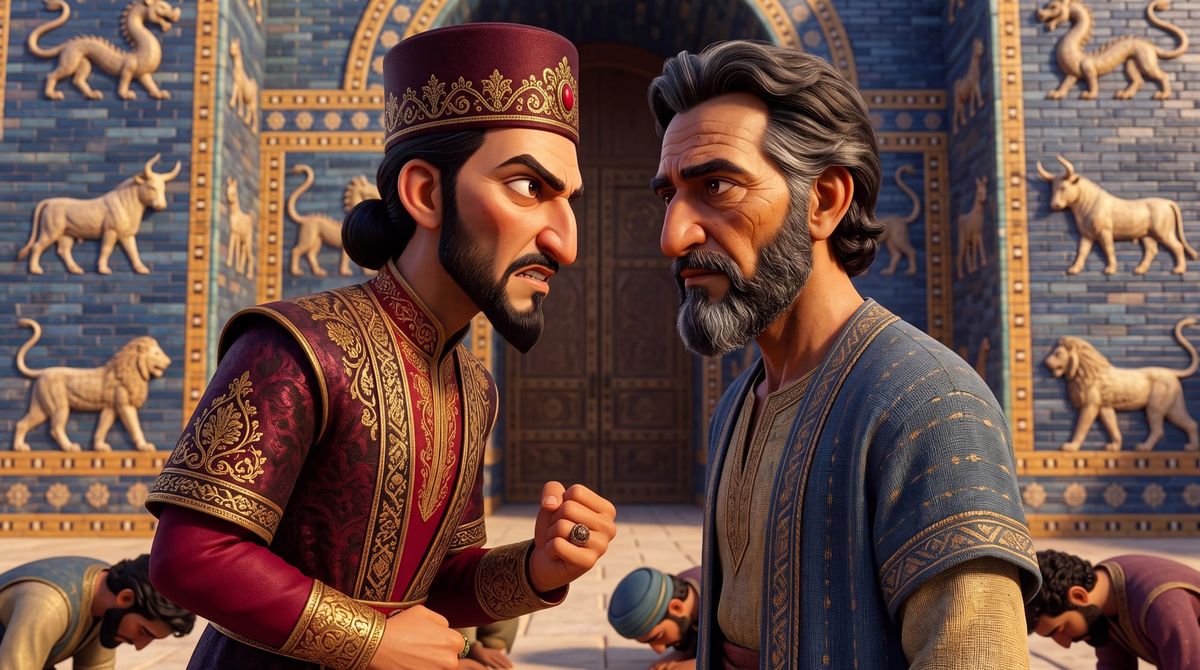
Miss last week?
Every lesson stands on its own — but together, they tell one continuous story.
 Bob LeBaron
Don’t Stop the Music
The Joy Tier starts right here. Go deeper into this week’s scripture story and explore the meaning behind the songs.
Inside Joy you’ll find:
- A weekly Fireside Moment overview of the Come, Follow Me lesson
- Expanded Set the Stage teaching guides for every song
- Choose Your Adventure family activities and simple weekly habits
- Lyric–Scripture Blueprints, printable coloring pages, and lyric sheets
- Cinematic reflection videos designed for quiet viewing and discussion
Access Joy below to turn this week’s song into a weeklong experience of scripture, music, and family conversation.