Before You Teach: A Fireside Moment
Before diving into individual lessons, here's a fireside overview of this week's scriptures.
The Ash Heap, the Accusers, and the Living Redeemer
Job 1–3; 12–14; 19; 21–24; 38–40; 42
Listen to the Full Fireside Moment
The Man Who Had Everything — and Then Didn't

Job 1:1–3, 20–22; 2:7–10; 2 Nephi 4:30–34; D&C 122:7–8
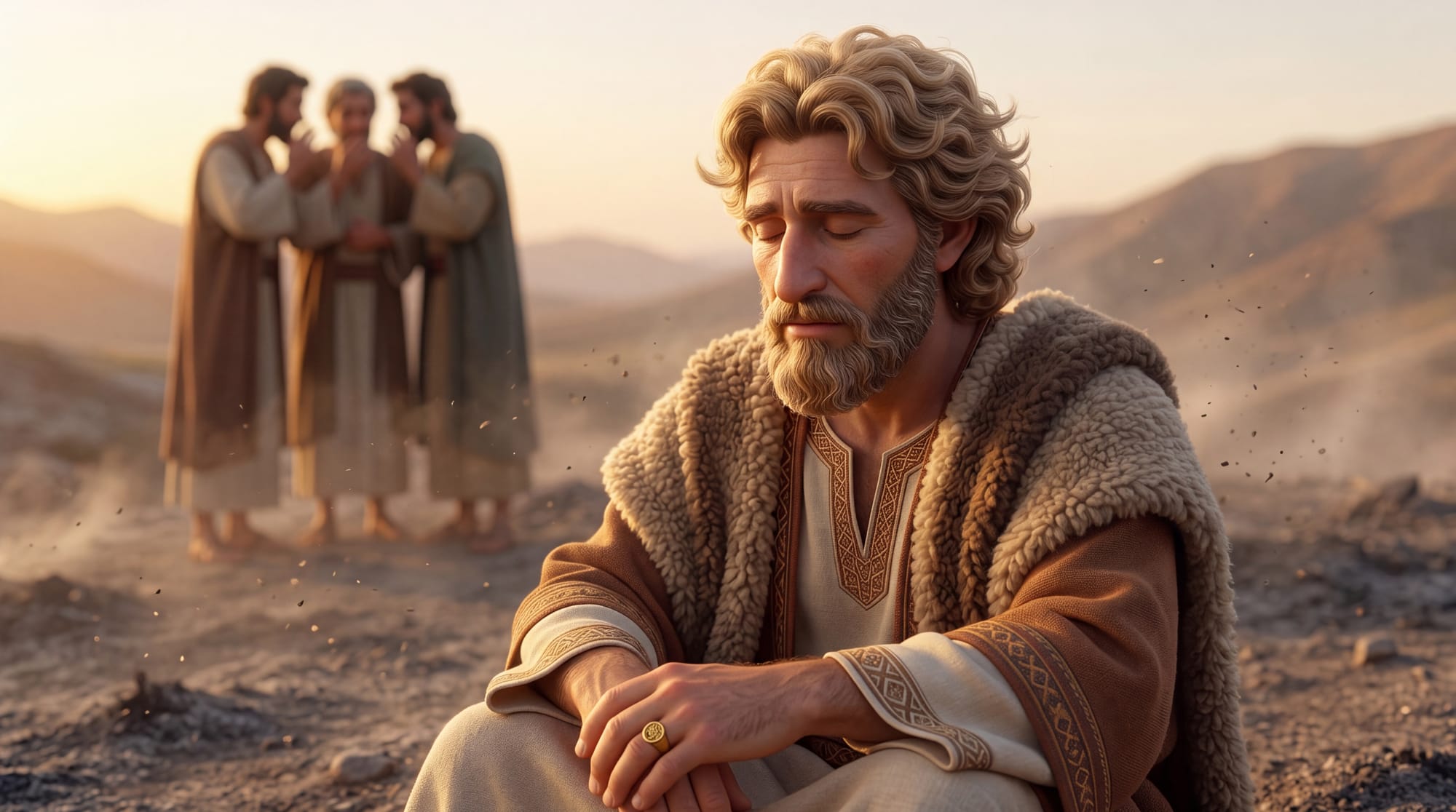
Seven thousand sheep. Three thousand camels. Five hundred yoke of oxen, five hundred female donkeys, a very great household, and ten children he loved. Job was, by any measure, the most prosperous man in the ancient Near East — and the most righteous. The text doesn't hedge on either point. 'That man was perfect and upright, and one that feared God, and eschewed evil.' That's not a neighbor's opinion. That's God's own assessment.
And then, in what feels like a single afternoon, it's gone. All of it. The livestock, the servants, the children — all ten of them, in one catastrophic moment. And then his health. Loathsome sores from the crown of his head to the soles of his feet, sitting in the ash heap, scraping himself with a piece of broken pottery.
Here's the thing the opening chapters of Job are doing that we sometimes miss: they're not describing a literal boardroom negotiation between God and Satan. The Come, Follow Me lesson is careful about this — it's a poetic framing that establishes Satan's role as our adversary and accuser. The real question the text is asking is the one Satan poses about all of us: 'Does Job fear God for nothing?' In other words — is your faith real, or is it just a transaction? Do you love God because He's good, or because life is going well?
Job's first response to total devastation is one of the most stunning sentences in all of scripture: 'The Lord gave, and the Lord hath taken away; blessed be the name of the Lord.' No bargaining. No bitterness. Just a man who understood, at a bone-deep level, that everything he had was a gift to begin with.
The Book of Mormon echoes this posture throughout. Nephi, chained in the belly of a ship, being mocked by his brothers, writes: 'Nevertheless, I did look unto my God, and I did praise him all the day long' (2 Nephi 4:30, 34). Different circumstances, same anchor. The question for our families isn't whether hard things will come. They will. The question is what we're actually standing on when they do.
Dive Deeper: Yet Will I Trust Him
 Bob LeBaron
The Friends Who Made Everything Worse

Job 2:11–13; 4–5; 8; 11; 12:1–3; 13:4–5; Mosiah 23:21–23; Ether 12:27; D&C 58:3–4
Give Job's three friends a little credit — at first. When Eliphaz, Bildad, and Zophar heard what had happened, they traveled to be with him. They sat with him on the ground for seven days and seven nights without saying a word, because they could see his grief was overwhelming. That's actually beautiful. That's what good friends do.
And then they opened their mouths.
The argument they make, over and over across multiple chapters, is theologically tidy and completely wrong: God rewards the righteous and punishes the wicked. Job is suffering. Therefore, Job must have sinned. It's the ancient version of 'everything happens for a reason' — which sounds comforting until you're the one in the ash heap and someone is using it to imply you brought this on yourself.
Job pushes back hard. He doesn't deny that God is powerful or just. He insists on his own integrity — not out of arrogance, but out of genuine bewilderment. He knows what he knows about God, and he knows what he knows about himself, and the two don't add up the way his friends say they should. In chapters 12 and 13, he essentially tells them: you're not helping, you're performing. 'Ye are forgers of lies, ye are all physicians of nothing.' Ouch.
The Come, Follow Me lesson asks a sharp question here: why would it be dangerous to obey God solely for the reason Satan suggested — meaning, only because life is going well? Job's friends had built their entire theology on that transaction. When the transaction broke down in front of them, they couldn't handle it, so they blamed Job instead of expanding their understanding of God.
This is a real conversation to have with teenagers especially. The restored gospel doesn't promise that faithfulness equals comfort. Mosiah 23:21 is direct: 'Nevertheless the Lord seeth fit to chasten his people; yea, he trieth their patience and their faith.' The refiner's fire isn't a sign that something went wrong. Sometimes it's a sign that something is going exactly right.
Dive Deeper: Yet Will I Trust Him
 Bob LeBaron
I Know That My Redeemer Liveth

Job 19:1–27; D&C 121:1–9; 122:5–9; Alma 11:42–44; 2 Nephi 9:6–7
Job 19 is the pivot point of the whole book. Everything before it is loss and argument and grief. And then, in the middle of cataloguing his suffering — abandoned by his brothers, forgotten by his acquaintances, estranged even from his wife, his body wasting away — Job says something that stops the whole conversation cold.
'For I know that my redeemer liveth, and that he shall stand at the latter day upon the earth: And though after my skin worms destroy this body, yet in my flesh shall I see God.'
Read that again slowly. This man, sitting in ashes, covered in sores, having lost everything, with friends who are accusing him and a God who seems silent — this man declares a testimony of the living Redeemer and the literal resurrection of the body. Not as a desperate wish. As something he knows.
The Come, Follow Me lesson makes the point gently but clearly: sometimes we learn the most important truths during our most difficult times. Job didn't arrive at this testimony in a comfortable moment. He arrived at it in the worst moment of his life. That's not a coincidence. The pressure of the trial forced him to reach for something deeper than his circumstances, and what he found there was Jesus Christ.
This is one of the earliest and clearest messianic testimonies in all of scripture — a non-Israelite man, living possibly in the era of Abraham, bearing witness of a Redeemer who would stand upon the earth. The Doctrine and Covenants echoes this in a remarkable way. In section 121, Joseph Smith is in Liberty Jail — his own ash heap — and the Lord's response isn't an explanation. It's a reminder of who is in charge and what is coming: 'All these things shall give thee experience, and shall be for thy good' (D&C 122:7).
For your family: the question isn't just 'do you believe in the Resurrection?' It's 'does that belief actually change how you face hard days?' Job's answer was yes. What's ours?
Dive Deeper: Yet Will I Trust Him
 Bob LeBaron
When He Hath Tried Me — The Refiner's Logic

Job 23:10; 21–24; Abraham 3:22–26; Ether 12:27; Mosiah 23:21–23; 24:10–16; 2 Nephi 2:11–13; D&C 58:3–5
Job 23:10 is one of those verses that sounds like a bumper sticker until you actually sit with it: 'But he knoweth the way that I take: when he hath tried me, I shall come forth as gold.'
The debate in chapters 21–24 is essentially Job and his friends arguing about the same data set and reaching opposite conclusions. His friends look at suffering and see punishment. Job looks at suffering and sees — eventually, painfully — a process. A refiner doesn't put ore in the fire because he hates the ore. He puts it in the fire because he knows what's inside it and he wants to get it out.
The restored gospel gives us language for this that the ancient world didn't have in the same way. Abraham 3:25 tells us plainly that we came to earth to be proved — 'to see if they will do all things whatsoever the Lord their God shall command them.' Ether 12:27 adds the mechanism: God gives us weaknesses so that we'll be humble, and if we humble ourselves, those weaknesses become strengths. That's not a consolation prize. That's the actual design.
President Spencer W. Kimball, who knew something about suffering — he dealt with serious illness for most of his adult life — taught that there are blessings that can only come through adversity. Not blessings that happen despite the trial, but blessings that are only available through it. The gold doesn't come out any other way.
The Book of Mormon gives us a beautiful case study in Mosiah 24. The people of Alma are in bondage under Amulon, who specifically forbids them from praying out loud. So they pray in their hearts. And the Lord's response is striking: He doesn't immediately remove the burden. He says, 'I will also ease the burdens which are put upon your shoulders, that even you cannot feel them upon your backs' (Mosiah 24:14). He made them strong enough to carry it — and then, in His timing, He delivered them.
That's the refiner's logic. Not cruelty. Not indifference. A Master Craftsman who knows exactly what He's working with and exactly what He's working toward.
Dive Deeper: Come Forth as Gold
 Bob LeBaron
Where Were You When I Laid the Foundations of the Earth?

Job 38:1–7, 18–24; 39; 42:1–6; Moses 1:8–10; D&C 121:33; Russell M. Nelson, 'Think Celestial!' (Nov. 2023 Liahona); Tamara W. Runia, 'Seeing God's Family through the Overview Lens' (Nov. 2023 Liahona)
After thirty-seven chapters of Job asking God to explain Himself, God finally speaks. And He doesn't answer the question.
What He does instead is take Job on a tour of the universe. 'Where wast thou when I laid the foundations of the earth? Who hath put wisdom in the inward parts? Canst thou bind the sweet influences of Pleiades, or loose the bands of Orion?' Chapter after chapter of the most breathtaking nature poetry in all of scripture — the dawn, the deep sea, the storehouses of snow, the mountain goats giving birth, the war horse, the eagle's nest on the cliff. God is essentially saying: look at what I hold. Look at the scale of what I'm managing. And then tell me again that you think I've lost track of you.
This is not God being dismissive. It's God being pastoral in the most cosmic way possible. Job needed a perspective shift, not an explanation. And the shift worked. Job's response in chapter 42 is one of the most moving moments in scripture: 'I have heard of thee by the hearing of the ear: but now mine eye seeth thee.' Something changed. Not his circumstances — not yet. His vision.
Moses 1:8–10 gives us a remarkable parallel. After Moses sees the glory of God and then is left alone, Satan comes to tempt him. Moses rebukes him, and then says something that sounds a lot like Job's transformation: 'I could not look upon God, except his glory should come upon me... but I can look upon thee in the natural man.' The encounter with God's greatness recalibrated everything else.
President Nelson's 'Think Celestial' and Sister Runia's 'Overview Lens' talk from the November 2023 Liahona are both doing the same thing God did for Job — inviting us to zoom out far enough that our current trial finds its proper proportion. Not minimized. Proportioned. There's a difference.
For your family: the next time something feels overwhelming, try the Job exercise. Go outside. Look at something enormous — the sky, a mountain, the ocean if you're lucky. Or look at something impossibly small and intricate. Then remember: the Being who made that knows your name.
The Restoration — and What It Actually Means

Job 42:1–17; Job 19:25–27; Alma 11:42–44; 2 Nephi 9:6–7; D&C 138:12–17
Job 42 is one of the most satisfying chapters in the Old Testament — and one of the most theologically careful ones, if you read it right.
God vindicates Job publicly. He tells Eliphaz directly: 'My wrath is kindled against thee, and against thy two friends: for ye have not spoken of me the thing that is right, as my servant Job hath.' The friends who spent thirty-plus chapters explaining Job's suffering as divine punishment are now the ones who need Job to pray for them. That's a remarkable reversal.
And then the restoration: 14,000 sheep (double the original 7,000). 6,000 camels (double). 1,000 yoke of oxen, 1,000 female donkeys (both doubled). His brothers and sisters and acquaintances — who had apparently been absent during the whole ordeal — come back, bringing gifts of silver and gold. He lives 140 more years and sees four generations of descendants.
And ten more children. Seven sons and three daughters — and the daughters are named, which is unusual in the ancient world and suggests they were remarkable: Jemimah, Keziah, and Keren-Happuch.
Here's where we need to be careful and honest, especially with our kids. The enrichment notes make this point beautifully: the new children are not replacements. While you can double livestock, you cannot replace a child with another child. Children are individual souls, known and loved by Heavenly Parents before they ever arrived. Job's grief for his first ten children wasn't erased by the arrival of ten more. What Job 42 shows us is God's power to restore joy and blessing to a shattered life — not a formula where loss gets quietly swapped out.
Job’s fullest restoration—the actual reunion with all twenty of his children, together, as the specific people they were—waits for the Resurrection. That is the promise underneath the whole story. Not that grief is erased in this life, but that nothing true is ever lost forever. The Redeemer Job testified of in chapter 19 is the same Redeemer who makes that reunion possible.
Our Family’s Furnace — Yet Will We Trust Him

Job never received a complete explanation for his suffering. He received something deeper: an encounter with God. He learned that even when he could not understand the path, he could trust the One who knew it.
That promise has become deeply personal for our family.
Mary and I have two children in heaven. Our son Alvin lived for four and a half hours after he was born. Four years later, our daughter Goldie died during childbirth. Both had bilateral renal agenesis—their kidneys never formed, which meant their lungs could not fully develop.
Both times, we knew months in advance what the doctors expected to happen. We met with specialists, explored every option, fasted, prayed, and asked the Lord for the miracle we knew He was capable of giving. We asked Him to give our children kidneys and allow them to live full earthly lives.
We did not receive that miracle.
That truth became especially tender as we studied Elijah and Elisha. Both prophets raised a child from the dead. The Savior also raised children and others from death. We believe those accounts completely. We know Jesus Christ had—and still has—the power to heal Alvin and Goldie.
But knowing He was able does not mean we understand why He did not.
For a long time, we couldn't help but quietly wonder whether we should have shown more faith. Could we have prayed harder, fasted longer, or believed more completely? Would greater faith have produced a different ending?
Shadrach, Meshach, and Abednego understood that faith is not confidence in one particular outcome. Standing before the fiery furnace, they testified that God was able to deliver them—and then added three of the most faithful words in scripture:
“But if not” (Daniel 3:18).
They chose faithfulness before they knew what God would do.
They were delivered from the furnace. But scripture also gives us stories in which the fire was not stopped. Abinadi was not spared. In Alma 14, believing women and children were cast into a fire while Alma and Amulek watched in anguish. Although God had the power to intervene, Alma explained that the Lord would receive the innocent unto Himself in glory.
Scripture gives us both kinds of stories: fires that were stopped and fires that were not. The difference was not a measurement of anyone’s faith. We do not always know why God intervenes in one circumstance and permits another to continue. We only know that He can consecrate even the suffering He does not remove and use it to help us become more like His Son. But it rarely feels like a gift while we are living through it.
Joseph Smith received a similarly sobering message while suffering in Liberty Jail—his own ash heap. The Lord described trials that could still come, including betrayal, imprisonment, and the loss of loved ones, and then said, “Thou art not yet as Job” (D&C 122:8).
The Lord did not explain every reason for Joseph’s suffering or immediately remove it. Instead, He promised that these experiences could give him experience and be for his good. He also reminded Joseph that “the Son of Man hath descended below them all” (D&C 122:8).
That is the comfort Mary and I have held onto. We were never promised that we would avoid every furnace. But the Lord did promise, “Draw near unto me and I will draw near unto you” (D&C 88:63). We came to understand that Christ might not remove the flames—but He would be with us in them.
And He was.

When Alvin was born, a warm and sacred spirit filled the room. He was so small. We counted his ten fingers and ten toes. We saw his pouty lips, his soft skin, and the little dimple on the tip of his nose. Each breath and each cry was a celebration of his life.
We wished we could give him our kidneys and our lungs. We wished we could learn his favorite color, hear his laugh, and watch him play with his brothers and sisters. But as I held him, the Spirit witnessed to me that we would see him again. We would hold him again. What had been lost would be restored.

Four years later, we entered another hospital room with Goldie. She also had ten fingers, ten toes, pouty lips, soft skin, and the same sweet nose as her brother. Although we did not get to hear her cry or spend the few hours with her that we had yearned for, the Lord again gave us a witness that her life had not ended and that we would hold her again.
We did not receive the miracle we requested. But we received miracles.
We received strength for days we did not believe we could face. We were carried by family and friends who mourned with us. Sacred peace entered rooms filled with grief. Most importantly, we received a witness that death would not have the final word.
Even the names of our children carry that promise.
We named Alvin after Joseph Smith’s older brother, whom Joseph saw in the celestial kingdom in D&C 137. Years later, we named Goldie because we remembered a scripture describing the streets of heaven as being paved with gold. When I looked for the passage, I wept as I realized that it was the same vision:
“I saw the beautiful streets of that kingdom, which had the appearance of being paved with gold,” followed shortly afterward by, “my brother Alvin, that has long since slept” (D&C 137:4–5).
We did not intentionally create that connection. But looking back, it feels as though the Lord placed both children inside the same scriptural promise: Alvin named for the brother Joseph saw there, and Goldie named for the gold that surrounded him.
That same revelation declares that “all children who die before they arrive at the years of accountability are saved in the celestial kingdom of heaven” (D&C 137:10).
Their place with God was never dependent upon whether their parents prayed hard enough. It was never something we had to earn for them. Because of Jesus Christ, Alvin and Goldie are not lost—and they are not waiting to be replaced. They are waiting to be held again.
That is why Job’s words mean so much to us.
Coming forth as gold does not mean the faithful will always be spared the fire. Gold is refined because it passes through the fire. Faith is not proven only when the prison opens, the child is healed, or the flames leave us untouched. Sometimes faith sounds like, “He is able to deliver us—but if not, we will still trust Him.”
The widows who received miracles through Elijah and Elisha first offered what little they had. One gave her last meal. Another gathered empty vessels and began to pour. Their faith did not purchase a miracle or force God’s hand. It created space in which they could encounter Him.
We also poured out what we had. We fasted. We prayed. We searched. We hoped.
God met us there—not with the miracle we had asked for, but with His presence beside us in our grief.
The Lord’s promise to draw near does not mean every prayer will be answered in the way we hope. It means that when we reach for Him—from the ashes, the prison, or the furnace—we will find that He is reaching for us. He may not always remove the fire, but He will not leave us to face it alone.
Sometimes the heat is not there to burn us. It is there to build us.
I would never choose to pass through these trials again. I would not wish them on anyone. But if we are called to pass through another furnace, I know we will not pass through it alone. Jesus Christ has descended below all things. He knows our grief, our questions, our pains, and our infirmities. He does not watch the fire from a distance. He meets us in the middle of it.
This is the shared testimony behind the songs we wrote for Job and earlier for Joseph of Egypt.
Gold in the Fire is Joseph serving faithfully in the darkness, long before the dungeon door opens.
Come Forth as Gold is Job trusting that the Master Craftsman can bring something holy through the refining.
Yet Will I Trust Him is the declaration that even when heaven seems silent and the miracle does not look like the one we requested, God’s character has not changed.
He is still able to deliver. He is still a God of miracles. What was lost will still be restored—fully, specifically, and by name.
And until that day, yet will we trust Him.