The Orphan Queen, the Unfinished Feud, and the Moment That Changed Everything
Esther
Listen to the full lesson
The Orphan Who Became Queen
Esther 2:5-7, 21-23; Esther 4:14; 1 Nephi 3:7; Ether 12:27; D&C 64:33; Elder Ronald A. Rasband, 'By Divine Design,' Nov. 2017; President Dieter F. Uchtdorf, 'Lift Where You Stand,' Nov. 2008
What are the odds? An orphaned Jewish girl, raised by her older cousin in a foreign empire, ends up in the royal palace of Persia — and then becomes queen at the exact moment her people need someone on the inside. If you ran those numbers, you'd call it impossible. But Elder Ronald A. Rasband has a different word for it: divine design. "What may appear to be a random chance is, in fact, overseen by a loving Father in Heaven," he taught. "The Lord is in the small details of our lives."
Here's what the small details look like in Esther's story. Her parents died — that's a tragedy, not a lucky break. Her cousin Mordecai took her in and raised her as his own daughter (Esther 2:7). Then a kingdom-wide search for a new queen sweeps her into the palace. Then Mordecai, sitting at the king's gate one ordinary afternoon, happens to overhear two guards plotting to assassinate King Ahasuerus (who is also more famously known as King Xerxes) — and reports it through Esther, and it gets recorded in the royal chronicles (Esther 2:21–23). That detail will matter enormously later. None of these moments feel like a master plan in the moment. They feel like life just... happening.
But that's exactly the point. President Dieter F. Uchtdorf put it plainly: each of us "stands at a unique place and has an important task that only [we] can perform. There may be people and hearts only you can reach and touch. Perhaps no one else could do it in quite the same way." Esther's unique place was a Persian throne room. Yours might be a school hallway, a neighborhood, a family dinner table, or a friendship that nobody else could have built.
The Book of Mormon echoes this same idea. Moroni tells us the Lord works through "weak things" to accomplish His purposes (Ether 12:27), and Nephi's whole story is built on the conviction that the Lord prepares a way for those He calls (1 Nephi 3:7). Esther didn't feel powerful. She felt hidden — she'd been keeping her Jewish identity secret on Mordecai's advice. But hidden and prepared are not the same thing.
For your family tonight: If you have a patriarchal blessing, this is a great week to pull it out. It's your personal "for such a time as this" document.
Dive Deeper: For Such a Time as This
Lyric Scripture Blueprint
Open +
Lyric Highlight
Scripture Bridge
Why It Matters
"Crown on. Head high."
Esther 2:17 "And the king loved Esther above all the women, and she obtained grace and favour in his sight more than all the virgins; so that he set the royal crown upon her head, and made her queen instead of Vashti."
D&C 121:45 "Let virtue garnish thy thoughts unceasingly; then shall thy confidence wax strong in the presence of God."
Proverbs 31:25 "Strength and honour are her clothing; and she shall rejoice in time to come."
Dignity Before Destiny: The intro is not vanity — it is a declaration of readiness. Esther's crown was placed on her head by a king who didn't know she was Jewish, but the real crown was the covenant identity she carried underneath. D&C 121:45 teaches that virtue — not position — is what gives a person confidence in high-stakes moments. Proverbs 31 frames this as a woman clothed in strength before the crisis ever arrives. For families: talk about what it means to 'crown up' spiritually before a hard conversation or a scary moment — what does your inner preparation look like?
"Keeping it quiet, didn't say a word / But now the truth is gonna be heard / Living in the palace, pretty and nice / But freedom comes with a heavy price"
Esther 2:10 "Esther had not shewed her people nor her kindred: for Mordecai had charged her that she should not shew it."
Esther 4:14 "For if thou altogether holdest thy peace at this time, then shall there enlargement and deliverance arise to the Jews from another place; but thou and thy father's house shall be destroyed: and who knoweth whether thou art come to the kingdom for such a time as this?"
Mosiah 18:9 "Yea, and are willing to mourn with those that mourn; yea, and comfort those that stand in need of comfort, and to stand as witnesses of God at all times and in all things, and in all places."
Hidden Identity, Appointed Moment: Esther's silence was strategic, not cowardly — Mordecai instructed it. But the moment arrives when concealment becomes complicity, and the covenant demands she speak. Mosiah 18:9 is the baptismal covenant standard: to stand as a witness at all times, in all places — including inside a Persian palace. The 'heavy price' of freedom is exactly this: covenant people are not permitted to stay comfortable when others are in danger. For families: ask your children if there has ever been a moment when staying quiet felt easier than speaking up for what was right — and what helped them find their voice.
"They made a law, said my people gotta go / But there's a secret that the King doesn't know"
Esther 3:13 "And the letters were sent by posts into all the king's provinces, to destroy, to kill, and to cause to perish, all Jews, both young and old, little children and women, in one day."
Esther 7:3–4 "Then Esther the queen answered and said, If I have found favour in thy sight, O king, and if it please the king, let my life be given me at my petition, and my people at my request: For we are sold, I and my people, to be destroyed, to be slain, and to perish."
1 Nephi 22:17 "Wherefore, he will preserve the righteous by his power, even if it so be that the fulness of his wrath must come, and the righteous be preserved, even unto the destruction of their enemies by fire."
The Hidden Covenant People: Haman's decree looked like the end of the story, but the King of Persia didn't know what the King of Heaven already had in motion. Esther's Jewish identity — the very secret she had kept — became the key that unlocked deliverance. Nephi's prophecy in 1 Nephi 22 echoes the same pattern: the Lord preserves His covenant people even when earthly powers decree otherwise. For families: this is a great moment to talk about how God's plans are often hidden from the world but not from those who are paying attention — and how our own covenant identity is never a liability, even when it feels like one.
"Mordecai said 'Don't you stay inside' / 'There's nowhere left for you to run and hide' / If I keep silent, help will come from somewhere else / But I can't live with myself!"
Esther 4:13–14 "Think not with thyself that thou shalt escape in the king's house, more than all the Jews. For if thou altogether holdest thy peace at this time, then shall there enlargement and deliverance arise to the Jews from another place; but thou and thy father's house shall be destroyed."
Alma 60:11 "But behold, great has been the slaughter among our people; yea, thousands have fallen by the sword, while it might have otherwise been if ye had rendered unto our armies sufficient strength and succor for them."
D&C 58:27–28 "Verily I say, men should be anxiously engaged in a good cause, and do many things of their own free will, and bring to pass much righteousness; For the power is in them, wherein they are agents unto themselves."
Agency and Accountability: Mordecai's words are among the most theologically loaded in the entire Old Testament. He does not say 'God needs you.' He says deliverance will come regardless — but Esther will have forfeited her place in it. D&C 58 frames this as the doctrine of agency: the Lord does not compel, but He does invite, and those who decline the invitation miss the moment. Alma 60 shows the same principle in a military context — inaction has consequences. For families: Mordecai's challenge is one every family member will face in some form — the moment when staying comfortable means someone else pays the price. What does it look like to be 'anxiously engaged' in your own family's good causes?
"For such a time as this! / I was made to take a risk! / Not gonna bow, not gonna break / Everything is now at stake / Yeah, I was born for this moment, I can't miss / For such a time as this!"
Esther 4:14 "And who knoweth whether thou art come to the kingdom for such a time as this?"
D&C 138:53–56 "The Prophet Joseph Smith, and my father, Hyrum Smith, Brigham Young, John Taylor, Wilford Woodruff, and other choice spirits who were reserved to come forth in the fulness of times to take part in laying the foundations of the great latter-day work … Even before they were born, they, with many others, received their first lessons in the world of spirits and were prepared to come forth in the due time of the Lord."
Alma 13:3 "And this is the manner after which they were ordained — being called and prepared from the foundation of the world according to the foreknowledge of God, on account of their exceeding faith and good works."
Jeremiah 1:5 "Before I formed thee in the belly I knew thee; and before thou camest forth out of the womb I sanctified thee, and I ordained thee a prophet unto the nations."
Foreordination and Covenant Courage: The chorus is the doctrinal heartbeat of the entire song. 'For such a time as this' is not motivational language — it is a theological statement about foreordination. D&C 138 and Alma 13 establish that choice spirits were reserved and prepared before birth for specific moments in history. Esther's story is not an accident of palace politics; it is a pre-mortal assignment arriving on schedule. 'Not gonna bow, not gonna break' echoes the same refusal Shadrach, Meshach, and Abednego made in Babylon — covenant people do not bend to earthly decrees when heaven has already spoken. For families: read D&C 138:53–56 together and ask each family member: what is the 'such a time as this' moment you might be being prepared for right now?
"Walk into the room, heart beating fast / Breaking the rules, could be my last / He's sitting on the throne, gold in his hand / I'm the only hope for everyone in the land"
Esther 5:1–2 "Now it came to pass on the third day, that Esther put on her royal apparel, and stood in the inner court of the king's house, over against the king's house: and the king sat upon his royal throne in the royal house, over against the gate of the house. And it was so, when the king saw Esther the queen standing in the court, that she obtained favour in his sight."
Esther 4:11 "All the king's servants, and the people of the king's provinces, do know, that whosoever, whether man or woman, shall come unto the king into the inner court, who is not called, there is one law of his to put him to death."
2 Nephi 2:27 "Wherefore, men are free according to the flesh; and all things are given them which are expedient unto man. And they are free to choose liberty and eternal life, through the great Mediator of all men, or to choose captivity and death."
The Uninvited Approach: Esther's walk into the throne room is one of the most suspenseful moments in all of scripture precisely because the law was clear — approach uninvited and die. She went anyway. This is not recklessness; it is faith-informed courage. The gold scepter extended by the king is a type of the grace extended by the true King — access granted not because we earned it but because He chose to extend it. 2 Nephi 2:27 frames the deeper choice: Esther chose liberty and life for her people over personal safety. For families: talk about a time when doing the right thing felt genuinely risky — and what it felt like when the 'scepter was extended' and things worked out.
"He looks up, will he hold the scepter out? / Or will he call the guards and take me out?"
Esther 5:2 "And it was so, when the king saw Esther the queen standing in the court, that she obtained favour in his sight: and the king held out to Esther the golden sceptre that was in his hand. So Esther drew near, and touched the top of the sceptre."
Helaman 3:35 "Nevertheless they did fast and pray oft, and did wax stronger and stronger in their humility, and firmer and firmer in the faith of Christ, unto the filling their souls with joy and consolation, yea, even to the purifying and the sanctification of their hearts, which sanctification cometh because of their yielding their hearts unto God."
Matthew 7:7–8 "Ask, and it shall be given you; seek, and ye shall find; knock, and it shall be opened unto you: For every one that asketh receiveth; and he that seeketh findeth; and to him that knocketh it shall be opened."
Grace Extended: The scepter is the pivot point of the entire book. Everything before it is preparation; everything after it is deliverance. The king's choice to extend the scepter rather than call the guards is the moment where human courage meets divine favor. Helaman 3:35 shows the pattern: fasting and prayer yield sanctification, which yields the kind of favor Esther received. Matthew 7 confirms the principle is universal — those who approach in faith find the door opened. For families: the scepter moment is a beautiful image for prayer itself — we approach a throne uninvited, and the King extends grace. Help your children picture their own prayers as Esther walking into the throne room.
"If I perish, I perish (I know, I know) / But I gotta let this courage show! / (Here we go!)"
Esther 4:16 "Go, gather together all the Jews that are present in Shushan, and fast ye for me, and neither eat nor drink three days, night or day: I also and my maidens will fast likewise; and so will I go in unto the king, which is not according to the law: and if I perish, I perish."
Alma 56:47–48 "Now they never had fought, yet they did not fear death; and they did think more upon the liberty of their fathers than they did upon their lives; yea, they had been taught by their mothers, that if they did not doubt, God would deliver them. And they rehearsed unto me the words of their mothers, saying: We do not doubt our mothers knew it."
D&C 98:13 "And whoso layeth down his life in my cause, for my name's sake, shall find it again, even life eternal."
Consecrated Surrender: 'If I perish, I perish' is one of the most quietly powerful lines in all of scripture. It is not despair — it is consecration. Esther has done the math and decided that her people's survival outweighs her personal safety. The stripling warriors in Alma 56 carry the same spirit: they did not fear death because they had been taught that God would deliver them if they did not doubt. D&C 98:13 is the Lord's own promise that this kind of surrender is never wasted. For families: this is a rare and beautiful moment to talk about what it means to truly give something to God — not just say the words, but mean them the way Esther did.
"Three days praying. / Three days fasting. / I'm walking in. / Watch him smile... / Watch him raise the gold... / Full Volume! / THE KING SAYS YES!"
Esther 4:16 "Fast ye for me, and neither eat nor drink three days, night or day: I also and my maidens will fast likewise; and so will I go in unto the king."
Esther 5:2 "And the king held out to Esther the golden sceptre that was in his hand. So Esther drew near, and touched the top of the sceptre."
Omni 1:26 "And now I would that ye should come unto Christ, who is the Holy One of Israel, and partake of his salvation, and the power of his redemption. Yea, come unto him, and offer your whole souls as an offering unto him, and continue in fasting and your prayers."
Isaiah 58:6 "Is not this the fast that I have chosen? to loose the bands of wickedness, to undo the heavy burdens, and to let the oppressed go free, and that ye break every yoke?"
Fasting as Covenant Action: The bridge is the emotional climax of the song, and it earns every decibel of that final 'YES' because it shows the full sequence: three days of fasting and prayer, then the walk, then the miracle. Omni 1:26 frames fasting as offering your whole soul — not just skipping meals. Isaiah 58 reveals what true fasting is designed to accomplish: loosing bands, freeing the oppressed, breaking yokes — which is exactly what Esther's fast achieved for her people. The bridge teaches children that the miracle at the end is inseparable from the quiet, hungry, prayerful days that came before it. For families: consider making your next family fast intentional — name what you are fasting for, and let the children feel the connection between the sacrifice and the answer.
"I was made for this. / (Yeah!)"
Esther 4:14 "And who knoweth whether thou art come to the kingdom for such a time as this?"
D&C 138:55–56 "I observed that they were also among the noble and great ones who were chosen in the beginning to be rulers in the Church of God. Even before they were born, they, with many others, received their first lessons in the world of spirits and were prepared to come forth in the due time of the Lord to labor in his vineyard for the salvation of the souls of men."
Alma 13:3 "And this is the manner after which they were ordained — being called and prepared from the foundation of the world according to the foreknowledge of God, on account of their exceeding faith and good works."
2 Timothy 1:9 "Who hath saved us, and called us with an holy calling, not according to our works, but according to his own purpose and grace, which was given us in Christ Jesus before the world began."
Foreordained and Faithful: The outro strips everything down to its core. Not 'I was lucky for this' or 'I stumbled into this' — 'I was made for this.' This is Restoration theology in four words. D&C 138 and Alma 13 establish that the Lord's preparation of His servants is not reactive — it is pre-mortal, intentional, and specific. 2 Timothy 1:9 confirms that the calling was given before the world began. Esther's story ends not with her name in lights but with her people saved — which is exactly what she was made for. For families: close your study this week by having each family member finish this sentence out loud: 'I was made for ___.' Let the Spirit fill in what comes next.
Esther 2:5-6; Esther 3:1-15; 1 Samuel 15:1-23; Proverbs 16:32; Alma 5:28; Esther 9:10, 15-16
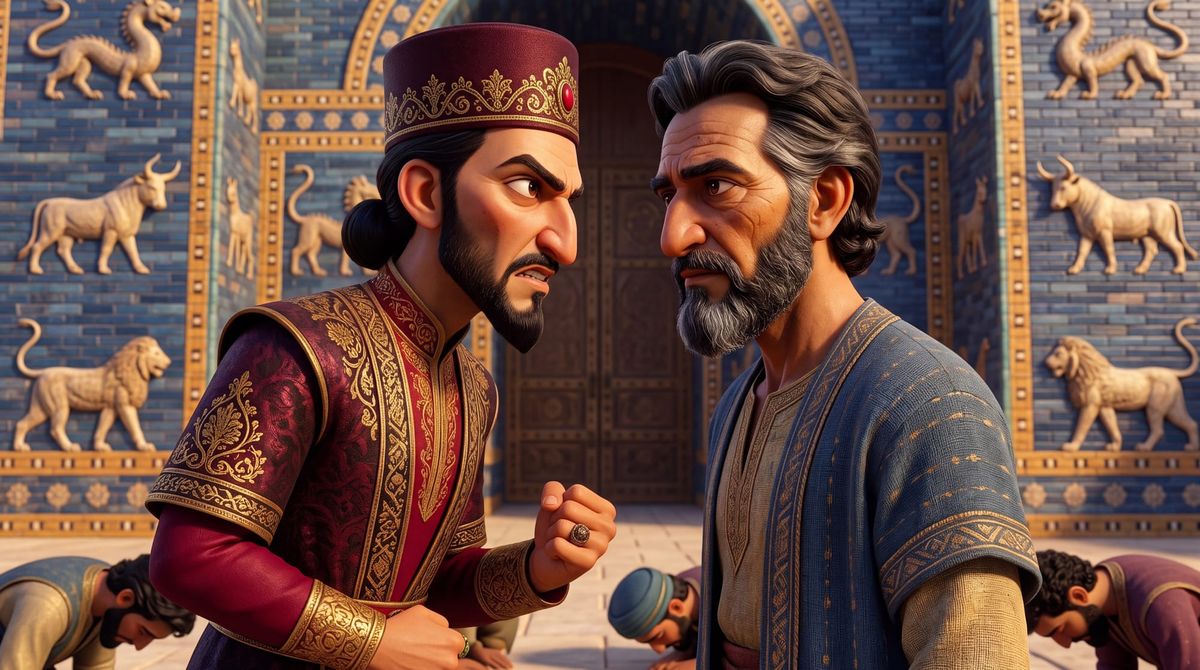
Haman gets promoted to the second-highest position in the Persian Empire, and King Ahasuerus issues a royal decree: everyone bow. And everyone does — except one guy sitting at the king's gate. Mordecai. Won't budge. Day after day, the royal officials nudge him. "Dude. Just bow." Mordecai refuses (Esther 3:2–4).
Haman is furious. But here's where the story gets much bigger than one man's wounded ego. The text goes out of its way to introduce Haman with a very specific title: "Haman the Agagite" (Esther 3:1). And it goes out of its way to trace Mordecai's lineage back through a man named Kish, of the tribe of Benjamin (Esther 2:5). If those names ring a bell, they should. Five hundred years earlier, God commanded King Saul — a Benjaminite, son of Kish — to completely defeat the Amalekites and their king, Agag (1 Samuel 15). Saul disobeyed. He spared Agag's life, kept the livestock as plunder, and lost his crown over it.
TRIBE OF BENJAMIN
THE AMALEKITES
Kish
King Agag
King Saul
(failed to defeat Agag)
(500 years)
Haman the Agagite
Jair
Mordecai
Esther
Haman
500-Year Matchup
Now, five centuries later, a descendant of Agag is standing across from a descendant of Kish. The ancient, unfinished conflict has a new chapter.
Haman's response to Mordecai's refusal is wildly disproportionate — he doesn't just want to punish Mordecai, he wants to annihilate every Jewish person in the entire empire (Esther 3:6). He goes to the king with a bag of silver and a smooth pitch: there's a people whose customs are different, who don't keep the king's laws — let's get rid of them. The king hands over his signet ring. The decree goes out. A date is chosen by casting lots for the slaughter of the Jews (Esther 3:7, 13).
And then the text gives us this haunting little detail: "The king and Haman sat down to drink; but the city Shushan was perplexed" (Esther 3:15). The powerful are toasting. The city is in shock.
Proverbs 16:32 says it plainly: "He that is slow to anger is better than the mighty." Haman had all the power and none of the self-control. Alma 5:28 asks us to check our own hearts — are we "stripped of pride"? Haman is a case study in what happens when the answer is no.
For your family: Mordecai and Esther weren't just saving their people — they were finishing what Saul started and never completed. When we stand firm in our covenants, we can heal generational failures and set a new standard for everyone who comes after us.
Dive Deeper: That Guy, Mordecai
Lyric Scripture Blueprint
Open +
Lyric Highlight
Scripture Bridge
Why It Matters
"Second only to the king. / Everybody bows. / (Except one guy.)"
Esther 3:1–2 "After these things did king Ahasuerus promote Haman the son of Hammedatha the Agagite, and advanced him, and set his seat above all the princes that were with him. And all the king's servants, that were in the king's gate, bowed, and reverenced Haman: for the king had so commanded concerning him. But Mordecai bowed not, nor did him reverence."
Acts 5:29 "We ought to obey God rather than men."
D&C 98:22 "And again I say unto you, if ye observe to do whatsoever I command you, I, the Lord, will turn away all wrath and indignation from you."
Obedience to God Over Man: The intro drops us straight into the central tension of the entire book — one man refuses to bow. Mordecai's refusal was not stubbornness or bad manners; it was a covenant act. Jewish tradition held that bowing to Haman, a descendant of the Amalekite king Agag, would have been a form of idolatrous submission. Acts 5:29 captures the same principle the apostles lived by, and D&C 98 promises the Lord's protection to those who hold the line. For families: ask your kids what it looks like to 'not bow' in their world — what pressures exist to go along with something that conflicts with their covenants?
"I got promoted to the top of the royal food chain, / Second only to King Xerxes, that's my whole domain. / Every single person in the kingdom hits the floor, / When I walk on by they bow down to the ground and more."
Esther 3:1 "After these things did king Ahasuerus promote Haman the son of Hammedatha the Agagite, and advanced him, and set his seat above all the princes that were with him."
Proverbs 16:18 "Pride goeth before destruction, and an haughty spirit before a fall."
Alma 5:28 "Behold, are ye stripped of pride? I say unto you, if ye are not ye are not prepared to meet God."
Pride and Its Setup: The song opens from Haman's point of view — and that is a deliberate storytelling choice. We hear his pride in his own voice, which makes it both funny and convicting. Proverbs 16:18 is the ancient world's warning label on exactly this kind of self-congratulation, and Alma 5:28 makes it personal and eternal. The Book of Mormon is relentless about pride as a spiritual diagnostic — not just a personality flaw but a covenant danger. For families: Haman's pride sounds ridiculous when sung out loud, which is the point — pride always sounds more reasonable from the inside than it looks from the outside.
"But there's this one guy sitting at the gate, / Named Mordecai, and he won't participate."
Esther 2:19–21 "And when virgins were gathered together the second time, then Mordecai sat in the king's gate."
Esther 3:2 "But Mordecai bowed not, nor did him reverence."
1 Nephi 3:7 "I will go and do the things which the Lord hath commanded, for I know that the Lord giveth no commandments unto the children of men, save he shall prepare a way for them to accomplish the thing which he commandeth them."
D&C 121:45 "Let thy bowels also be full of charity towards all men, and to the household of faith, and let virtue garnish thy thoughts unceasingly; then shall thy confidence wax strong in the presence of God."
Covenant Courage at the Gate: Mordecai's position 'at the gate' is not incidental — it is where he would later overhear the assassination plot that saved the king's life. His faithfulness in a small, daily act of covenant integrity placed him exactly where God needed him. Nephi's declaration in 1 Nephi 3:7 is the Book of Mormon's clearest statement that obedience and divine preparation travel together. D&C 121:45 connects virtue and confidence — Mordecai's quiet refusal to bow was an act of that kind of virtue. For families: the 'gate' in your child's life might be a lunch table, a group chat, or a locker room — the place where daily small choices of integrity are made.
"So I said 'Fine, we'll take out the Jews, / Every last one, they can pick the day they lose.' / Went to the king with a bag of silver in my hand."
Esther 3:8–9 "And Haman said unto king Ahasuerus, There is a certain people scattered abroad and dispersed among the people in all the provinces of thy kingdom; and their laws are diverse from all people; neither keep they the king's laws: therefore it is not for the king's profit to suffer them. If it please the king, let it be written that they may be destroyed: and I will pay ten thousand talents of silver to the hands of those that have the charge of the business."
Esther 3:13 "And the letters were sent by posts into all the king's provinces, to destroy, to kill, and to cause to perish, all Jews, both young and old, little children and women, in one day."
2 Nephi 9:28 "O that cunning plan of the evil one! O the vainness, and the frailties, and the foolishness of men!"
Wrath Weaponized: Haman's wounded pride escalates instantly from personal offense to genocidal policy — and he funds it himself. This is the Book of Mormon's 'cunning plan of the evil one' made flesh: personal vanity dressed up as civic necessity. The ten thousand talents of silver is an almost incomprehensible sum — Haman was willing to bankrupt himself to destroy one man's people. 2 Nephi 9:28 names the pattern: vainness and foolishness masquerading as power. For families: Haman's reaction to Mordecai is a case study in what happens when we let a small offense grow unchecked — it metastasizes into something that harms far more people than just the original target.
"That guy, Mordecai! / Won't bow down and I don't know why! / Every single knee is on the ground but his, / Gonna teach him what a bow really is."
Esther 3:5 "And when Haman saw that Mordecai bowed not, nor did him reverence, then was Haman full of wrath."
Philippians 2:10–11 "That at the name of Jesus every knee should bow, of things in heaven, and things in earth, and things under the earth; And that every tongue should confess that Jesus Christ is Lord."
Mosiah 27:31 "Yea, every knee shall bow, and every tongue confess before him. Yea, even at the last day, when all men shall stand to be judged of him, then shall they confess that he is God."
The Only Knee Worth Bending: The chorus is Haman's obsession on loop — and the irony is rich. He is furious that Mordecai won't bow to him, while the entire New Testament and Book of Mormon are clear that every knee will one day bow to the only One who deserves it. Mosiah 27:31 is the Book of Mormon's direct echo of Philippians 2 — both point to the final judgment as the moment when all false claims to supremacy collapse. Mordecai's refusal to bow to Haman was, in a sense, a preview of that eternal truth: there is only one throne worth kneeling before. For families: the chorus is catchy precisely because Haman's obsession sounds absurd — use that absurdity to open a conversation about what or who your family bows to with their time, attention, and loyalty.
"So the king can't sleep and he's flipping through his book, / Reading about how Mordecai saved him from a crook. / King says 'Man, we never even honored him for that.'"
Esther 6:1–3 "On that night could not the king sleep, and he commanded to bring the book of records of the chronicles; and they were read before the king. And it was found written, that Mordecai had told of Bigthana and Teresh, two of the king's chamberlains, the keepers of the door, who sought to lay hand on the king Ahasuerus. And the king said, What honour and dignity hath been done to Mordecai for this? Then said the king's servants that ministered unto him, There is nothing done for him."
Esther 2:21–23 "In those days, while Mordecai sat in the king's gate, two of the king's chamberlains, Bigthan and Teresh, of those which kept the door, were wroth, and sought to lay hand on the king Ahasuerus. And the thing was known to Mordecai, who told it unto Esther the queen; and Esther certified the king thereof in Mordecai's name. And when inquisition was made of the matter, it was found out; therefore they were both hanged on a tree: and it was written in the book of the chronicles before the king."
Alma 37:6 "Now ye may suppose that this is foolishness in me; but behold I say unto you, that by small and simple things are great things brought to pass."
Divine Insomnia and Small Records: The king's sleepless night is one of the most quietly miraculous moments in all of scripture. There was no angel, no vision, no burning bush — just a restless king and a dusty record book. Alma 37:6 is the Book of Mormon's theological framework for exactly this kind of moment: small and simple things, faithfully recorded and faithfully done, become the hinge on which great deliverances turn. Mordecai's earlier act of loyalty — reported, recorded, and apparently forgotten — was preserved in the chronicles for precisely this night. For families: this is a powerful moment to talk about journals, patriarchal blessings, and family histories — the records we keep may matter more than we know, and at a time we cannot predict.
"He says 'Haman, tell me, what should I do for a man, / Who I want to honor above every other man in the land?' / Now I'm thinking he's talking about me, obviously, / So I paint him the parade of a lifetime, verbally. / Royal robes, royal horse, royal crown on top, / Someone leading through the streets and they can't ever stop. / Shouting 'This is what the king does for the guy he loves!' / And the king says 'Perfect! Do all that... for Mordecai!'"
Esther 6:6–10 "So Haman came in. And the king said unto him, What shall be done unto the man whom the king delighteth to honour? Now Haman thought in his heart, To whom would the king delight to do honour more than to myself? And Haman answered the king, For the man whom the king delighteth to honour, Let the royal apparel be brought which the king useth to wear, and the horse that the king rideth upon, and the crown royal which is set upon his head: And let this apparel and horse be delivered to the hand of one of the king's most noble princes, that they may array the man withal whom the king delighteth to honour, and bring him on horseback through the street of the city, and proclaim before him, Thus shall it be done to the man whom the king delighteth to honour. Then the king said to Haman, Make haste, and take the apparel and the horse, as thou hast said, and do even so to Mordecai the Jew."
Proverbs 16:32 "He that is slow to anger is better than the mighty; and he that ruleth his spirit than he that taketh a city."
D&C 121:39 "We have learned by sad experience that it is the nature and disposition of almost all men, as soon as they get a little authority, as they suppose, they will immediately begin to exercise unrighteous dominion."
Pride's Perfect Trap: Haman walks into the most exquisite irony in the Old Testament — he designs his own humiliation while thinking he is designing his own coronation. D&C 121:39 is the Restoration's clearest diagnosis of what went wrong: the moment Haman received authority, he assumed it existed to serve him. Proverbs 16:32 holds up the contrast — the man who rules his own spirit is greater than any military conqueror, and Mordecai, sitting quietly at the gate, embodied exactly that. For families: the scene is genuinely funny, and laughter is a gift here — but underneath the comedy is a serious question: when we are given authority or opportunity, whose glory do we reach for first?
"So I led the man I hate through the town, / Shouted honor with my head down in a frown. / Went home covered in the shame that I built."
Esther 6:11–12 "Then took Haman the apparel and the horse, and arrayed Mordecai, and brought him on horseback through the street of the city, and proclaimed before him, Thus shall it be done unto the man whom the king delighteth to honour. And Mordecai came again to the king's gate. But Haman hasted to his house mourning, and having his head covered."
Proverbs 11:2 "When pride cometh, then cometh shame: but with the lowly is wisdom."
2 Nephi 9:42 "And whoso knocketh, to him will he open; and the wise, and the learned, and they that are rich, who are puffed up because of their learning, and their wisdom, and their riches — yea, they are they whom he despiseth."
Shame That Pride Built: Haman goes home with his head covered — the ancient gesture of grief and disgrace. Proverbs 11:2 is almost a caption for the scene: pride arrives, shame follows. 2 Nephi 9:42 deepens it — those puffed up by their position are precisely the ones the Lord sets aside. The pre-chorus is the pivot point of the song: Haman is still singing, but the tone has shifted from swagger to dread. For families: the phrase 'covered in the shame that I built' is worth sitting with — Haman's shame was entirely self-constructed, brick by brick, choice by choice. That is always how it works.
"That guy, Mordecai! / Won't bow down and I don't know why! / Every single knee is on the ground but his, / Now I'm learning what a real bow is."
Esther 6:12–13 "And Mordecai came again to the king's gate. But Haman hasted to his house mourning, and having his head covered. And Haman told Zeresh his wife and all his friends every thing that had befallen him. Then said his wise men and Zeresh his wife unto him, If Mordecai be of the seed of the Jews, before whom thou hast begun to fall, thou shalt not prevail against him, but shalt surely fall before him."
Isaiah 45:23 "I have sworn by myself, the word is gone out of my mouth in righteousness, and shall not return, That unto me every knee shall bow, every tongue shall swear."
Helaman 12:5–6 "How quick to be lifted up in pride; yea, how quick to boast, and do all manner of that which is iniquity; and how slow are they to remember the Lord their God, and to give ear unto his counsels, yea, how slow to walk in wisdom's paths."
The Bow Reversed: The second chorus uses the same words but they land differently — 'Now I'm learning what a real bow is.' Haman is beginning to understand that the bow he demanded was hollow, and the honor he craved was counterfeit. Isaiah 45:23 and Helaman 12 together frame the eternal principle: pride delays the inevitable bow, but it does not prevent it. Haman's advisors even tell him plainly — if Mordecai is a Jew, you will fall. The writing is on the wall. For families: the repeated chorus with the changed final line is a songwriting choice worth noticing — same situation, new understanding. That is what repentance looks like in its earliest stages: same circumstances, but you finally see them clearly.
"Wife says 'Haman, you're a dead man walking.' / Then Esther calls me to a banquet, second night. / Turns out she's a Jew. / I'm through — I'm about to be exposed. / King walks out mad, I fall on Esther's couch, begging, / He walks back in, thinks I'm attacking her — so the king's guards arrest me. / I forgot to tell y'all, but this morning I built a gallows for Mordecai. / Well guess who they're —"
Esther 7:3–10 "Then Esther the queen answered and said, If I have found favour in thy sight, O king, and if it please the king, let my life be given me at my petition, and my people at my request: For we are sold, I and my people, to be destroyed, to be slain, and to perish. … Then the king Ahasuerus answered and said unto Esther the queen, Who is he, and where is he, that durst presume in his heart to do so? And Esther said, The adversary and enemy is this wicked Haman. … And Harbonah, one of the chamberlains, said before the king, Behold also, the gallows fifty cubits high, which Haman had made for Mordecai … Then the king said, Hang him thereon. So they hanged Haman on the gallows that he had prepared for Mordecai."
Esther 4:14 "For if thou altogether holdest thy peace at this time, then shall there enlargement and deliverance arise to the Jews from another place; but thou and thy father's house shall be destroyed: and who knoweth whether thou art come to the kingdom for such a time as this?"
Galatians 6:7 "Be not deceived; God is not mocked: for whatsoever a man soweth, that shall he also reap."
Alma 41:10 "Do not suppose, because it has been spoken concerning restoration, that ye shall be restored from sin to happiness. Wickedness never was happiness."
The Gallows He Built: The bridge is where the song cuts off — and the silence is the punchline. Haman is hanged on the gallows he built for Mordecai. Galatians 6:7 and Alma 41:10 are the twin doctrinal anchors: you reap what you sow, and wickedness never produces the happiness it promises. Esther 4:14 appears here because it is the theological center of the entire book — Esther's courage at the banquet is the fulfillment of her divine appointment. The bridge also completes the 500-year genealogical arc: a descendant of Kish (Mordecai) finally finishes what Saul (also of Kish) left undone, and the text pointedly notes three times that the Jews 'laid not their hands on the prey' — correcting Saul's exact sin of taking plunder. For families: the song ending abruptly before the final word is a gift — let your kids finish the sentence. Then ask: what 'gallows' do we sometimes build for ourselves when we let pride or anger run unchecked?
Sackcloth, Fasting, and the Moment Esther Had to Choose
Esther 4:1-3, 10-17; Esther 3:13; Isaiah 58:6-12; Alma 17:3; Alma 28:6; D&C 88:76
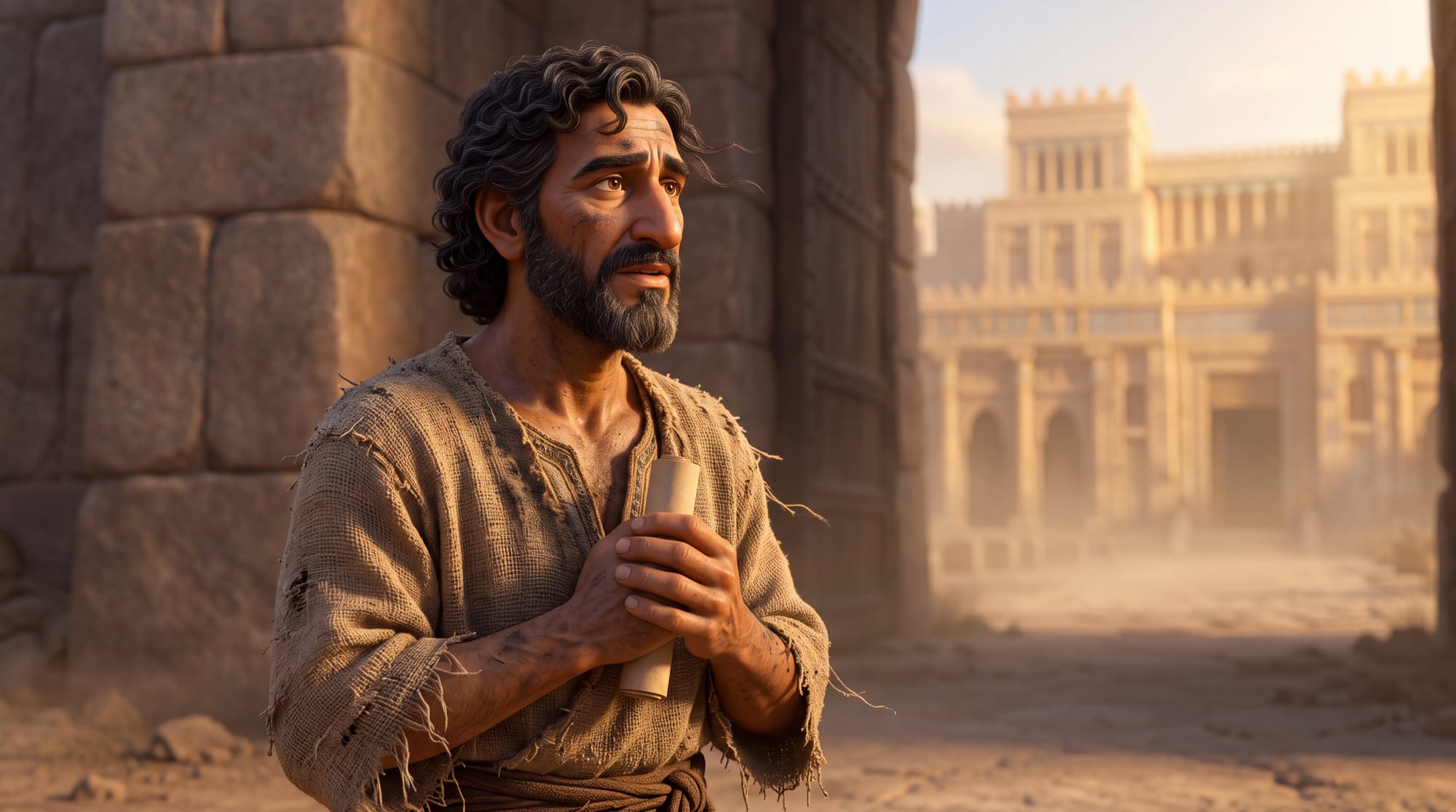
When the decree reaches Mordecai, he tears his clothes, puts on sackcloth and ashes, and goes out into the city crying loudly and bitterly (Esther 4:1). Throughout the empire, wherever the king's command arrives, the Jewish people are in mourning — fasting, weeping, wailing (Esther 4:3). This is not a quiet, private grief. This is a people in full, public, desperate dependence on God.
Esther hears about Mordecai's state and sends him clothes. He sends them back. She sends a servant to find out what's happening. He sends back a copy of the decree — and a message that cuts right to the heart of the story: "Think not with thyself that thou shalt escape in the king's house, more than all the Jews. For if thou altogether holdest thy peace at this time, then shall there enlargement and deliverance arise to the Jews from another place; but thou and thy father's house shall be destroyed: and who knoweth whether thou art come to the kingdom for such a time as this?" (Esther 4:13–14).
That's one of the most quietly powerful lines in all of scripture. Mordecai isn't flattering her. He's being honest: help will come from somewhere, with or without you. But you are here. You have access. And this moment will not wait.
Esther's response is to call a fast. Three days, no food, no water — her, her maidens, and all the Jews in Shushan (Esther 4:16). This isn't a diet. This is a covenant people saying collectively: we have nothing to offer except our dependence on God. Isaiah 58 describes the fast the Lord chooses as one that "loose[s] the bands of wickedness" and lets the oppressed go free (Isaiah 58:6). That's exactly what Esther's fast is reaching for.
The Book of Mormon is full of this same pattern. Alma and the sons of Mosiah fasted and prayed before their missions (Alma 17:3). The people of Ammon fasted and prayed in their most desperate moments. Fasting isn't a religious formality — it's the physical act of saying, "I know I can't do this alone."
For your family: The next fast Sunday, consider giving your kids a specific thing to bring to the Lord. Not just "fast for the sick" in the abstract — but something real, something they're actually worried about. That's what Esther did. And it changed everything.
Here's the detail that makes Esther's courage concrete: approaching the king unsummoned was a capital offense. Didn't matter who you were. Didn't matter that you were the queen. If you walked into the inner court without being called, you could be executed on the spot — unless the king extended his golden scepter. That was the only out (Esther 4:11).
Esther hadn't been called to the king in thirty days (Esther 4:11). Thirty days. She had no idea if she was in favor or out of it. She had no guarantee the scepter would come out. She had no backup plan.
She went anyway.
"So Esther drew near, and touched the top of the scepter" (Esther 5:2). The king extends it. She's safe. And then — and this is the part that shows you how composed she is under pressure — she doesn't immediately blurt out the whole crisis. She invites the king and Haman to a banquet. Then another banquet. She's building the moment carefully, reading the room, waiting for exactly the right time to speak (Esther 5:4–8).
Meanwhile, Haman is riding high — until he passes Mordecai at the gate, who still won't bow. Haman goes home, gathers his friends and his wife, brags about his wealth and his promotion and his dinner invitation from the queen — and then says he can't enjoy any of it as long as Mordecai is sitting there (Esther 5:11–13). His wife suggests building a gallows fifty cubits high — about seventy-five feet — and hanging Mordecai on it before the banquet. Haman loves this idea (Esther 5:14).
That same night, the king can't sleep. He asks for the royal chronicles to be read to him — and the reader lands on the entry about Mordecai uncovering the assassination plot (Esther 6:1–2). The king asks what honor was given to Mordecai for this. The answer: nothing. Haman arrives at the palace early to ask about the gallows, and the king asks him, "What shall be done unto the man whom the king delighteth to honour?" Haman, assuming the king means him, describes an elaborate public honor — give the guy royal clothes, a royal horse, and a royal crown and have a prince parade him through the city. Then the king effectively says, "Great idea, go and do everything you just said for Mordecai the Jew (Esther 6:6–11).
The reversal is almost comic. Almost. Because the stakes are still life and death for an entire people.
This is the kind of story that makes you believe in a God who is paying attention to the details — even the king's insomnia. D&C 84:88 promises that the Lord will be on our right hand and on our left, and His Spirit will be in our hearts. Esther walked into that throne room banking on exactly that promise.
The Gallows Haman Built
Esther 7:1-10; Joshua 1:9
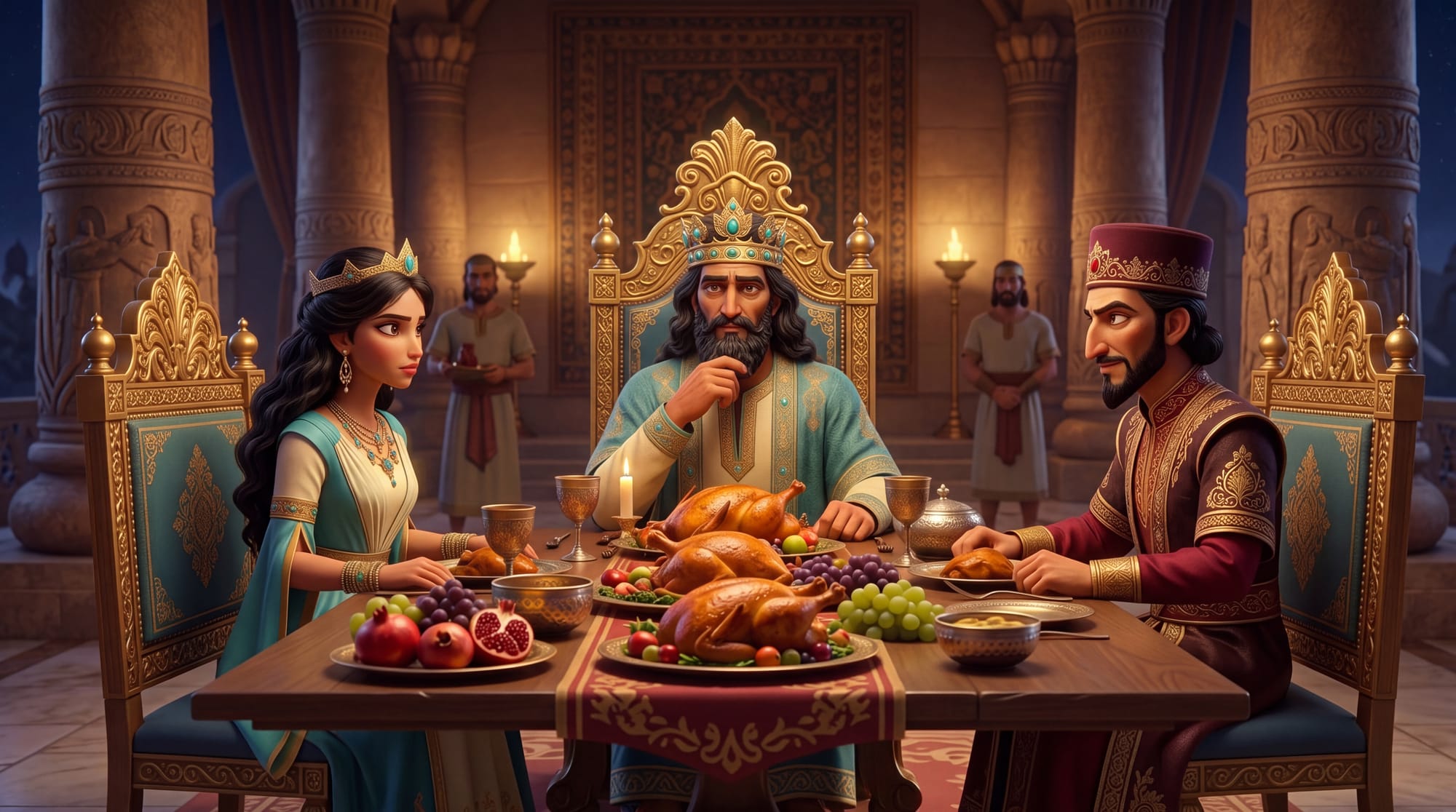
At the second banquet, the king asks Esther again: what is your petition? Whatever it is, up to half the kingdom, it's yours (Esther 7:2). And this time, Esther speaks.
"If I have found favour in thy sight, O king, and if it please the king, let my life be given me at my petition, and my people at my request: For we are sold, I and my people, to be destroyed, to be slain, and to perish" (Esther 7:3–4).
The king is stunned. Who would dare do this? Esther points across the table: "The adversary and enemy is this wicked Haman" (Esther 7:6).
Haman is terrified. The king storms out into the garden. Haman throws himself on Esther's couch to beg for his life — and the king walks back in and sees it, and interprets it as an assault on the queen. A servant immediately points out the seventy-five-foot gallows Haman had built for Mordecai. The king's response is immediate: "Hang him thereon" (Esther 7:9).
Haman dies on the gallows he built for someone else. It's one of the most complete reversals in all of scripture.
For your family: Courage isn't the absence of fear. Esther was afraid. She fasted for three days before she walked through that door. Courage is deciding that what God is asking of you matters more than what you're afraid of.
Haman is dead. Problem solved — except it isn't. Here's the detail that trips up almost everyone reading this story for the first time: in Persia, once the king sealed a law with his signet ring, it could not be revoked. Not by anyone. Not even by the king himself (Esther 1:19). It's the same rule that trapped Daniel's enemies decades earlier, when they manipulated King Darius into signing a law he couldn't undo even though he wanted to save Daniel from the lions (Daniel 6:8-15). Ahasuerus didn't even need convincing to sign it the first time — when Haman offered ten thousand talents of silver to fund the destruction of the Jews, the king waved off the payment and just handed over the ring (Esther 3:9-11). That's how little thought went into a decision that couldn't be reversed.
So on the day Haman hangs, the original decree is still legally standing. Every province in the empire still has a signed, sealed order to destroy the Jewish people on the thirteenth of Adar. Killing Haman ended the threat behind the law. It did nothing to the law itself.
Esther falls at the king's feet again, weeping, begging him to reverse Haman's plot (Esther 8:3). And the king's answer is honest about the limits of even his own power: he can't undo what's been sealed. But he can seal something new. So he gives Mordecai the ring and tells him to write whatever he wants "in the king's name" (Esther 8:8). Two irrevocable laws, both fully in force, both carrying the king's authority — one still technically calling for the Jews' destruction, the other about to give them the right to fight back. God didn't erase the danger. He opened a legal door nobody had used yet.
Haman's Timeline: A Sense of Urgency Here's a detail easy to miss: Haman cast lots to determine when the Jews would die. In the first month of the king's twelfth year, Haman cast the "pur" — the lot — to choose a date for destroying the Jews. It landed on the thirteenth day of the twelfth month, nearly a full year out (Esther 3:7). That same day, the decree was written and sealed with the king's ring and sent racing out to all 127 provinces (Esther 3:12-13).
This means Haman built in an eleven-month runway without meaning to. And here's the part worth slowing down on: Esther and Mordecai didn't sit on that time. Mordecai's counter-decree is dated to the twenty-third day of the third month (Esther 8:9) — which means the mourning, the fast, the walk into the throne room, both banquets, the king's sleepless night, Haman's fall, and the drafting of an entirely new empire-wide law all happened inside of about eight weeks. Esther even tells us she hadn't been called to the king in thirty days (Esther 4:11), so a good chunk of that window was spent in real uncertainty, not comfortable planning.
They didn't wait for the deadline to feel urgent before they moved. They went right to work the moment they understood what was at stake — and that left nine full months of runway for the Jewish people to prepare, arm themselves, and be ready when the thirteenth of Adar finally came. The salvation of an entire people didn't hinge only on the scepter going up. It hinged on two people who refused to procrastinate once they knew what they'd been placed there to do.
D&C 82:10 says the Lord is bound when we do what He says — but notice here it isn't a miracle that saves the day. It's a king willing to let Esther and Mordecai write a second truth into existence right alongside the first one.
For your family: Sometimes the hard thing in your life doesn't just disappear once the danger feels like it's passed. What did God ask Esther and Mordecai to do even after Haman was gone? What's your family's version of writing a second law instead of waiting for the first one to vanish?
Mordecai's counter-decree goes out with the same urgency Haman's did — copied in every language, sent by fast riders on horses bred for the king's own service, reaching all 127 provinces (Esther 8:9-10). Mordecai had this counter-decree written and sealed within about two months of the original — Esther and Mordecai moved fast, and that urgency is exactly what gave the Jewish people the nine months of runway they needed to prepare. But it doesn't cancel anything. It can't. Instead it gives the Jewish people something they didn't have before: the legal right to gather, to defend themselves, and to destroy, kill, and annihilate any armed force that comes against them, women and children included, and to take the plunder if they want it (Esther 8:11).
Read that again. Both decrees are now legally active on the exact same day, the thirteenth of Adar. One says the Jews are marked for slaughter. The other says they're authorized to fight back with the full force of the king behind them. It's not a rescue that erases the threat — it's a fair fight that didn't exist before.
And when the day comes, Esther 9:1 says something almost startling: "the Jews had rule over them that hated them." The tables didn't just turn — the legal ground itself had shifted underneath everyone, because a second truth had been written into the same reality as the first.
Once again, three separate times, the text stops to tell us the Jews did not touch the plunder they were legally entitled to take (Esther 9:10, 15-16) — completing, once and for all, what Saul left undone with Agag five hundred years earlier.
Out of that deliverance comes the Feast of Purim — named, almost defiantly, after the very "pur," the lot Haman cast to choose a day of destruction. The Jewish people took the word for their annihilation and turned it into the name of their celebration (Esther 9:26-28), and it's still kept by Jewish families every year. The Book of Mormon's Moroni says God "worketh not in darkness" (Ether 4:12). Haman's plan was built in secret, in silver, in wounded pride. Esther and Mordecai's was built in fasting, in community, in covenant — and it's the one still being celebrated thousands of years later.
For your family: Mordecai didn't erase Haman's law — he added a truer, stronger word next to it. Is there a hard "law" in your life right now — a fear, a habit, a hard circumstance — that might not disappear, but that God wants to answer with something new standing right beside it?
Watch where the signet ring ends up. The same ring Ahasuerus used to seal Haman's death decree — the ring that nearly destroyed an entire people — gets pulled off, handed to Mordecai, and used to seal deliverance instead (Esther 8:2). The instrument didn't change. The hand holding it did.
Everything Haman had is given to Esther, and Esther puts Mordecai in charge of it (Esther 8:1-2). Mordecai walks out of the palace in royal blue and white, a great crown of gold, robes of fine linen and purple — and the city of Shushan, which had been "perplexed" when the first decree went out (Esther 3:15), now shouts for joy (Esther 8:15). By the end of the book, Mordecai is second only to the king himself, "great among the Jews, and accepted of the multitude of his brethren" — not because he schemed for the position, but because he wouldn't bow when it cost him everything (Esther 10:2-3).
The man who sat at the gate in sackcloth is now sitting nearly on the throne. The ring that sealed a death warrant now seals a nation's survival. Proverbs 22:4 ties humility and the fear of the Lord to riches, honor, and life — and Mordecai is the walking proof of it. D&C 121:41-42 describes the kind of influence that only comes "without hypocrisy, and without guile" — exactly the opposite of how Haman climbed.
For your family: Haman chased honor and built his own gallows. Mordecai just kept showing up faithfully at the gate, and honor came looking for him. Where in your life are you tempted to chase a "bow," and where might faithfulness — even quiet, unnoticed faithfulness — be the better long game?


 Bob LeBaron



 Bob LeBaron