November 2–8: "A New Spirit Will I Put Within You" (Ezekiel 1–3; 33–34; 36–37; 47)
Ezekiel was a priest in exile with no temple, no homeland, and no obvious reason for hope — and God showed up with a promise to replace stony hearts, raise dry bones, and send a river that heals everything it touches.
Your Game Plan for This Week
Here's the thread running through every chapter of Ezekiel this week: God is not done with people who look done. Stony hearts. Dry bones. A sea so salty nothing can live in it. These aren't metaphors for mild spiritual fatigue — they're images of total, bottom-of-the-barrel deadness. And God looks at every single one and says, 'I can work with that.'
'Heart of Flesh' puts that promise to music in a way your family can feel in their chest. The lyric 'Take away the stony heart, give me one of flesh' isn't just a catchy hook — it's Ezekiel 36:26 word for word, set to a beat. And the river imagery in the chorus? That's Ezekiel 47, where a trickle from the temple door grows until it's healing the Dead Sea itself. The song is asking your kids to imagine what it feels like when God replaces the hard, heavy thing inside you with something soft and alive.
For families, that's a conversation worth having at the dinner table. Where do we go stony? Where do we need the river? The answer Ezekiel gives — and that 'Let the Dry Bones Live' echoes — is that the gathering of Israel isn't just a geopolitical event. It's personal. It happens one heart at a time, starting with yours.
15-Minute Family Home Evening
Monday night — your launch for the week.
-
Ask this to open. Take 2–3 responses, then move on.2 minOpening QuestionHas anyone ever been asked to do something that seemed completely impossible — like, so impossible it almost felt like a joke — and you had to decide whether to try anyway or just walk away?
-
Read this together:2 minSet the StageEzekiel was a priest — trained for the temple, shaped by its rituals, built for Jerusalem. Then Babylon happened. Conquest. Exile. And suddenly the man meant to serve at the altar of God was sitting in the dust of a foreign land, surrounded by people who had stopped believing God remembered their names. Then the hand of the Lord came upon him and set him down in a valley. Not a valley of rivers or vineyards — a valley of bones. Dry ones. Scattered ones. Bleached by the sun so long they had forgotten they were ever alive. And God asked him a question that must have felt almost cruel in its directness: 'Can these bones live?'Ezekiel 37:3-4And he said unto me, Son of man, can these bones live? And I answered, O Lord God, thou knowest. Again he said unto me, Prophesy upon these bones, and say unto them, O ye dry bones, hear the word of the Lord.
-
Press play — watch together:3 min

🎵 Breathe on the valley, let the dry bones live! / Stand on your feet like an army in the light, / Breaking through the shadows of the Babylon night! / Out of your graves, He is opening the door!
Dive Deeper: Let the Dry Bones Live -
Read the Big Idea together:2 minBig Idea God Specializes in Dead Things Coming Back
Ezekiel's valley of dry bones is not just an ancient vision about Israel in exile — it is a picture of every person who has ever felt too far gone, too scattered, too hollow for God to reach. The miracle is not that the bones were impressive or ready; the miracle is that God breathed on them anyway, and they stood up as an army. That same breath — the Spirit of the Lord — is available to you and your family right now, not someday when things are better, but today, in whatever valley you are standing in. -
Ask your family:3 minReflect TogetherIs there something in your life right now — a friendship, a habit, a part of how you feel about church or about yourself — that feels a little dry or scattered? What would it look like to let God breathe on that this week?
-
Do this activity together:5 min
Dry Bones Freeze Dance
Try This: Clear some floor space and play a round of Dry Bones Freeze Dance. When the music plays, everyone dances around like scattered, rattling bones — loose, floppy, a little silly. When the music stops, everyone freezes like a statue. But here's the twist: the person who called the freeze shouts a body part ('knee bone!' or 'backbone!'), and everyone has to snap that part of their body into a stiff, connected pose before the music starts again. Keep going until everyone is laughing too hard to stand. Then gather together and ask: in Ezekiel 37, what was the ONE thing that turned a pile of bones into a living army? (The breath of God — His Spirit.) What does that tell us about where real life comes from?
Reflect: What's one area of your life — a habit, a relationship, a testimony — that feels a little 'dry' right now? What would it look like to let the Lord breathe new life into it?
-
Close together: Say a family prayer. Then enjoy a special treat as a family.2 min
20-Minute Primary / Sunday School
Lead with Heart of Flesh.
-
Ask this to open. Take 2–3 responses, then move on.3 minOpening QuestionHas anyone ever felt like their heart had kind of gone cold — like you used to care about something a lot, and then one day you realized the warmth was just... gone?
-
Read this together:2 minSet the StageEzekiel was a priest — trained from boyhood to serve in the Jerusalem temple, to stand in the holiest place on earth. Then the Babylonian army came and hauled him six hundred miles east into exile. No temple. No altar. No home. Just flat, foreign plains, surrounded by people who had stopped believing God still knew their names. He sat where the broken people sat. And that is exactly where the heavens opened. God showed up — not in Jerusalem, not in the sacred space Ezekiel had trained his whole life to serve in, but right there in the middle of the loss. And what He said next would become one of the most stunning promises in all of scripture.Ezekiel 36:26A new heart also will I give you, and a new spirit will I put within you: and I will take away the stony heart out of your flesh, and I will give you an heart of flesh.
-
Press play — watch together:3 min
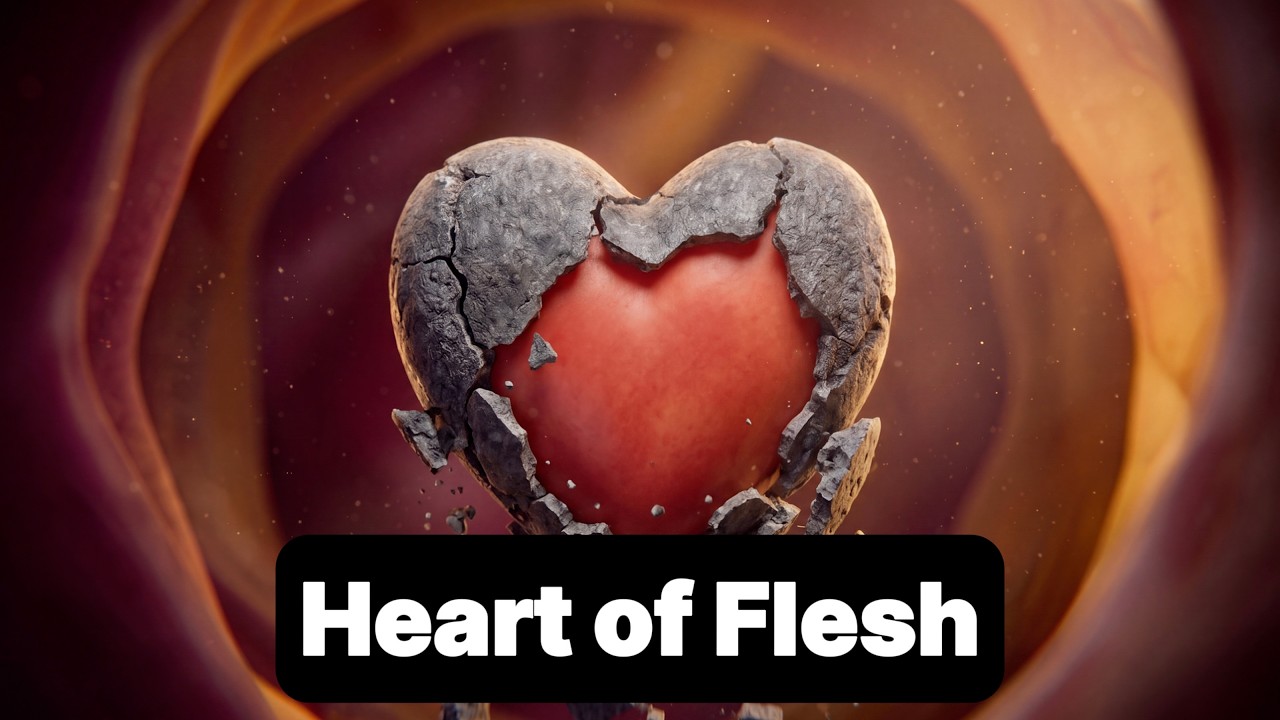
🎵 Take away the stony heart, give me one of flesh! / Pouring out a spirit that is living and fresh! / Flowing like a river running down to the sea, / Bringing every salty desert water back to free!
Dive Deeper: Heart of Flesh -
Ask this. Give the class a moment to think before taking responses.3 minPivot QuestionWhy do you think God chose to show Ezekiel this vision of a new heart and a valley of dry bones while Ezekiel was in exile, at his lowest point, rather than when things were going well?
-
Keep going:4 minFollow-UpIf God came to you right now and said He wanted to remove the stony, self-protective part of your heart and replace it with something warm and alive, what do you think you would have to be willing to let go of — and does that feel scary or hopeful, or both?
-
Liken it unto yourself. Hand each student a slip of paper. Give 2 minutes to write, then 2–3 share with the class.5 minLiken Unto YourselfWhen has your heart felt more like stone than flesh — and what did it take for you to let the Lord start chiseling?
-
2 minClose With ThisGod does not wait for us to get our hearts right before He shows up — He shows up in the exile, in the cold, in the valley of dry bones, and He does the work Himself. The promise of a heart of flesh is not a reward for the already-warm; it is a gift offered to the stone.
-
Optional Activity — use if you have extra time or a younger class:5 min
Stony Heart Freeze Tag
Try This: Play a quick round of freeze tag with a twist. When someone is tagged, they freeze in place and put both hands over their heart — that's their 'stony heart' moment. To unfreeze them, another player has to run over, tap their chest, and shout 'Heart of flesh!' Then both players do five jumping jacks together before rejoining the game. Keep going for a few rounds, then gather everyone and talk about how it felt to be frozen versus set free.
Reflect: Ezekiel 36:26 says the Lord will take away our stony heart and give us a heart of flesh. What does a 'stony heart' actually feel like in real life — stubborn, cold, shut down? What does it feel like when someone helps soften it?
Week Schedule
You don't have to do all seven — pick what fits. Monday launches, Sunday caps. Tap any day to expand or collapse.
This Week's Fireside Moment
The full story behind the songs — in one sitting.
Watch & Listen
Heart of Flesh
Ezekiel was trained to serve in Jerusalem's temple. Then Babylon happened, and he found himself hundreds of miles from home, sitting in the dust with other exiles who had lost everything. But God didn't stay behind in the building. He appeared to Ezekiel right there in captivity — and the message He brought was one of the most personal promises in all of scripture: 'I will take away the stony heart out of your flesh, and I will give you an heart of flesh' (Ezekiel 36:26). Not a lecture. Not a list of rules. A transplant offer. Then, in Ezekiel 47, the vision expanded — a river flowing from the temple threshold, getting deeper with every step, turning the Dead Sea fresh, lining its banks with fruit trees whose leaves carried healing. Life, flowing outward from the source.
Heart of Flesh grabs both of those visions and runs with them. The song opens with a narrator who knows exactly what a stony heart feels like — heavy, cold, stubborn — and then traces the moment the Lord shows up with a chisel and a spark. The chorus erupts into the river imagery: living water, salty deserts turning fresh, fruit on the branches, healing in the leaf. It's Ezekiel 36 and 47 set to a beat, and it moves.
For your family this week, this song is a conversation starter about what it actually feels like to let God change you from the inside — and why that's something only He can do.
Want the full story? Read the complete Fireside Moment or explore the Lyric-Scripture Blueprint in our Joy Tier Deep Dive.
Lyric–Scripture Blueprint (Preview)
Did you know these lyrics come straight from the scriptures?
Explore the full Lyric–Scripture Blueprints and deeper activities in the Joy Tier.

Let the Dry Bones Live
The Lord asks Ezekiel a question that cuts right to the heart of faith: 'Son of man, can these bones live?' Ezekiel's answer is perfect in its humility — 'O Lord God, thou knowest.' He doesn't pretend to have the answer. He just trusts that God does. And then he's told to do something that sounds absurd: preach to the bones. Prophesy to a congregation that cannot hear. Speak life into what is obviously, completely dead. He obeys — and the ground starts to shake. Bone finds bone. Sinew knits. Breath enters. An army rises.
Let the Dry Bones Live puts you inside that moment. The song opens in the dust and the rust, earns every note of its chorus by sitting in the valley first, and then — when the breath of heaven finally comes — it feels like the most natural and the most miraculous thing in the world at the same time. Verse 2 takes it further, weaving in Ezekiel's second vision: the stick of Judah and the stick of Joseph becoming one — a Latter-day Saint family's cue to talk about why the Book of Mormon exists and what the gathering of Israel actually means for their lives right now.
This song is a reminder that God specializes in valleys, and that the bones He's breathing on today might be closer to home than Babylon ever was.
Want the full story? Read the complete Fireside Moment or explore the Lyric-Scripture Blueprint in our Joy Tier Deep Dive.

Listen Everywhere


Miss last week?
Every lesson stands on its own — but together, they tell one continuous story.
 Bob LeBaron
Don’t Stop the Music
The Joy Tier starts right here. Go deeper into this week’s scripture story and explore the meaning behind the songs.
Inside Joy you’ll find:
- A weekly Fireside Moment overview of the Come, Follow Me lesson
- Expanded Set the Stage teaching guides for every song
- Choose Your Adventure family activities and simple weekly habits
- Lyric–Scripture Blueprints, printable coloring pages, and lyric sheets
- Cinematic reflection videos designed for quiet viewing and discussion
Access Joy below to turn this week’s song into a weeklong experience of scripture, music, and family conversation.